Air Pollution
Country gets
tough over smog
By ZHENG JINRAN (China
Daily)Updated:
2014-12-23 08:07
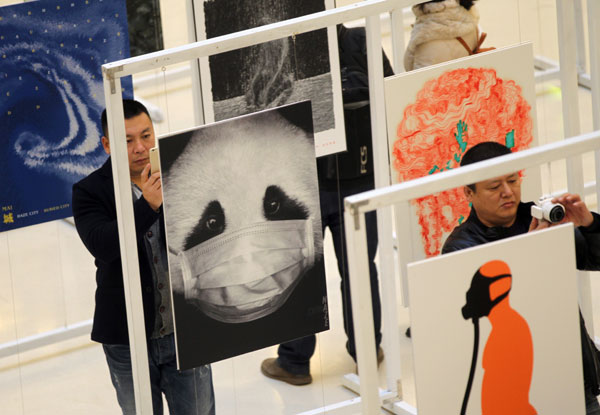
Posters illustrating China's dense and long-lasting smog in recent years are exhibited at Galaxy SOHO in Beijing on Dec 15. Three hundred posters depicting bad air were displayed to the public during the exhibition. ZOU HONG/CHINA DAILY
National People's
Congress mulls amendment that cracks down on worst violators
China's top
legislature will review the first amendment to the Law on Air Pollution
Prevention and Control since 2000.
The amendment is a
necessary move to improve the national campaign to control air pollution, which
has more sources today, the environmental protection minister said on Monday.
"The previous
amendment is not effective in controlling current multiple pollution sources,
and isn't working in ongoing efforts," Zhou Shengxian said on Monday while
handing in the new draft to the National People's Congress Standing Committee.
The new draft was
finished amid growing calls throughout the country for controls on air
pollution, he said.
Based on the
ministry's annual report on air quality, only three of China's major 74 cities
in 2013 had air pollution within acceptable national standards. The average
number of days with smog in the country in 2013 was 35.9, the most since 1961.
Coal-consumption
sources contribute more to air pollution than they did 14 years ago, with such
sources now including industrial production, Zhou said.
The new draft of the
Law on Air Pollution Prevention and Control has separate chapters for each
source.
The chapters include
more details on dealing with various pollution sources, including the required
use of advanced equipment and technology in production, instructions on how to
monitor vehicle exhaust, and bans on importing coal that emits an unacceptable
level of pollution.
The draft also will
impose emission caps on the whole country. The current antipollution law has
caps in only 11.4 percent of the nation.
The minister also said
polluters currently are paying too low a price for violations, a big
disincentive to controlling their behavior. The law needs more teeth to be
effective, he said.
The new draft lists
the detailed financial punishments, saying those responsible for air pollution
will face larger fines, at most five times the direct economic loss in each
case.
In addition, the
amendment also has other stipulations on fines for different violations
involving pollution, information disclosure or other aspects. For example, an
automobile company, either domestic or foreign, that fails to release exhaust
information on its vehicles will get a fine of 500,000 yuan ($80,400) at most.
Chang Jiwen, deputy
director of the Research Institute of Resources and Environment Policies,
Development Research Center of the State Council, said, "The new draft
highlights the major role of companies in the air pollution control
efforts."
Moreover, the draft
stipulates joint control of air pollutants and greenhouse gases, a move to lay
the foundation for a future draft on greenhouse gas control, said Chang, who
has participated in the writing of the draft since 2006.
After the revised
Environmental Protection Law passed in April, several other laws, including
pollution prevention in the air, water and soil, are on the working agenda of
the National People's Congress, of which the air pollution prevention draft
will be taken up first.

No comments:
Post a Comment