Information wars
BBC
World Service fears losing information war as Russia Today ramps up pressure
Former director calls for more cash to fight
propaganda saying BBC is being outgunned by Kremlin-backed news channel
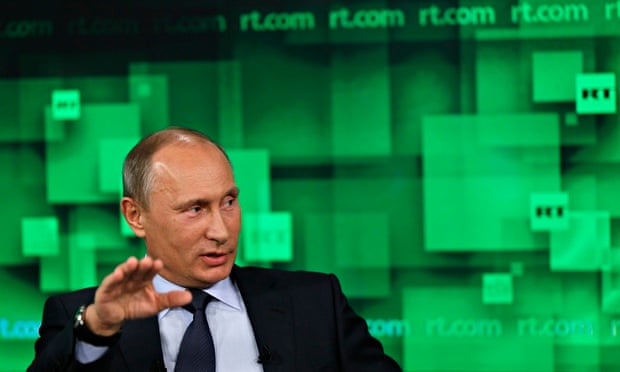
President Vladimir
Putin speaks during a visit to the studio of Russia Today in Moscow. Photograph: Pool/Reuters
Sunday
21 December 2014 17.04 GMT
The BBC World Service is being
financially outgunned by Russian and Chinese state-owned news channels, its
former director Peter Horrocks has warned, amid high-level concerns that
Britain and the US are losing a global “information war” with the Kremlin.
Horrocks
said ministers should review Britain’s spending overseas and consider freeing
up extra World Service funding to combat the wave of Moscow-backed propaganda
sweeping Europe.
“Medium
to long term there has to be an anxiety about the spending of others compared
to what the BBC are putting into
it,” Horrocks said. “You can take a view of the overall national interest and
things we spend on international influence, like military spending. When you
look at that it would take it in a certain direction.”
International
alarm over the rise of Kremlin-funded news, led by 24-hour news channel Russia Today, has intensified
following Vladimir Putin’s military intervention in Ukraine and his feud with
the west.
David
Cameron told MPs he had raised with President Obama his concern about Russian
news channels “pumping out a distorted picture” of events in Ukraine after the
issue was raised by leaders in the Baltic states at the G20 summit in
Australia.
Horrocks,
who stepped down earlier this month as the executive in charge of the BBC’s
global news operations, said the corporation had asked the Foreign Office (FCO)
“whether there’s anything they want to do with development funding for extra
programming for Ukraine” but he had not yet had a reply.
FCO
funding for the World Service stopped in April, with the £245m annual budget
now coming out of the licence fee. Despite this shift, Horrocks said
“considering supplementary funding [from the FCO] is something that could be on
the policy agenda and could be part of the discussion about the BBC’s future”.
He
added: “We are being financially outgunned by Russia and the Chinese
but there’s no way we’re being outgunned on the results [global audience]. The
role we need to play is an even handed one. We shouldn’t be pro-one side or the
other, we need to provide something people can trust.”
Demand
for BBC World Service output has soared since the Ukraine-Russia crisis began.
The corporation’s Russian-language service has more than doubled to 6.9 million
listeners, while in Ukraine its audience has trebled to more than 600,000 since
last year.
Globally
the BBC’s news operation appears to be healthy – reaching a record 265 million
people a week, including the World Service’s 191.4 million audience – in spite
of a raft of service closures and cuts since 2010…
Read
more at: http://www.theguardian.com/media/2014/dec/21/bbc-world-service-information-war-russia-today

No comments:
Post a Comment