Drones
Drone shot down in Beijing suburb, operators charged
(Chinadaily.com.cn)Updated: 2014-12-16 16:32
 |
|
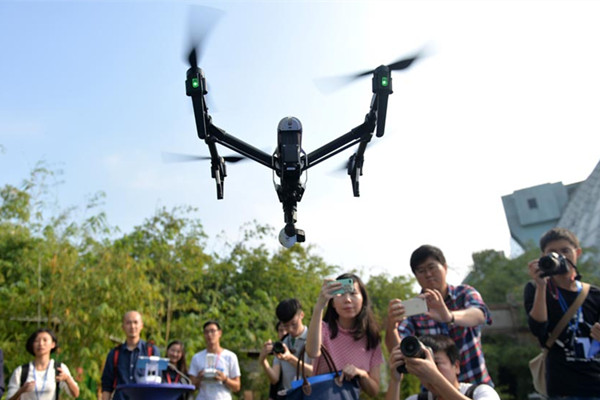
A camera drone is tested outdoors on Nov 26, 2014 in Shenzhen,
Guangdong province of China. [Photo/cfp]
|
Three people have been
charged with involuntarily endangering public security by flying drones for
surveying and mapping, according to a recent report in People's Liberation Army
Daily.
The drone forced
several commercial airliners to alter their paths or delay their flights before
it was shot down by air force, the report said.
The incident happened
on Dec 29, 2013, when the military radar detected an air emergency near an
airport in Beijing suburb. Air force commander immediately ordered several
regiments of an air division and ground-to-air missiles to be combat ready. Six
teams were dispatched to the target area.
Six minutes later, the
object was identified as a small aircraft. The information was submitted to air
force command and public security departments in Beijing and neighboring Hebei
province.
An attack helicopter
was sent to investigate the situation. Minutes later, the target was identified
as a white drone.
The drone posed a
threat to the security of the capital city after repeatedly ignoring the
warning and flying in the direction of Beijing, the report said. The air
command then decided to avoid densely populated area and attack the drone with
shotgun.
After being shot, the
drone fell in Beijing's northeastern Pinggu district, where the investigators
found three operators and a vehicle.
The aircraft turned
out to belong to a Beijing-based technology company, which didn't submit a
request to aviation and air force authorities beforehand, the report said.
Such incidents are not
uncommon. As authorities' attempt to reform low-altitude airspace management
continues, aircraft for general aviation, including small airplanes and hot-air
balloons, are growing at a rate of 15 percent annually.
When emergency occurs,
the air force in Beijing will have to alert at least 10 regiments and missiles
in several locations, as well as fighters. The operation will force several
commercial airliners to alter their paths or delay their flights, a huge loss
of resources, the report said.
In China, airspace
below 1,000 meters is controlled by the military. Therefore, the low-altitude
airspace reform only facilitates the flights with certain qualifications. And
all the low-altitude aviation activities must be permitted by aviation
regulation authorities before being carried out.
But flying without
approval is common among owners of small general aviation aircraft because they
want to avoid the complicated application procedures and long waiting times for
approval, said Wu Peixin, an aviation observer in Beijing.

No comments:
Post a Comment