Epidemic security
CBS NEWSDecember 19, 2014,
6:03 PM
Flu outbreak
spreading rapidly in U.S.
Last Updated Dec 19,
2014 7:17 PM EST
Flu season is picking
up steam just in time to ruin a lot of people's holidays. The U.S. Centers for
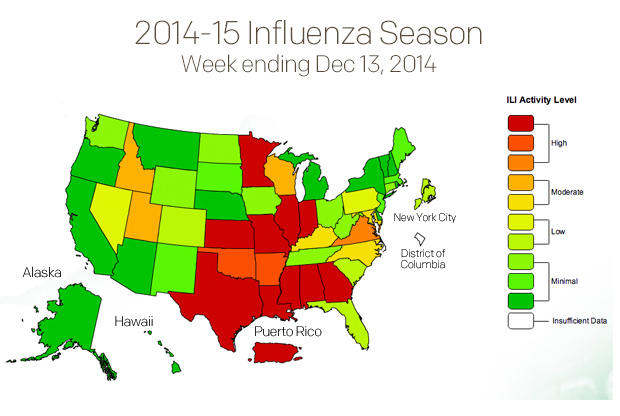
Disease Control and Prevention reports widespread flu activity in 29
states, primarily in the South and Midwest. That's twice as
many states as the previous week.
Most of the patients
who have been hospitalized with severe cases of the flu are either very
young or the very old. In recent days flu outbreaks have forced schools in
Ohio, Tennessee, Georgia and North Carolina to close.
So far this season,
the virus has killed 11 children.
Describing the pattern
of this year's outbreak, Dr. Anne Schuchat, director of the CDC's National
Center for Immunization and Respiratory Diseases, told CBS News, "There's
almost like a Christmas tree right in the middle of the country of the hot spots
for disease."
Thirteen states
reported high levels of influenza-like illnesses, while another six states saw
moderate activity.
CDC
Health experts say
part of the problem is that this year's vaccine doesn't provide
protection for H3N2, the strain of the
influenza that's currently making the rounds. This year's vaccine does help
protect against H1N1 and one or two strains of influenza B.
Earlier this month the
CDC issued a health advisory stating that only 48 percent of flu virus samples
taken through last month were closely related to this year's vaccine.
"Because the H3N2
is dominating, we probably will see more disease," said Schuchat.
"There might be reduced protection as opposed to zero protection,"
she said.
However, the CDC and
other health experts still recommend people go for the vaccine. At a minimum,
the vaccine may prevent a more severe case of the flu if you have happen to be
one of the unlucky ones this season. The shot will also protect against other
strains of the flu that are still floating around.
"The stuff that's
circulating out there is different than what they made the vaccine
against," said CBS News chief medical correspondent Dr. Jon LaPook. "Though
unfortunately, as of today, it's only about 30 percent well-matched."
LaPook added this news
shouldn't discourage people from getting a flu shot. Even if the vaccine is
less effective than usual, it will still be better than no protection at all.
"It's never too late until flu season is over. Flu season sometimes can go
into May," he said.
The CDC says anyone
who develops symptoms of the flu should contact their doctor immediately.
Tamiflu (oseltamivir) and Relenza (zanamivir), two prescription antiviral drugs
currently on the market, can actually lessen the time of acute illness by two
days if taken early on.

No comments:
Post a Comment