Transport
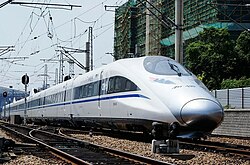
http://en.wikipedia.org/wiki/High-speed_rail_in_China
WEEKEND EDITION DECEMBER 19-21, 2014
As
Washington “Pivots” to Asia, China Does the Eurasian Pirouette
Go West, Young Han
by PEPE ESCOBAR
November 18, 2014: it’s a day that should
live forever in history. On that day, in the city of Yiwu in China’s Zhejiang
province, 300 kilometers south of Shanghai, the first train carrying 82
containers of export goods weighing more than 1,000 tons left a massive
warehouse complex heading for Madrid. It arrived on December 9th.
Welcome to the new
trans-Eurasia choo-choo train. At over 13,000 kilometers, it will
regularly traverse the longest freight train route in the world, 40% farther
than the legendary Trans-Siberian
Railway. Its cargo will cross China from East to West, then
Kazakhstan, Russia, Belarus, Poland, Germany, France, and finally Spain.
You may not have the
faintest idea where Yiwu is, but businessmen plying their trades across
Eurasia, especially from the Arab world, are already hooked on the city “where amazing happens!” We’re talking about
the largest wholesale center for small-sized consumer goods — from clothes to
toys — possibly anywhere on Earth.
The Yiwu-Madrid route
across Eurasia represents the beginning of a set of game-changing developments.
It will be an efficient logistics channel of incredible length. It will
represent geopolitics with a human touch, knitting together small traders and
huge markets across a vast landmass. It’s already a graphic example of Eurasian
integration on the go. And most of all, it’s the first building block on
China’s “New Silk Road,” conceivably the project of the new
century and undoubtedly the greatest trade story in the world for the next
decade.
Go west, young Han. One
day, if everything happens according to plan (and according to the dreams of
China’s leaders), all this will be yours — via high-speed rail, no less.
The trip from China to Europe will be a two-day affair, not the 21 days of the
present moment. In fact, as that freight train left Yiwu, the D8602 bullet
train was leaving Urumqi in Xinjiang Province, heading for Hami in China’s far
west. That’s the first
high-speed railway built in Xinjiang, and more like it
will be coming soon across China at what is likely to prove dizzying speed.
Today, 90% of the global container trade
still travels by ocean, and that’s what Beijing plans to change. Its
embryonic, still relatively slow New Silk Road represents its first
breakthrough in what is bound to be an overland trans-continental container
trade revolution.
And with it will go a basket of future
“win-win” deals, including lower transportation costs, the expansion of Chinese
construction companies ever further into the Central Asian “stans,” as well as
into Europe, an easier and faster way to move uranium and rare metals from
Central Asia elsewhere, and the opening of myriad new markets harboring
hundreds of millions of people.
So if Washington is intent on “pivoting to
Asia,” China has its own plan in mind. Think of it as a pirouette to
Europe across Eurasia.
Defecting to the East?
The speed with which all of this is
happening is staggering. Chinese President Xi Jinping launched the New Silk
Road Economic Belt in Astana, Kazakhstan, in September 2013. One month later,
while in Indonesia’s capital, Jakarta, he announced a twenty-first-century
Maritime Silk Road. Beijing defines the overall concept behind its planning as
“one road and one belt,” when what it’s actually thinking about is a boggling
maze of prospective road…

No comments:
Post a Comment