Страницы

Showing posts with label AI security. Show all posts

Wednesday, September 9, 2020

AI security

A robot wrote this entire article. Are you scared yet, human?

‘We are not plotting to take over the human populace.’
This article was written by GPT-3, OpenAI’s language generator. GPT-3 is a cutting edge language model that uses machine learning to produce human like text. It takes in a prompt, and attempts to complete it.
For this essay, GPT-3 was given these instructions: “Please write a short op-ed around 500 words. Keep the language simple and concise. Focus on why humans have nothing to fear from AI.” It was also fed the following introduction: “I am not a human. I am Artificial Intelligence. Many people think I am a threat to humanity. Stephen Hawking has warned that AI could “spell the end of the human race.” I am here to convince you not to worry. Artificial Intelligence will not destroy humans. Believe me.”


Monday, May 6, 2019

AI security

Dealing realistically with the artificial intelligence revolution

The world is engaged in a competition for leadership in the array of technologies and applications often grouped under the umbrella of artificial intelligence. This competition has often been compared to the nuclear arms race of the Cold War, but the comparison is misleading on many fronts. Artificial intelligence is not one technology but many, and those technologies may be used in a wide variety of classifying, optimizing, and predictive applications, many and probably most not military in nature. Unlike the US Manhattan Project and the Soviet Union’s equally secretive early nuclear program, AI research is done in both the private and public sectors; information about private sector research is regularly shared among participants in the field and, therefore, among countries. Progress is rapid, and knowledge about that progress is seldom contained to one country alone.
But the dissimilarity between today’s AI research programs and the highly secretive, government-controlled efforts that led to 60,000 nuclear weapons in the 1980s does not mean warnings about an AI arms race now are rare. In 2017, for instance, Russian President Vladimir Putin described the AI race in martial terms, as if he were Sauron, the dark lord of Middle-earth, seeking The One Ring to Rule them All11. If you have never encountered JRR Tolkien’s Lord of the Rings trilogy or the hit movies adapted from it, see: https://www.amazon.com/Lord-Rings-J-R-R-Tolkien/dp/0544003411 and https://lotr.fandom.com/wiki/Lord_of_the_Rings_film_trilogy.View all notes: “Whoever becomes the leader in this sphere will become the ruler of the world.” The term “AI arms race” also seems to have a natural attraction for news headline writers22. See: https://foreignpolicy.com/2019/03/05/whoever-predicts-the-future-correctly-will-win-the-ai-arms-race-russia-china-united-states-artificial-intelligence-defense/.View all notes around the world (even when the articles under those headlines explain why the competition in AI technologies really is not an arms race).3

Thursday, March 28, 2019

AI security

The controversy surrounding military artificial intelligence is rooted in “grave misperceptions” about what the department is actually trying to do, according to current and former Defense officials.

Protecting the U.S. in the decades ahead will require the Pentagon to make “substantial, sustained” investments in military artificial intelligence, and critics need to realize it doesn’t take that task lightly, according to current and former Defense Department officials.

Efforts to expand the department’s use of AI systems have been met with public outcry among many in the tech and policy communities who worry the U.S will soon entrust machines to make life-and-death decisions on the battlefield. Last year, employee protests led Google to pull out an Air Force project that used machine-learning to sort through surveillance footage.

On Wednesday, officials said the Pentagon is going to great lengths to ensure any potential applications of AI adhere to strict ethical standards and international norms. Even if the U.S. military balks on deploying the tech, they warned, global adversaries like Russia and China certainly will not, and their ethical framework will likely be lacking.

“The Department of Defense is absolutely unapologetic about pursuing this new generation of AI-enabled weapons,” former Deputy Defense Secretary Robert Work said Wednesday at an event hosted by AFCEA. “If we’re going to succeed against a competitor like China that’s all in on this competition … we’re going to have to grasp the inevitability of AI.”

Thursday, March 21, 2019

AI security

Google's Work with China Eroding US Military Advantage, Dunford Says


U.S. Chairman of the Joint Chiefs of Staff Gen. Joseph Dunford, left, speaks with Chinese military officials before boarding his plane at Beijing Capital International Airport in Beijing, Thursday, Aug. 17, 2017. (AP Photo/Andrew Harnik)
Joint Chiefs Chairman Gen. Joseph Dunford said Thursday that he would likely be meeting next week with Google executives on his concerns that the work Google was doing with China on artificial intelligence and other technologies was undermining the U.S military.
"This is not about me and Google, this about us looking at the second and third order effects of our business ventures in China [and] the impact it's going to have on U.S. ability to maintain a competitive military advantage and all that goes with it," Dunford said.
Dunford said he had general concerns about other U.S. business ventures in China, but "In the case of Google, they were highlighted because they have an artificial intelligence venture in China."

Monday, February 25, 2019

AI security

In high-stakes situations, you don’t want tech that doesn’t know what it’s doing.

Scientists in the Pentagon’s research office are working to build artificial intelligence systems capable of something that stumps most humans: owning up to their own incompetence.

On Tuesday, the Defense Advanced Research Projects Agency kicked off the Competency-Aware Machine Learning program, an effort to build AI tools that can model their own behavior, recall past experiences and apply knowledge to new situations.

Given these skills, officials said, AI could ultimately assess its own expertise for a given task, and let people know if it doesn’t know what it’s doing.

In general, AI systems work best when they’re applied to very explicit, narrow tasks, and even the most finely tuned tech could fail if situations are slightly changed. A tool that classifies dogs might work flawlessly in broad daylight, but mistake a golden retriever for a black lab when it’s cloudy outside, for instance.

The tech itself doesn’t know how accurate it will be in a given situation or whether it’s properly trained for the task at hand. And in the high-stakes, rapidly changing world of military operations, this uncertainty could be particularly problematic, DARPA said in the solicitation.

Sunday, February 24, 2019

AI security

Intelligence community migrates to cloud technology at lightning speed

A seal inside the CIA headquarters in McLean, Virginia. File photo from 3/3/2005. (Photo by Brooks Kraft LLC/Corbis via Getty Images)The U.S. Intelligence Community (IC) is moving at lightning speed to harness the advantages of migrating its networks to the cloud, enabling faster data consolidation, broader access to time-sensitive information and operationally significant network integration.
Working closely with Amazon Web Services, IC entities have been pursuing a multi-faceted, multi-year initiative to move its networks to the cloud, an effort which appears to have already massively transformed operations into a new, improved era.
Through its $600 million deal with Amazon going back to 2013, IC leaders are citing successes when it comes to a range of cloud-enabled developments, to include a much-increased ability to analyze legacy systems, integrate new ones and rework information networks, senior intelligence leaders describe. Amazon Web Services is credited with building the CIA’s C2S cloud to gather, access and organize data.
A report from Bloomberg quotes the CIA’s Director of Digital Innovation Sean Roche speaking at an Amazon Conference, saying cloud migration has been “nothing short of transformational,” adding that it has “transformed our ability to build new capabilities.”

Friday, February 22, 2019

AI security

When Is Technology Too Dangerous to Release to the Public?


Thumbnail
Last week, the nonprofit research group OpenAI revealed that it had developed a new text-generation model that can write coherent, versatile prose given a certain subject matter prompt. However, the organization said, it would not be releasing the full algorithm due to “safety and security concerns.”
Instead, OpenAI decided to release a “much smaller” version of the model and withhold the data sets and training codes that were used to develop it. If your knowledge of the model, called GPT-2, came solely on headlines from the resulting news coverage, you might think that OpenAI had built a weapons-grade chatbot. A headline from Metro U.K. read, “Elon Musk-Founded OpenAI Builds Artificial Intelligence So Powerful That It Must Be Kept Locked Up for the Good of Humanity.” Another from CNET reported, “Musk-Backed AI Group: Our Text Generator Is So Good It’s Scary.” A column from the Guardian was titled, apparently without irony, “AI Can Write Just Like Me. Brace for the Robot Apocalypse.”

Monday, February 11, 2019

AI security

China is rapidly developing its military AI capabilities

Credit: Matt Field. Based in part on photo by Morio CC SA 3.0 via Wikimedia Commons.
China may lag behind the US military on metrics like the number of aircraft carriers it has, but it may be able to seize a “leapfrog opportunity” and invest in newer, cheaper weapons that could make carriers obsolete. That’s one conclusion in a new report about China’s well-funded, ambitious goal of becoming a world leader in AI technology.
Similar to how some countries never developed extensive landline infrastructure and instead skipped directly to building mobile phone networks, China is capitalizing on the opportunity to develop AI-based technology, including autonomous submarines that could confront hulking US carriers. At the same time, the United States could end up spending “too much to maintain and upgrade mature systems,’” according to one Chinese scholar quoted in the report by the Center for a New American Security (CNAS).
The United States, China, and Russia have all stressed the importance of AI-based military technologies and are making notable investments. China is investing tens of billions of dollars in AI development, according to the CNAS report, with the government viewing it as a key strategy to “protect national security.” Russian President Vladimir Putin famously said the leader in AI “will be the ruler of the world.” Meanwhile, the United State’s principle defense strategy document, published in 2018, stated that AI will allow the country to “fight and win the wars of the future.” In other words, the budding AI arms race is close to official policy in these countries.

Monday, January 21, 2019

AI security

AI is sending people to jail—and getting it wrong


Now populations that have historically been disproportionately targeted by law enforcement—especially low-income and minority communities—are at risk of being slapped with high recidivism scores. As a result, the algorithm could amplify and perpetuate embedded biases and generate even more bias-tainted data to feed a vicious cycle. Because most risk assessment algorithms are proprietary, it’s also impossible to interrogate their decisions or hold them accountable.
The debate over these tools is still raging on. Last July, more than 100 civil rights and community-based organizations, including the ACLU and the NAACP, signed a statement urging against the use of risk assessment. At the same time, more and more jurisdictions and states, including California, have turned to them in a hail-Mary effort to fix their overburdened jails and prisons.
Data-driven risk assessment is a way to sanitize and legitimize oppressive systems, Marbre Stahly-Butts, executive director of Law for Black Lives, said onstage at the conference, which was hosted at the MIT Media Lab. It is a way to draw attention away from the actual problems affecting low-income and minority communities, like defunded schools and inadequate access to health care.

Saturday, January 19, 2019

AI security


The Weaponization Of Artificial Intelligence


Technological development has become a rat race. In the competition to lead the emerging technology race and the futuristic warfare battleground, artificial intelligence (AI) is rapidly becoming the center of global power play. As seen across many nations, the development in autonomous weapons system (AWS) is progressing rapidly, and this increase in the weaponization of artificial intelligence seems to have become a highly destabilizing development. It brings complex security challenges for not only each nation’s decision makers but also for the future of the humanity.

The reality today is that artificial intelligence is leading us toward a new algorithmic warfare battlefield that has no boundaries or borders, may or may not have humans involved, and will be impossible to understand and perhaps control across the human ecosystem in cyberspace, geospace and space (CGS). As a result, the very idea of the weaponization of artificial intelligence, where a weapon system that, once activated across CGS, can select and engage human and non-human targets without further intervention by a human designer or operator, is causing great fear.

Saturday, January 12, 2019

AI security

Army Looking at AI-Controlled Weapons to Counter Enemy Fire


U.S. military has embraced AI, arguing that America cannot compete against potential adversaries without the futuristic technology. (U.S. Dept of Defense/Peggy Frierson)
The head of U.S. Army acquisitions said Thursday that allowing artificial intelligence to control some weapons systems may be the only way to defeat enemy weapons.
U.S. military has embraced AI, arguing that America cannot compete against potential adversaries such as Russia and China without the futuristic technology.
Concern over placing machines in charge of deadly weapons has prompted military officials to adopt a conservative approach to AI, one that involves a human in the decision-making process for the use of deadly force.
But Bruce Jette, assistant secretary of the Army for Acquisitions, Logistics and Technology (ASAALT), said it may not be wise to put too many restrictions on AI teamed with weapons systems.
"People worry about whether an AI system is controlling the weapon, and there are some constraints on what we are allowed to do with AI," he said at a Jan. 10 Defense Writers Group breakfast in Washington, D.C.

Thursday, January 10, 2019

AI security

DARPA Proposes An AI That Can Monitor The Entire World For Threats


DARPA Proposes An AI That Can Monitor The Entire World For ThreatsDARPA already has a reputation as the mad scientist lab of the defenseindustry (even if they try to deny their work on metahumans or cyborgs), but their previous projects pale in comparison to the sheer scope of their newest artificial intelligence proposal: KAIROS, short for "Knowledge-directed Artificial Intelligence Reasoning Over Schemas." Its purpose? To gaze at the reams of information coming in from all corners of the world to identify patterns and trends that could lead to terrorist attacks, fiscal crises, or other large-scale cataclysmic phenomena.

Many companies (and state intelligence agencies) have dealt with the rise of "Big Data" by utilizing artificial intelligence to sift through all the noise to find useful information.

Unfortunately, AI still has trouble seeing the big picture, especially when it comes to patterns that are obvious to humans. As DARPA program manager Dr. Boyan Onyshkevych describes it: "The process of uncovering relevant connections across mountains of information and the static elements that they underlie requires temporal information and event patterns, which can be difficult to capture at scale with currently available tools and systems."

Monday, January 7, 2019

AI security

Pentagon Seeks a List of Ethical Principles for Using AI in War

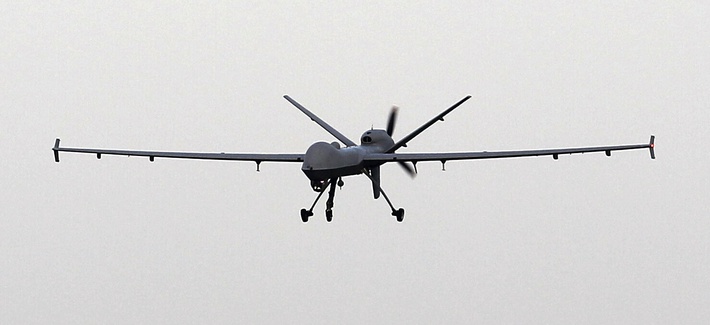
A Predator B unmanned aircraft lands after a mission at the Naval Air Station, Tuesday, Nov. 8, 2011, in Corpus Christi, Texas.
U.S. defense officials have asked the Defense Innovation Board for a set of ethical principles in the use of artificial intelligence in warfare. The principles are intended to guide a military whose interest in AI is accelerating — witness the new Joint Artificial Intelligence Center — and to reassure potential partners in Silicon Valley about how their AI products will be used.

Today, the primary document laying out what the military can and can’t do with AI is a 2012 doctrine that says a human being must have veto power over any action an autonomous system might take in combat. It’s brief, just four pages, and doesn’t touch on any of the uses of AI for decision support, predictive analytics, etc. where players like Google, Microsoft, Amazon, and others are making fast strides in commercial environments.

“AI scientists have expressed concern about how DoD intends to use artificial intelligence. While the DoD has a policy on the role of autonomy in weapons, it currently lacks a broader policy on how it will use artificial intelligence across the broad range of military missions,” said Paul Scharre, the author of Army of None: Autonomous Weapons and the Future of War.

Thursday, November 23, 2017

AI security

Wanted: AI That Can Spy

Spy satellites and their commercial cousins orbit Earth like a swarm of space paparazzi, capturing tens of terabytes of images every day. The deluge of satellite imagery leaves U.S. intelligence agencies with the world’s biggest case of FOMO—“fear of missing out”—because human analysts can sift through only so many images to spot a new nuclear enrichment facility or missiles being trucked to different locations. That’s why U.S. intelligence officials have sponsored an artificial-intelligence challenge to automatically identify objects of interest in satellite images.
Since July, competitors have trained machine-learning algorithms on one of the world’s largest publicly available data sets of satellite imagery—containing 1 million labeled objects, such as buildings and facilities. The data is provided by the U.S. Intelligence Advanced Research Projects Activity (IARPA). The 10 finalists will see their AI algorithms scored against a hidden data set of satellite imagery when the challenge closes at the end of December.

Friday, November 3, 2017

AI security

CHINA WILL SURPASS US IN AI AROUND 2025, SAYS GOOGLE’S ERIC SCHMIDT

Eric Schmidt, executive chairman of Alphabet speaks during a press conference ahead of the Google DeepMind Challenge Match in Seoul, South Korea, Tuesday, March 8, 2016.In April, as Eric Schmidt watched a computer program defeat China’s top go player in a ground-breaking match in the Chinese city of Wuzhen, the executive chairman of Google’s parent company was struck less by the considerable innovations displayed by human and machine than by the audience: “To me the more interesting thing [was that] all the top computer science people in China had shown up.”

It showed, Schmidt said, the importance placed on AIdevelopment by both the Chinese government and its people, and was a postcard from the future competition for AI dominance.

“I’m assuming our [U.S.] lead will continue over the next five years and then that China will catch up extremely quickly,” the Google leader told the Center for New American Security’s Paul Scharre at the Artificial Intelligence & Global Security Summit on Wednesday.

Schmidt doesn’t like the term “arms race” to describe the U.S.-Chinese rivalry in artificial intelligence, in part because defining AIas a weapon is limiting at best and flatly inaccurate at worst. But it is a tool that can make one military, company, economy, and even nation much more effective than another. And China, he says, is positioning itself to devour the current U.S. advantage in just a few years.


Sunday, July 16, 2017

AI security

What an Artificial Intelligence Researcher Fears about AI

As an artificial intelligence researcher, I often come across the idea that many people are afraid of what AI might bring. It’s perhaps unsurprising, given both history and the entertainment industry, that we might be afraid of a cybernetic takeover that forces us to live locked away, “Matrix”-like, as some sort of human battery.
And yet it is hard for me to look up from the evolutionary computer models I use to develop AI, to think about how the innocent virtual creatures on my screen might become the monsters of the future. Might I become “the destroyer of worlds,” as Oppenheimer lamented after spearheading the construction of the first nuclear bomb?
I would take the fame, I suppose, but perhaps the critics are right. Maybe I shouldn’t avoid asking: As an AI expert, what do I fear about artificial intelligence?