Страницы

Showing posts with label Dam security. Show all posts

Saturday, March 18, 2017

Dam security

Climate Change Complicates the Whole Dam Debate

With California now on track to have the rainiest year in its history—on the heels of its worst drought in 500 years—the state has become a daily reminder that extreme weather events are on the rise. And the recent near-collapse of the spillway at California’s massive Oroville Dam put an exclamation point on the potentially catastrophic risks.
More than 4,000 dams in the U.S. are now rated unsafe because of structural or other deficiencies. Bringing the entire system of 90,000 dams up to current standards would cost about $79 billion, according to the Association of State Dam Safety Officials. Hence, it has become increasingly common to demolish problematic dams, mainly for economic and public safety reasons, and less often to open up old habitats to native fish. About 700 dams have been taken down across the U.S. over the past decade, with overwhelmingly beneficial results for river species and ecosystems.

Wednesday, March 1, 2017

Dam security

Dramatic new images show scale of damage to Oroville Dam spillway 

Story image for oroville from Sacramento BeeGeologists attempted for the first time Tuesday to figure out what to do about the vast, yawning canyon dug out of the earth after a crater opened up in the Oroville Dam’s concrete spillway and diverted water at high speed into the adjacent hillside.
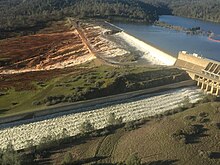
Monday’s shutoff of water flowing down the main spillway revealed a shocking panorama of damage, forcing experts with the California Department of Water Resources to scramble to figure out how the crippled chute can possibly be fixed by the end of the year — in time for the next rainy season.
Photographs and video released by the department Tuesday showed that an enormous section of the spillway, which is as wide as a 15-lane freeway, had been wiped out. In its place is a giant rocky channel carved out of the earth leading down to the Feather River.
  • Riverbend Park is seen under flood water in Oroville, California on February 13, 2017. Almost 200,000 people were under evacuation orders in northern California Monday after a threat of catastrophic failure at the United States' tallest dam. Officials said the threat had subsided for the moment as water levels at the Oroville Dam, 75 miles north of Sacramento, have eased. But people were still being told to stay out of the area.
  • The Oroville Dam’s concrete spillway needs major repairs after an enormous section of the channel was ruined in recent rains.

Wednesday, February 15, 2017

Dam security

Dams are like loaded weapons. Oroville could be the first disaster of many to come

What is most surprising about the near-collapse of a spillway at Oroville Dam is that events like that have not happened more often.
Located 75 miles north of Sacramento, Oroville is the nation’s tallest dam and holds back the state’s second-largest reservoir. Both its main spillway and an auxiliary one have experienced major erosion because of massive emergency releases of reservoir water during this winter’s heavy storms. On Sunday, engineers worried that the top 20 or 30 feet of the emergency spillway could give way, causing devastating flooding on the Feather River. State officials ordered the evacuation of nearly 200,000 people living downstream from the dam.

Monday, February 13, 2017

Dam security

20% of dams in populated areas lack emergency plan

GTY 635156718 A POL USA CA
As the nation's 84,000 dams continue to age, a growing number of people downstream are at risk, experts say.

That's not only because of older infrastructure but also because of population growth around some of the dams. More than a quarter were developed primarily for recreational purposes, according to National Inventory of Dams data from 2016.

"The nation’s dams are aging, and the number of high-hazard dams is on the rise," according to a 2013 report from the American Society of Civil Engineers. "Many of these dams were built as low-hazard dams protecting undeveloped agricultural land. However, with an increasing population and greater development below dams, the overall number of high-hazard dams continues to increase."

Sunday, December 11, 2016

Dam security

Mosul Dam collapse 'will be worse than a nuclear bomb'


As Iraqi forces continue their military operation to take Mosul from the Islamic State of Iraq and the Levant (ISIL, also known as ISIS), another equally important battle to save the Mosul Dam, located 60km north of Mosul, is under way.
After six months of frantic security and logistical preparations, an Italian company has kicked off the repair works to beef up the dam, under the protection of five hundred Italian soldiers and Kurdish Peshmerga forces.
The Italian company,TREVI, will have about 18 months to prevent the foundations of the dam from plunging deeper underground, averting an impending catastrophe. Experts warn that if the dam collapses, up to 11.11 billion cubic-metres of water known as Lake Dahuk, will submerge Mosul and create an inundation that will affect the lives of millions of people living along the banks of the Tigris river.