Страницы

Showing posts with label Wildlife security. Show all posts

Sunday, March 29, 2020

Wildlife security

China and Vietnam finally ban wildlife trade due to coronavirus

A security guard stands outside the Huanan Seafood Wholesale Market in Wuhan in January.
If there can be a bright side to the coronavirus pandemic, which started in a “wet market” in Wuhan that sold live animals in deplorable conditions, it has finally spurred China and Vietnam to ban consumption of wild animals.
The two countries have been behind the skyrocketing death rates for endangered animals like the rhinoceros, elephant and the heavily trafficked pangolin, which have been killed for food and homeopathic “medicinal” cures in the countries. But this trade and the wet markets have been behind not just the recent outbreak, but the SARS explosion in 2002 (which is believed to have emanated from a small mammal called a civet), the swine flu and others.
In January, China imposed a ban on all farming and consumption of “terrestrial wildlife of important ecological, scientific and social value,” which is expected to be signed into law later this year.

Saturday, December 29, 2018

Wildlife security

The Observer view on Japan’s decision to resume commercial whaling


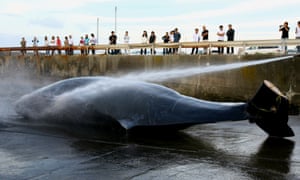
Japanese fishermen process whale carcass
Whales have been hunted by humans for thousands of years. Their flesh, oil and blubber have been variously employed for food, to make wax for candles and to provide fuel for lamps. This kind of exploitation is no longer needed today. Modern society gets its protein and its lighting from other, more accessible sources. Hence the decision by the International WhalingCommission (IWC) to place a moratorium on commercial whaling in 1986.
Given that many species had already been brought close to extinction, the move was long overdue. Three decades later, the blue whale, the humpback whale, the North Atlantic right whale and many other great cetaceans are still struggling to rise out of the critically endangered state to which hunting had reduced them. Had whaling not been halted 30 years ago, many of these great creatures would no longer be swimming in our oceans. The world that we currently inhabit would have been greatly impoverished.
Given this worrying background, it is all the more difficult to understand the announcement by the government of Japan that it has decided that it will leave the IWC in June in order to resume commercial whaling the following month. By any standards, the move is depressing – and alarming. It has absolutely no economic or ecological justification and in preparing to slaughter some of the planet’s most intelligent creatures for food the plan is repugnant.

Thursday, September 15, 2016

Wildlife security

How forensic science can stop slaughter of endangered wildlife

Man takes notes against blurred backdrop showing corpse of large animal in the bush
With wildlife crime escalating, maybe it’s time to revamp the international treaty aimed at combatting it. Forensic scientists are proposing a series of changes to the Convention on the International Trade in Endangered Species (CITES) to allow new technologies to be unleashed on the problem.
Later this month, the CITES meeting in Johannesburg, South Africa, will hear of growing desperation over the rise in poaching and the illicit wildlife trade, which is said to be the fourth largest illegal trade in the world.
For example, rhino killings in Africa have risen for the last six years, with over 1300 killed in 2015. Some CITES-listed plant species have become more valuable than ever. A 1-kilogram piece of resinous agarwood, used in pricey perfumes and traditional Chinese medicine, sold for $3 million earlier this year, says Ed Espinoza, deputy director of the US Fish and Wildlife Services Forensics Laboratory in Ashland, Oregon.