Страницы

Showing posts with label Infrastructure security. Show all posts

Sunday, February 16, 2020

Infrastructure security

Trump quietly strengthens U.S. military's ability to wage precision-strike warfare

The Arleigh Burke-class guided-missile destroyer USS Curtis Wilbur (DDG 54) fires a Standard Missile 2 (SM-2) during a missile firing exercise. (U.S. Navy photo)
President Trump this week signed an executive order aimed at strengthening U.S. infrastructure against the disruption of critical services like GPS.

Not mentioned by the White House in announcing the order is that the bolstering of precision, navigation and timing — or PNT — services will also greatly bolster the military’s capability to conduct precision-strike warfare.

The order is aimed at preventing an electronic disruption of the numerous systems that rely on accurate PNT, most notably the GPS navigation system. Civilian uses of PNT include traffic management and precision agriculture and in the future will be needed for driverless cars and drones.

Other critical infrastructures that rely on PNT include the electrical power grid, communications infrastructure and mobile devices, transportation, weather forecasting and emergency response.

Sunday, February 17, 2019

Infrastructure security

Germany sees big rise in security problems affecting infrastructure

cybercrime
Germany has experienced a big increase in the number of security incidents hitting critical infrastructure such as power grids and water suppliers, the BSI cybersecurity agency said on Sunday, adding however that they were not all due to hacking.

The Welt am Sonntag weekly had reported on Sunday that Germany had learned of 157 hacker attacks on critical infrastructure companies in the second half of 2018 compared to 145 attacks in the whole of the previous year.

“The number of reports of IT security incidents has increased but it is not to be equated with the number of cyber attacks,” tweeted the BSI in response to the newspaper report.

“Reports are also made for other reasons such as technical problems,” it added.

The attacks were aimed at sabotaging power supplies and manipulating water supplies or disrupting communications lines, the paper said, adding security authorities suspected foreign intelligence agencies were behind such attacks.

Friday, September 14, 2018

Infrastructure security

Explosions, Fires Burst Across Massachusetts Community - Gas Problem Suspected
Several homes in Massachusetts catch on fire, gas line issues suspected.
Emergency response crews are responding to gas-related explosions in three separate communities in Massachusetts' Merrimack Valley region, local media reported Thursday. Three people, including a firefighter, were directed to the Lawrence General hospital after being injured.
State Police have confirmed 70 fires, gas, or investigations of gas odors in Lawrence and in North Andover. However, numbers are expected to grow. At least one home has been reported as being completely destroyed.
According to local newspaper the Eagle-Tribune, the fires are the result of a problem with the gas line that homes and businesses in Andover, North Andover and Lawrence are connected to. 
Massachusetts State Police have told residents in all the affected communities who are served by Columbia Gas to evacuate, as the company is depressurizing its gas lines in response to the incidents.

Wednesday, May 16, 2018

Infrastructure security

Do our infrastructure systems put people at risk?


Chart: The relationship of traffic fatalities and US annual vehicle miles traveledRisk—the likelihood that an individual may be harmed if exposed to a hazard—is not a foreign concept. It’s often our infrastructure’s most extreme failures, like the Minneapolis bridge collapse or the Amtrak crash outside Philadelphia, that tend to put infrastructure in the news. Recently, much has been written about America’s failing infrastructure systemstransportationenergywatertelecommunications, and the built environment as a whole. But these narratives inherently fall short, as they focus on the engineering itself, tapping into a sort of carnal fear that physical structures could collapse around us any minute.

Thursday, March 1, 2018

Infrastructure security

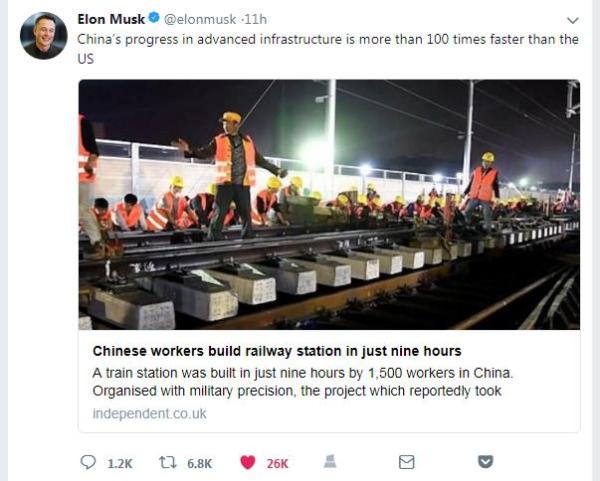
China is 100x faster than the US in advanced infrastructure construction: Elon Musk


SpaceX and Tesla founder Elon Musk on Wednesday gave his thumbs up for Chinese infrastructure construction, calling the nation 100 times faster than the US.
“China’s progress in advanced infrastructure is more than 100 times faster than the US,” Musk wrote on his personal Twitter account in a quote tweet of a news report about how a railway station in eastern China’s Fujian province was completed within 9 hours.
The construction took place at Longyan Station on January 19, 2018. A total of 1,500 laborers worked together with 23 excavators.
Many followed the thread and echoed Musk. A user named Brandon, who said he works for a light rail system in the US city of San Diego, commented that they have been working on a new station for more than six months.
Musk said in comments that the system of incentives in the US is messed up. “Higher safety & environmental requirements & labor costs explain only a small part of the difference. True root cause imo is an exponential growth in bureaucracy & a self-serving private sector consultant industry earning a % on project cost, incenting them to maximize cost,” he said.

Monday, January 22, 2018

Infrastructure security

Protective security advice for the UK’s national infrastructure

Protective security adviceThe Centre for the Protection of National Infrastructure, (CPNI), is the government authority for protective security advice for the UK’s national infrastructure. Their primary role is to protect national security through means of helping to reduce the vulnerability of the national infrastructure from terrorism and other threats. As well as obvious areas of critical danger, less urgent but still vulnerable assets and events such as high-profile landmarks or iconic targets are also protected by the CPNI indirectly, through advice and damage protection. The CPNI is impacted by a range of government policies such as the National Security Strategy (NSS), the National Risk Register and the Counter-terrorism strategy (CONTEST).
CONTEST aims to reduce risks of international terrorism, allowing individuals and businesses to continue with ease. This strategy is divided into four principal strands: Prevent, Pursue, Protect and Prepare. The CPNI’s work falls within the ‘Protect’ strand, which is concerned with reducing the vulnerability of the UK and UK interests overseas to a terrorist attack. CPNI’s protection work covers facilities, sites, information, people, systems, network and processes under the blanket of “infrastructure”. Everything upon which daily life depends on and requires protection due to the potential danger of UK citizens is included in National Infrastructure, yet all is not “critical”.

Wednesday, August 3, 2016

Infrastructure security

Securing Critical Infrastructures with Laser Radar Sensors

The circle of threats to gas platforms, critical infrastructure, air and sea ports and borders has expanded in recent years.
Two of the many threats relate to the Mediterranean gas explorations and to the threat of drones. The need for threat detection and identification and for securing critical infrastructure has led to clear definitions, regulations, and accelerated development of unique technologies and products.
The US and European authorities define the sectors and facilities considered “critical infrastructure” as:
∙ Energy related sites – power plants, nuclear reactors, nuclear material and waste disposal sites
∙ Defense and chemical plants
∙ Bridges and dams
∙ Drinking water and water treatment facilities.

Wednesday, June 22, 2016

Infrastructure security

Critical infrastructure protection market rising at 7.16% CAGR and reach $144.82 billion by 2021 driven by government regulations and best practices


Government regulations and best practices is driving the demand for critical infrastructure protection. The critical infrastructure protection market size is estimated to grow from USD 102.47 billion in 2016 to USD 144.82 billion by 2021, at a Compound Annual Growth Rate (CAGR) of 7.16% from 2016 to 2021.
The critical infrastructure protection market is driven by factors such as government regulations and best practices and increase in the number of cyber threats. Complete report on critical infrastructure protection market spread across 159 pages, profiling 10 companies and supported with 88 tables and 46 figures is now available at http://www.rnrmarketresearch.com/critical-infrastructure-protection-cip-market-network-security-physical-security-cip-radars-cbrne-detection-vehicle-identification-secure-communication-scada-security-building-management-g-market-report.html .
Maintenance and support service to gain the largest market share during the forecast period. The need for monitoring infrastructures is always there, especially for infrastructures such as oil and gas, smart grids, or nuclear reactors.

Sunday, November 1, 2015

Infrastructure security

Can ISIS Attack Our Infrastructure?

The FBI says that highly capable hacking software is available for purchase on the black market and could be used to hack networks associated with energy companies, fuel refineries, or water-pumping stations.
Because of the size and complexity of America’s utility grids, and a lack of due diligence, US infrastructure is vulnerable to advanced cyberattacks — from terrorists or, more likely, from rival governments that already have the necessary capabilities. A survey in 2013 found more than 500,000 potential targets for cyberattacks against computers associated with power plants, water treatment centers, traffic control towers, and various portions of the electrical grid.

Monday, October 19, 2015

Infrastructure security

Britain calls in spies amid security fears as we let CHINA build our nuclear plants

Soldiers and flag from China with Hinkley Point plans
Intelligence agency GCHQ will be responsible for protecting the country's energy network from cyber attacks.
The safeguard emerged as President Xi Jinping arrives for a four-day state visit hailed by David Cameron as a symbol of a "golden era" in relations with Beijing.Among the business deals set to be sealed during the visit is an accord that could see the Chinese take a key role in constructing nuclear plants at Hinkley Point, Sizewell and Bradwell.
Security sources have warned that the contracts could pose a major threat to national security.
An intelligence insider revealed: "There is a big division between the money men and the security side.

Sunday, September 27, 2015

Infrastructure security

Soundwave Technology To Locate Faults In Critical Infrastructure

Scottish researchers have developed an ultrasound sensor that is able to detect cracks and faults in buildings and facilities, such as oil pipelines and nuclear reactors, based on a system similar to the hearing mechanisms in bats, dolphins and moths.
According to the research, published in the Journal of Applied Mathematics, scientists at Strathclyde University (Glasgow, Scotland) have developed a transducer (a component that converts physical to electrical signals and vice versa) that can detect physical faults via variable supersonic frequencies. The transducer has a flexible structure based on fractals, a geometric form that is composed of copies of itself of diminishing sizes, like snowflakes or cauliflower.
One of the researchers, Tony Mulholland, explained that man-made transducers have a normal geometric form, similar to a chess-board, and this limits the technology’s potential in finding cracks and faults in buildings and infrastructure where safety is vital.

Tuesday, July 28, 2015

Infrastructure security

Daily Open Source Infrastructure Report28 July 2015

Картинки по запросу dhsThe DHS Daily Open Source Infrastructure Report is a daily [Monday through Friday] summary of open-source published information concerning significant critical infrastructure issues. The DHS Daily Open Source Infrastructure Report is archived for 10 days on the Department of Homeland Security Web site: http://www.dhs.gov/IPDailyReport