Страницы

Showing posts with label Electromagnetic security. Show all posts

Wednesday, November 13, 2019

Electromagnetic security


    Improved Situational Awareness Regarding Electromagnetic Spectrum
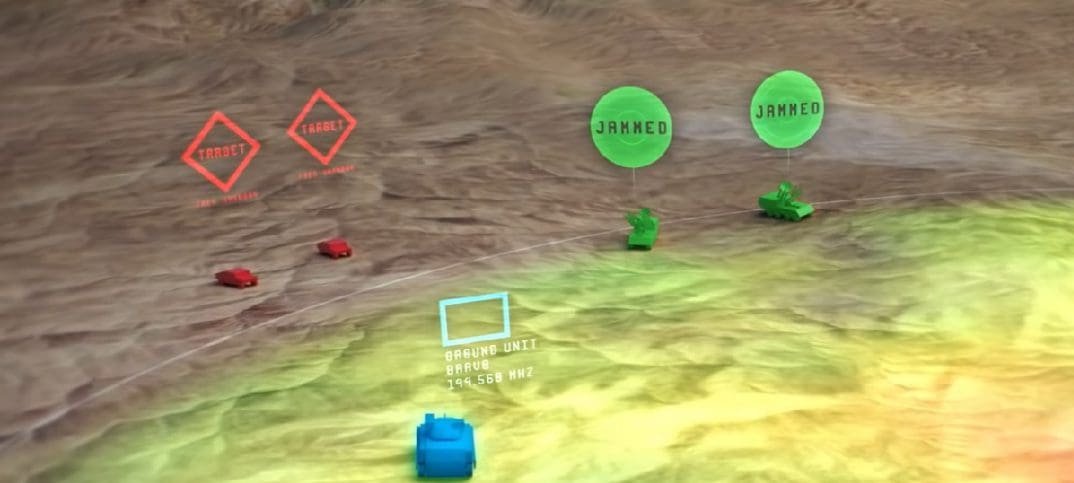
    Photo illust. from Raytheon Youtube
    Military forces have to manage an increasingly complex electromagnetic spectrum (EMS) at the tactical environment. This encompasses the entire field of electromagnetic radiation that surrounds us – infrared, radar, TV and radio waves, jamming systems, electronic warfare, etc.
    A new software under development will give the operators of military hardware, including aircraft, situational awareness of the electromagnetic spectrum. 
    The U.S. Army is in the final stages of developing a software tool, the Electronic Warfare Planning and Management Tool (EWPMT). Raytheon is currently developing the last stage of the technology under a contract with the US Army.
    The tool is designed to plan, manage and control sensors and other systems in the electromagnetic spectrum to provide fighting forces with critical information on the crowded signal environment of a modern battlefield. 
    The framework will allow electronic warfare officers to analyze possible courses of action and to provide situational awareness for Army brigade combat team commanders. 

    Sunday, July 16, 2017

    Electromagnetic security

    Look up! Northern Lights spectacle possible Sunday night


    A geomagnetic storm could bring a spectacular show to skies across the northern United States on Sunday night.
    The Aurora Borealis phenomenon -- also known as the Northern Lights -- may be visible "as low as New York to Wisconsin to Washington State," according to NOAA's Space Weather Prediction Center.
    Aurora Borealis happen when electrically charged electrons and protons in the Earth's magnetic field collide with neutral atoms in the upper atmosphere, turning into a stunning show of lights.
      The phenomenon is named after Aurora, the Roman goddess of dawn.

      Friday, December 2, 2016

      Electromagnetic security

      Joint force must close gaps in electromagnetic spectrum

      ElectronWith an intense focus on technologically inferior adversaries in non-permissive environments for the last 15 years, the U.S. is coming to grips with the nature of advanced warfare and the capabilities of near-peer competitors. One of these capabilities, which some have described as on par or even superior to that of the U.S., is electromagnetic spectrum operations (EMSO) and electronic warfare (EW). 

      EMSO will play an outsized role in future concepts the military is devising, which, in some cases, simply assumes the superiority the U.S. has enjoyed in most domains for nearly the last two decades. Writings on the combat cloud or anything related to the so-called third offset strategy relies on a baseline assumption on the United States' ability to dominate in the spectrum, Brig. Gen. Edward Sauley, deputy director of operations for joint electromagnetic spectrum operations and the mobilization assistant to the director of operations for Strategic Command, said at the Association of Old Crows' annual conference in Washington on Tuesday. 

      Thursday, July 7, 2016

      Electromagnetic security

      Who’s Afraid of the Big Bad Pulse?


      Power distribution station with lightning striking electricity towers.
      While testifying before Congress in May, Peter Pry warned that a rogue state or terrorist could attack the United States with a weapon that would kill 9 out of 10 Americans “through starvation, disease, and societal collapse.”
      That fearsome weapon? An electromagnetic pulse. Pry, executive director of the EMP Task Force on National and Homeland Security, a congressional advisory board, described a scenario in which an adversary could detonate a nuclear device in the atmosphere over the United States, which would in turn generate an EMP that would cause catastrophic damage to the nation’s electricity grid, resulting in long-term, national power outages.
      It is, indeed, a frightening scenario—and it isn’t the only threat to the nation’s electricity grid. U.S. critical infrastructure is also vulnerable to cyber and physical attacks. The risk of such attacks is real, and, in some cases, growing. But don’t run out and stock your bomb shelter with whale oil just yet. In fact, odds are you have far more to fear from nut-obsessed squirrels than nutty extremists when it comes to the reliability of your electricity.

      Saturday, May 21, 2016

      Electromagnetic security

      Federal Agencies Have Taken Actions to Address Electromagnetic Risks, but Opportunities Exist to Further Assess Risks and Strengthen Collaboration

      gridKey federal agencies have taken various actions to address electromagnetic risks to the electric grid, and some actions align with the recommendations made in 2008 by the Commission to Assess the Threat to the United States from Electromagnetic Pulse Attack (EMP Commission). Since 2008, the Department of Homeland Security (DHS), the Department of Energy (DOE), and the Federal Energy Regulatory Commission (FERC) have taken actions such as establishing industry standards and federal guidelines, and completing EMP-related research reports. GAO found that their actions aligned with some of the EMP Commission recommendations related to the electric grid. For example, DHS developed EMP protection guidelines to help federal agencies and industry identify options for safeguarding critical communication equipment and control systems from an EMP attack. Further, agency actions and EMP Commission recommendations generally align with DHS and DOE critical infrastructure responsibilities, such as assessing risks and identifying key assets.