Страницы

Showing posts with label Defense. Show all posts

Saturday, March 28, 2020

Defense

COVID-19 Drives Command Teams Charged With Homeland Defense Into Cheyenne Mountain Bunker

U.S. Northern Command has dispersed essential command and control teams to multiple hardened locations, including the famous Cheyenne Mountain bunker complex in Colorado, as well as another unspecified site, and is keeping them in isolation. The command took these steps to help ensure these personnel can continue to watch around the clock for potential threats to the U.S. homeland as the COVID-19 pandemic continues to expand across the country and around the world, including within the U.S. military.
U.S. Air Force General Terrence O’Shaughnessy, head of Northern Command (NORTHCOM), who also serves as the commanding officer of the U.S.-Canadian North American Aerospace Defense Command (NORAD), detailed the changes during a virtual town hall on Facebook on Mar. 24, 2020. Under normal circumstances, the watch teams, which support both NORTHCOM and NORAD missions, would take shifts staffing a central command center at Peterson Air Force Base in Colorado. 

Thursday, March 26, 2020

Defense

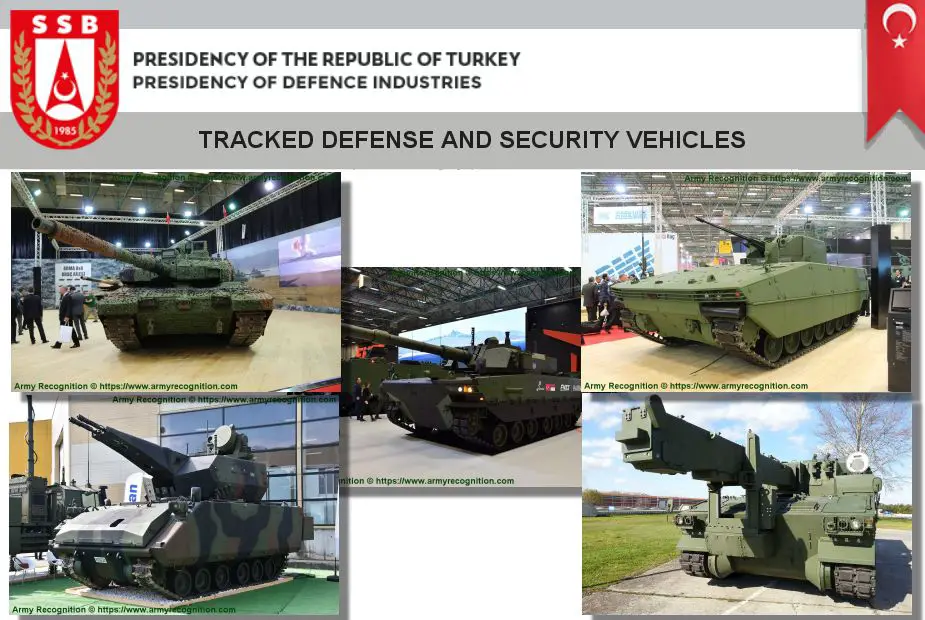
Analysis: Tracked defense and security combat vehicles of Turkish Industry


Happy new year 2020 and our best wishes for friends readers customers and family 925 001The Turkish defense industry offers high-technology and cost-efficient solutions in compliance with NATO standards to armies in the world. Three Turkish companies - FNSS, OTOKAR and BMC - design and manufacture the latest technologies of tracked combat vehicles including main battle tanks, light tanks, APC armored personnel carriers, IFV infantry fighting vehicles, etc.
The ACV-15 is a family of tracked Armored Combat Vehicles (ACV) designed and manufactured by the Turkish company FNSS. The Armored Combat Vehicle (ACV) is the generic designation for a tracked, diesel-engine powered, heavily armored platform in the 13-15-ton class, capable of performing combined arms operations with main battle tanks. The platform design allows the integration of different subsystems for executing a variety of different roles.
The ACV-15 is a full-tracked (5 roadwheels), lightweight, low-silhouette armored vehicle capable of high-speed operations in desert conditions, poor infrastructure, roads and/or highways. The hull is manufactured in a ballistic aluminum plate. Plate thickness varies on the different planes of the hull to meet appropriate ballistic requirements. FNSS produced more than 2,500 ACV-15s for the Turkish Land Forces and users worldwide.
The vehicle modernization packages are aimed at improving survivability, situational awareness, firepower and mobility. For survivability, priority has been given to the enhancement of mine and ballistic protection levels, mine-resistant seats, protection lining applications, dual-stage automatic fire extinguishing and suppression systems, an NBC system, air conditioning for the crew and the RPG protection network.

Wednesday, February 26, 2020

Defense

The Case for Closing the Pentagon

FILE - In this June 3, 2011, file photo, the Pentagon is seen from air from Air Force One. The House has passed its annual defense policy measure, which combines a $738 billion Pentagon price tag with legislation to provide federal employees with 12 weeks of paid parental leave. The Pentagon, famed as the world’s largest office building, sits on 24 acres of land across the Potomac River from Washington. Home to 3.7 million square feet of offices, it was constructed during the Second World War. In anticipation of the military shrinking once peace returned, the building was designed to be easily converted into a records storage center. Instead, if the Trump administration’s budget is approved, in 2021 it will oversee the largest defense expenditure since 1945.
This history makes the Pentagon a potent symbol of America’s foreign-policy infrastructure in general, which is dominated by a massive, increasingly inefficient military machine better suited to the challenges of the mid-20th century than the early 21st. It is a machine that carries considerable direct economic costs but, more important, overshadows other foreign-policy tools more effective in confronting the global problems that the United States faces today. And just as the Pentagon is no longer fit for its backup purpose of records storage center in an age of cloud computing, nor is the Department of Defense well-placed to readjust to new roles, such as anti-terror or cybersecurity, let alone responding to climate change, pandemic threats or global financial crises.

Wednesday, December 18, 2019

Defense

Fifth Pentagon official announces resignation in seven days


The Pentagon January 2008.jpg
The Defense Department’s senior adviser for international cooperation earlier this week left the Pentagon, marking the fifth top official in seven days to leave or announce their departure.
Ambassador Tina Kaidanow, a longtime State Department official who began working in her Pentagon role in September 2018, resigned on Dec. 16, the Pentagon confirmed. Defense News first reported her departure.
“We appreciate her service to the department and wish her continued success. ... The department remains committed to the development and implementation of international cooperative programs and defense exportability efforts to foster cooperation with U.S. allies on research, development, production and support of weapons systems and related equipment,” a Department of Defense (DOD) spokesman said in a statement.
“The department will not provide anything further on this personnel matter,” the spokesman added.

Monday, August 26, 2019

Defense

Egypt continues to produce locally M1A1 Abrams main battle tanks


Egypt continues to produce locally M1A1 Abrams main battle tanks 925 001
The M1A1 is a third-generation of American main battle tank that has been produced in Egypt since 1992. The main components the M1A21 are manufactured locally including the hull, the turret, and ammunition. The M1A1 Abrams is the backbone of the Egyptian army.
On October 25, 2011, Egypt and the United States celebrated the resumption of co-production of M1A1 Abrams Tanks at a ceremony held at the Egyptian Tank Plant outside of Cairo. The manufacturing of M1A1s in Egypt is a key part of ongoing U.S. support for Egypt’s crucial role as a factor of security and stability in the region. Through this program, the Tank Plant provides jobs for over 2500 Egyptians and supports the capacity of the Egyptian Armed Forces to defend the country.
Since the beginning of the M1A1 Co-production Program, a joint venture between the governments of the United States and Egypt to produce parts and assemble tank kits for the M1 Abrams Main Battle Tank (MBT), the Egyptian Defense Company Tank Plant has produced around 1,200 M1A1 Abrams main battle tank in Egypt.
The first version of the M1 Abrams was armed with one 105mm cannon, while the M1A1 is armed with one 120 mm smoothbore M256 armament equipped with a muzzle reference system to measure the bend of the gun tube. The main cannon of the Egyptian M1A1 is also produced license in Egypt.
The M1A1 Abrams has a crew of four, including the driver, commander, gunner and loader. The driver is seated at the front of the vehicle in the center while the three other crew members are located in the turret. The commander and gunner are seated on the right of the turret and the loader on the left.

Sunday, May 5, 2019

Defense

Russia Makes Some of the Deadliest Weapons on Earth (But There Is a Problem)

Russia's defense industry is face to face with a major foe, but it's not a foreign military power. The Kremlin has been striving to modernize all branches of the Russian military, but the country's defense industry is struggling thanks to decreasing volumes of orders, difficulties in attracting high-skilled talent and limits to its technological capabilities. According to recent figures, the performance of Russia's aerospace sector is declining precipitously. In 2018, for instance, Russian aircraft and spacecraft makers produced 13.5 percent less than in 2017. And there's been no letup in 2019 either: In the first two months of the year, aerospace output plummeted 48 percent year on year.

The decline in Russia's defense output raises concerns about the competitive strength of Russia's defense industry in general, whose health is critical if the country is to project itself as a military power in the longer term. Russian Deputy Prime Minister Yuri Borisov attributed the reduction in output to a slowdown of orders for military systems, but projections suggest the slowdown is not just a short-term fluctuation; in fact, it's expected to become even worse in the future. The downturn in oil prices has taken a bite out of Russia's bottom line, squeezing spending for the military — all at a time when the country's arms manufacturers have lost their competitive edge in the global arms market. Together, these factors ensure that Russia's defense industry will struggle to get out of its funk.

Tuesday, March 19, 2019

Defense

Northrop launches hypersonic defense push


With the Pentagon making hypersonic weapons a priority, Northrop Grumman is throwing its hat into the ring in an attempt to claim space in the still-early hypersonic defense market.
The company last week launched a new campaign website focused on hypersonic defense as part of a broader push into the business area, where the Pentagon expects to spend more than $10 billion in the next five years to develop offensive and defensive capabilities.
Hypersonic defense is significantly behind hypersonic offense, something Kenn Todorov, vice president of missile defense solutions and the lead for Northrop’s counter-hypersonic efforts, acknowledged in a March 19 interview. That means there is a lot of room for experimentation in how to tackle the issue.

Thursday, March 7, 2019

Defense

China closer to equipping warships with electromagnetic railguns, state media reportsChina's military is going from strength to strength under Xi Jinping


Under Chinese President Xi Jinping, a revolution has been taking place inside Beijing's armed forces.
The People's Liberation Army (PLA) has grown and modernized rapidly since China reopened to the world in the 1980s, but under Xi that pace has accelerated with a focus on fighting and winning future wars.
Xi has also embarked on a massive internal reorganization of the PLA, streamlining the organization and bringing it firmly under his control.
On Tuesday, the Chinese government unveiled an increase in military spending of 7.5% during its annual "Two Sessions" legislative meeting in Beijing, a slight dip on last year's spending increase.
Experts said the slight drop was likely to avoid domestic perceptions that the country's military spending far exceeded its overall economic growth, which is set to grow at no more than 6.5% in 2019.
While the Chinese military may be one of the world's best-funded armed forces, its budget still pales in comparison to United States. In December, US President Donald Trump agreed to increase the defense budget funding to $750 billion in 2019.

Tuesday, January 29, 2019

Defense

Defense Stocks Are in a Funk. Their Earnings Could End It.

Defense Stocks Are in a Funk. Their Earnings Could End It.
Defense stocks have been a little like the federal government lately: not working.

The aerospace and defense components of the S&P 500 dropped 10% in 2018 even though earnings increased nearly 13%. The sector now trades for about 16 times estimated 2019 earnings, down from 21 times a year ago.

Those cheaper valuations, plus a solid outlook for military spending, are two good reasons to revisit the sector now. If you need a third, Barron’s likes defense.

We made a bullish call on Boeing (ticker: BA) stock in November, the same month we warned about a coming hypersonic arms race that could channel more cash to defense companies. Lockheed Martin (LMT) and Northrop Grumman (NOC) are two of the Barron’s Roundtable picks for 2019.

A year ago, when valuations in the sector were higher, investors were more comfortable with the outlook for military spending and the federal government hadn’t just been closed for five weeks.

Tuesday, January 15, 2019

Defense

Japan surges new weapons, military roles to meet China’s rise


Most Japanese military officials won’t name the potential adversary that has spurred rapid Japanese modernization across its ground, maritime and air Self Defense Forces, in a nod to sensitive diplomatic relations.
But it’s not Russia that has spurred Japan’s recent commitment to purchase up to 147 F-35s, or moved Japan to produce the country’s first aircraft carrier since World War II. It’s not North Korea that’s caused Japan to rapidly train, for the first time ever, an amphibious assault brigade to seize or retake the Senkaku Islands to its southwest if they have to.
It’s China. But among many U.S. and Japanese military officials in Japan, it’s “a competitor,” or “that country.”
“We have some weakness to defending Japan, especially on the south west islands," Maj. Gen. Shinichi Aoki, commander that Amphibious Rapid Deployment Brigade, said. “So that’s why our Self Defense Force is now trying to set up a strong posture toward that country."
Defense

Trump says US must stop its ‘endless wars' and bring troops home


President Donald Trump on Sunday said America must “stop the endless wars” and has begun the withdrawal of troops and equipment from Syria, in keeping with his recent pledges to end U.S. involvement in that conflict.
The comments came two days after Pentagon officials confirmed they have begun moving military equipment out of the region and begun planning the extraction of about 2,000 U.S. troops from the country. Military officials have said they will not reveal exact timetables or withdrawal details for security reasons.
Trump, in a series of tweets on Sunday, said the “long overdue pullout from Syria” would not disrupt American efforts to stabilize the region. He said despite the moves, American forces are still “hitting the little remaining ISIS territorial caliphate hard, and from many directions” and said remaining U.S. forces in the region would protect Kurdish allies from Turkey.

Monday, January 7, 2019

Defense

Army testing 'hostile fire detection' sensors for armored combat vehicles

USA flag and US Army
The Army is engineering new AI-enabled Hostile Fire Detection sensors for its fleet of armored combat vehicles to identify, track and target incoming enemy small arms fire.

Even if the enemy rounds being fired are from small arms fire and not necessarily an urgent or immediate threat to heavily armored combat vehicles such as an Abrams, Stryker or Bradley, there is naturally great value in quickly finding the location of incoming enemy small arms attacks, Army weapons developers explain.

There is a range of sensors now being explored by Army developers; infrared sensors, for example, are designed to identify the “heat” signature emerging from enemy fire and, over the years, the Army has also used focal plane array detection technology as well as acoustic sensors.

“We are collecting threat signature data and assessing sensors and algorithm performance,” Gene Klager, Deputy Director, Ground Combat Systems Division, Night Vision and Electronic Sensors Directorate, told Warrior Maven in an interview last year.

Thursday, January 3, 2019

Defense

For Shanahan, a Very Public Debut in Trump's Cabinet

Картинки по запросу patrick shanahanIn one of his first meetings of the day, Shanahan told civilian leaders of the U.S. military to focus on "China, China, China," even as America fights militants in Syria and Afghanistan, a U.S. defense official said.
The U.S. official, who spoke on condition of anonymity, did not elaborate on Shanahan's views on China or what other guidance he gave during the meeting.
Other officials have described Shanahan as an advocate of the Pentagon's toughening stance toward Beijing. The 2018 National Defense Strategy https://dod.defense.gov/Portals/1/Documents/pubs/2018-National-Defense-Strategy-Summary.pdf, which Shanahan helped develop, branded China as a strategic competitor.
"While we're focused on ongoing operations, acting Secretary Shanahan told the team to remember China, China, China," the official said.

Sunday, December 30, 2018

Defense

RUSSIA MILITARY NEWS 2018: HISTORIC YEAR FOR VLADIMIR PUTIN AS NEW WEAPONS, STRATEGY AIM TO CHALLENGE U.S.


RussiaAvangardTest2
Russia's armed forces have claimed historic technological achievements and regional partnerships throughout 2018, making it a year in which the country further challenged U.S. military dominance around the world.
Russian President Vladimir Putin first set out in 2008 to revamp his country's military, whose might was devastated by the dissolution of the Soviet Union in the 1990s. A decade later, he said the most modern and even prospective defense systems are "incapable" of thwarting Russia's newly minted arsenal of weapons. In addition, Moscow forged new ties with Asian powers such as China, India and Pakistan, enhancing the country's footing in the East—a region often touted as the up-and-coming global economic powerhouse.
In the West, however, heightened tensions between Moscow and the U.S.-led NATO Western military alliance have led to dueling military exercises across militarized borders. The East-West dispute also played out in the Middle East, where Moscow's pro-Syrian government campaign outpaced a rival one led by the Pentagon, which has since been ordered to leave the war-torn nation.

Friday, December 28, 2018

Defense

During a time of chaos, the next Pentagon chief Patrick Shanahan brings his corporate style to America's largest bureaucracy

Defense Department's Patrick Shanahan, before he was tapped by President Donald Trump to serve as the department's Acting Secretary
From his firm handshake, precise manner of speaking and efficient introductions, it's clear Patrick Shanahan is a businessman.

Before taking the No.2 spot in the Pentagon, Shanahan spent just over 30 years at one of the nation's top defense companies. People close to the former Boeing executive say his departure from the highest echelons of the corporate world was motivated by his father, a Vietnam War veteran and Bronze Star recipient.

And so, a little over a year ago, he left the aerospace giant, where he helped develop the 787 Dreamliner, and became the 33rd deputy secretary of Defense.

He often describes his job as the Pentagon's chief operating officer, and his boss, Secretary of Defense James Mattis, as the chief executive officer.

"The secretary has the traditional role of being, you know, like, the CEO, if we were talking in terms of business vernacular. Really, up and out," he said gesturing the directions with one hand. "And my job is really down and in."

Monday, December 24, 2018

Defense

Trump's acting secretary of defense will step into role with no foreign policy, military experience

Patrick M. Shanahan, Deputy Secretary of Defense, poses for his official portrait in the Army portrait studio at the Pentagon in Arlington, Virginia, July 19, 2017.  (U.S. Army photo by Monica King/Released)
With Defense Secretary James Mattis on his way out two months earlier than planned, Deputy Defense Secretary Patrick Shanahan will take the reins of the government's largest and most complex agency with no military and foreign policy experience.
Shanahan will lead the Pentagon on an interim basis until President Donald Trump names a nominee to be his new defense secretary. Shanahan will be charged with carrying out the President's orders of withdrawing US troops from Syria, and possibly Afghanistan. A defense official confirmed to CNN Monday that Shanahan has canceled his holiday travel and is heading back to Washington.
A former corporate executive, Shanahan's portfolio at the Department of Defense has been narrow with no experience in international affairs or with counterterrorism.
    Past Pentagon chiefs have served in the role without prior military service, with Ashton Carter -- President Barack Obama's last secretary of defense -- as the most recent example.
    For the 17 months, Shanahan was Mattis' No. 2 in the Pentagon. Shanahan almost exclusively handled internal reform, budget issues and the Space Force, the new military branch proposed by Trump.
    A senior administration official told reporters on Sunday that Shanahan had been essentially "running the building" while Mattis focused on policy and outreach to military and allies.

    Friday, December 21, 2018

    Defense

    Mattis quits at Pentagon over policy clashes with Trump

    Screenshot 2018-12-21 at 01.04.39
    Jim Mattis has resigned on principle as Pentagon chief after President Trump decided to slash U.S. troop presence in Syria and Afghanistan, citing in a letter the need for "a Secretary of Defense whose views are better aligned" with the president's.
    In his strikingly frank resignation letter, Mattis issued what amounted to a stark rebuke of Trump. He outlined his beliefs in alliances, opposition to Russia and China, being respectful to allies, and standing up to authoritarianism before concluding that Trump differed with him on key principles.
    He said, "Because you have the right to have a Secretary of Defense whose views are better aligned with yours on these and other subjects, I believe it is right for me to step down from my position."
    Trump announced Wednesday that all U.S. troops would be withdrawn from Syria. There were reports Thursday that he intended to pull out thousands of troops from Afghanistan. Mattis reportedly told the White House early Thursday he needed to speak with Trump. The two met in the Oval Office at 3 p.m., and Mattis tried — and failed — to persuade Trump to keep American forces in Syria. At that point, Mattis decided to quit.
    Minutes before Mattis, 68, released his letter, Trump announced via Twitter that Mattis, a former four-star general in the U.S. Marine Corps, would be retiring "with distinction" at the end of February.

    Monday, October 22, 2018

    Defense

    The Pentagon Is Recruiting Tech Talent Like Colleges Recruit Athletes
    Students enter information from Adirondack hiking trail registers into a computer map program at the State University of New York College of Environmental Science and Forestry research station in Newcomb, NY, on June 12, 2013.Like many federal agencies, the Defense Department struggles to attract, recruit and retain young, technically talented employees. Data from the Office of Personnel Managementindicates the Defense Department has approximately 6.6 IT professionals over the age of 60 for every one under the age of 30.

    Those numbers compound the Pentagon’s lengthy list of national security challenges topped by keeping pace with China and Russia and remaining at the forefront of global information dominance. Reversing the trend won’t happen by accident, and the Pentagon’s top tech official, Chief Information Officer Dana Deasy, is addressing the challenge directly.

    “Our biggest challenges inside the [Defense Department], they are complex. They are mind-boggling, and we need the creative people who want to work on the complex and the mind-boggling,” Deasy said Monday at the Imagine Nation conference in Philadelphia.

    For starters, the Pentagon is beginning to target young tech talent in ways that more closely resemble how universities recruit elite athletes than government’s traditional hands-off hiring method.

    Thursday, October 4, 2018

    Defense

    The US may not be able to fight two big wars at once

    The U.S. military would be able to handle itself adequately in a single major regional conflict while maintaining smaller operations around the globe, but its “marginal” capabilities mean America would struggle if forced to take on a second major conflict at the same time, a new report has found.

    That is the conclusion of The Heritage Foundation’s 2019 Index of U.S. Military Strength, which offers reviews of the past year’s defense-policy issues. The index looks at both the global operating environment and an internal assessment of U.S. military strength. As in previous years, all topics are rated on a five-point scale: “very weak,” “weak," “marginal,” “strong," and “very strong.”

    Defense News was given an exclusive interview with Heritage expert Dakota Wood, who edited the nearly 500-page report, ahead of its formal release. The full report can be read here.

    On the whole, the report sees progress over the last year in bringing some new equipment into the force, filling gaps in manpower, and rebuilding some stocks of munitions and repair parts. But broader problem trends persist in force readiness, declining proficiency in key areas like trained pilots, and continued uncertainty across the defense budget.

    Wednesday, September 19, 2018

    Defense

    Forget the S-500 or Su-57 PAK-FA. Russia's Military Has Big Plans for the Future.

    Russia has started planning for the development of a series of next-generation weapons to follow-on to systems such as the Sukhoi Su-57 PAK-FA and the S-500 surface-to-air missile (SAM) battery. These new systems—which the Russian government has not named—will be developed under future advanced State Armament Program.

    “An important and key issue on our agenda is to define the beginning of the creation of yet another advanced state armament program,” Russian President Vladimir Putin said during a meeting of the Kremlin’s Military Industrial Commission .

    Putin said that Russia has to start planning for its future defense needs now as it completes developmental programs that were funded under the current State Armament Plan (GPV-2027). “It is important for us to move further and start planning today the future development and production of advanced weapons and equipment that will define the image of the Russian Armed Forces in the long-term, for the next few decades,” Putin said.