Страницы

Showing posts with label Antiquities security. Show all posts

Thursday, January 5, 2017

Antiquities security

Severing Jihadists’ Revenue Sources Should Be Top Military Priority, NCPA Says

A doctrinal change in how military strategy accounts for cultural heritage will help diminish an important funding stream that terrorist groups need to fund operations against American forces, and will improve the image of embedded US forces and discourage cultural infighting in their area of responsibility, according to a new report by National Center for Policy Analysis Senior (NCPA) Fellow David Grantham.

Stopping the illegal antiquities trade and protecting movable cultural heritage in conflict regions should be one of the United States’ military’s top priorities, according to the report.

“Since money earned from the sale of antiquities directly finances the very organizations pitted against US armed forces,” Grantham said, adding “all relevant military assets and legal procedures should be used as tools for interaction and preservation.”


Friday, April 15, 2016

Antiquities security

Lucrative Loot: The Murky World of the Ancient Artifact Market

Leonardo Patterson in his apartment in Munich.People like Patterson are euphemistically known as antiquities traders. But with a business model that is only half legal at best, the term dealer might be more accurate -- even if it is often difficult to prove wrongdoing. They profit from the fact that the immense market for archeological objects is split. On the one hand are the source countries, which are mostly poor and have passed laws against taking ancient objects out of the country -- but they often don't have the wherewithal to enforce the bans.
On the other hand are the rich countries where the collectors live. They could take action to stop the plundering, but they don't often do so. There simply isn't enough political pressure. After all, it isn't their cultural heritage that is being exploited. And the unappetizing elements of the business -- grave robbing and smuggling -- aren't taking place close to home.


Tuesday, September 1, 2015

Antiquities security

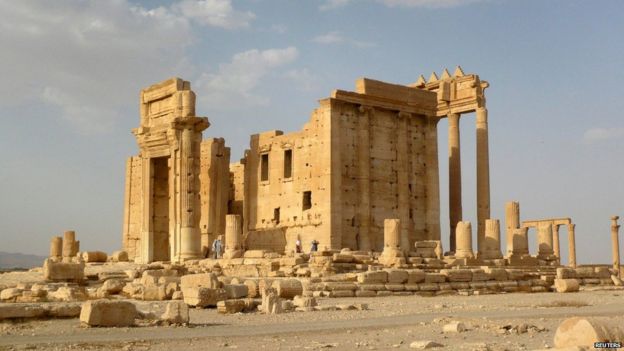
Palmyra's Temple of Bel destroyed, says UN


A general view shows the Temple of Bel in the historical city of Palmyra, Syria, August 4, 2010
Add caption
A satellite image confirms that the main temple in the ancient city of Palmyra in northern Syria has been destroyed, the United Nations says.
There had been earlier reports of an explosion at the Temple of Bel in Palmyra, which is held by militants from the Islamic State (IS) group.
Syria's antiquities chief had earlier said the basic structure of the 2,000-year-old site was intact.
But UN satellite analysts Unosat say the imageshows almost nothing remains.
"Unfortunately, the images we acquired do show that the main building of the temple has been destroyed," Einar Bjorgo, Unosat's manager, told the BBC early on Tuesday.