Страницы

Showing posts with label Aerospace. Show all posts

Monday, September 14, 2020

Aerospace

The future of eco-friendly flying? Groundbreaking Flying-V makes first successful flight

A scaled prototype of the futuristic Flying-V aircraft has taken flight for the first time, a pioneering event in the aerospace industry that could spark a new age of more environmentally friendly air travel.
The successful pilot flight of the remote-controlled model this September marks two years of work by engineers from Delft University of Technology (TU Delft) and the Dutch airline company KLM, which could eventually replace its own fleet with the Flying-Vs.
The aircraft's design is radical in that it is shaped like its namesake, Gibson's 'Flying-V' guitar, and its fuselage and wings are merged, meaning that the passengers travel inside the wings. This makes it comparatively smaller and lighter than other planes. 
And as project lead Roelof Vos told CGTN Europe, "the aeroplane itself demands 20 percent less energy to fly the same distance with the same number of passengers as a state-of-the-art aeroplane is doing right now with the same engines."


Saturday, September 5, 2020

Aerospace

Futuristic 'Flying-V' airplane makes successful maiden flight

KLM TU Delft Flying-V
 Researchers have conducted a successful maiden flight of the Flying-V, a futuristic and fuel efficient airplane that could one day carry passengers in its wings.
The Flying-V's unique design places the passenger cabin, the cargo hold and the fuel tanks in the wings, and experts hope that the plane's aerodynamic shape will cut fuel consumption by 20% compared to today's aircrafts.
Experts tested a 22.5 kg and 3-meter scale model of the futuristic airplane, developed by researchers at Delft University of Technology in the Netherlands and partner Dutch airline KLM, to take the highly anticipated aircraft along its next developmental steps.

Wednesday, September 2, 2020

Aerospace

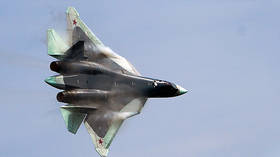
Self-flying fighter jets? Russian aerospace giants MiG & Sukhoi discuss UNMANNED 6th generation fighter jet project


Self-flying fighter jets? Russian aerospace giants MiG & Sukhoi discuss UNMANNED 6th generation fighter jet project
Russia's most famous aircraft manufacturers, MiG and Sukhoi, are discussing the possibility of cooperating to develop the country's sixth-generation jet fighter. The fifth-generation Sukhoi is due to be delivered this year.
Anatoly Serdyukov, the industrial director of the Rostec aviation complex, told Moscow business daily RBK that everything is under discussion, refusing to rule out a collaboration of the industry heavyweights.
"Perhaps it will be so, a fighter produced by MiG - Sukhoi," he said. "But while everything is at the discussion stage, it is too early to talk about the details."
In 2016, then Deputy Prime Minister Dmitry Rogozin announced that the country had already begun preliminary work on a sixth-generation fighter. At the same time, Vladimir Mikhailov, the director of Military Aviation Programs at Russia's United Aircraft Corporation, predicted that Russia's plane would be ready in 2025.
Sixth-generation jet fighters are an upgrade to the current class of aircraft, such as the US Lockheed Martin F-22 Raptor, China's Chengdu J-20, and Russia's Sukhoi Su-57. Although the aircraft are still in the concept stage, it is thought that they will have the ability to fly at hypersonic speed and be equipped with directed-energy weapons. They will also be able to enter 'near space' and have the capability to fly without a pilot.

Monday, July 27, 2020

Aerospace

Man VS Machine, Battle Of The Skies

U.S. Air Force researchers are currently in the midst of developing an autonomous aircraft, equipped with the capabilities of taking down a manned fighter jet in a battle of the skies.
Lt. Gen. Jack Shanahan, head of the Pentagon’s Joint Artificial Intelligence Center, said the Air Force Research Laboratory team is expanding the military’s horizons in the manufacture of aircrafts in comparison to the current ones.
The Air Force Research Laboratory team first began their endeavor back in 2018, hoping to display results in approximately 18 months. By first integrating machine learning technology into a less sophisticated plane such as the F-16, they can adjust whatever is needed and then pursue this into the more advanced models such as F-35 or F-22.

Friday, July 17, 2020

Aerospace

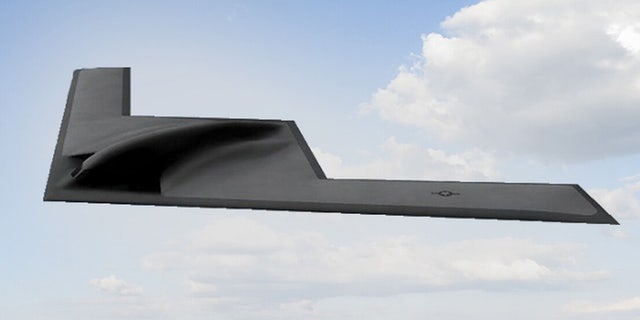
Can Russia's new stealth bomber rival the Air Force B-21?

The B-21 Raider - artist's impression.Russia has reportedly begun construction of its next-generation PAK DA stealth bomber as part of an apparent strategic effort to usher in a new era of stealth bombing technology. Moscow hopes to get ahead of the U.S. Air Force’s emerging B-21 stealth bomber and China’s H-20 strategic bomber.
Citing Russian News Agency TASS Military Watch Magazine reports that the first prototype is expected to be finished by the end of next year. Later, more prototypes are slated to be ready for testing by April 2023, something which puts the bomber’s production schedule on roughly the same anticipated timeframe as the U.S. B-21.
Interestingly, its configuration seems to parallel elements of the U.S. B-2 and emerging B-21 bombers, with some key differences. Of course, its horizontal blended wing-body shape is to be expected for these kinds of stealthy platforms, yet available renderings of the PAK DA show rectangular-shaped inlets aligned with or somewhat parallel to the top of the fuselage.

Tuesday, July 14, 2020

Aerospace

Boeing lands the first order of the F-15EX


The F-15EX will be a two-seat jet with fly-by-wire controls, the new Eagle Passive Active Warning Survivability System electronic warfare system, an advanced cockpit, and new mission systems. But according to the Air Force, the most significant upgrade comes in the form of an open mission systems architecture that will allow the service to more rapidly update the F-15′s software.
Another major advantage of purchasing additional F-15s is the aircraft’s payload capacity, which will allow it to carry and launch hypersonic missiles at standoff distances.
“The F-15EX is the most advanced version of the F-15 ever built, due in large part to its digital backbone,” said Lori Schneider, Boeing F-15EX program manager. “Its unmatched range, price and best-in-class payload capacity make the F-15EX an attractive choice for the U.S. Air Force.”
Monday’s announcement follows a firm, fixed-price contract worth up to $101 million that was awarded to General Electric in late June for the first lot of F-15EX engines. Under the contract, GE will provide “F110-GE-129 engines, including installs and spares, and modernized engine monitoring system computers,” the department stated.

Saturday, July 4, 2020

Aerospace

Finland’s Air Force Confirms Dropping Swastika From Emblem


Image
Finland’s Air Force Command has confirmed that it removed pre-Nazi era swastikas from its emblem back in 2017, though they still feature in some decorations and flags.
“It was considered impractical to continue using the old Air Force Command unit emblem (a swastika and a pair of wings), which had caused misunderstandings from time to time, especially abroad,” a spokesperson told Bloomberg on Friday in emailed response to questions.
The decision to remove the swastika had largely gone unnoticed until it was spotted by Teivo Teivainen, a professor of world politics at the University of Helsinki.

...A blue version of the thousands-years-old geometrical figure was first used by the Finnish air force in 1918, when Swedish Count Eric von Rosen used it on a plane that was gifted to the nascent force. It remained on display on Finland’s military aircraft until 1945.
“Having been von Rosen’s symbol and the first national insignia of Finnish military aircraft, a swastika remains a part of Air Force unit flags” and “some Air Force decorations,” the spokesperson said.

Sunday, June 28, 2020

Aerospace

The U.S. Navy Is Making Plans to Replace the F-35 Stealth Fighter


The U.S. Navy is currently analyzing airframes, targeting systems, artificial-intelligence-enabled sensors, new weapons and engine technologies to engineer a new sixth-generation carrier-launched fighter jet to fly alongside the F-35 fighter jet and ultimately replace the F/A-18 aircraft.
The Navy program, known as the Next-Generation Air Dominance (NGAD), has moved beyond a purely conceptual phase and begun exploration of prototype systems and airframes as it pursues a new fighter to emerge in 2030 and beyond.
Navy officials say that several current areas of consideration include “developmental air-vehicle designs, advanced engines, propulsion, weapons, mission systems and electronic warfare.” 
Ongoing work has been weighing the advantages of leveraging nearer-term existing technologies such as new variants or upgrades to cutting edge weapons, sensors and stealth configurations—or allowing more time for leap-ahead developmental systems to emerge.

Saturday, June 6, 2020

Aerospace

The X-36 Was a Crazy Maneuverable Stealth Fighter. Why Wasn’t it Built?


In the late 1940s and early 1950s, several experimental aircraft were built that were semi-tailless. Post-World War II jet engine designs had improved, allowing for greater and greater speeds past the speed of sound, or Mach 1. Airframes of the time were struggling to get through the transonic range, from around Mach 0.8 to Mach 1. It was thought that a total or semi-tailless design would allow for greater stability when passing through the transonic range, but airplane technology and airframe designs during the 1950s were not yet sophisticated enough to safely control a tailless design.
In the 1970s and 1980s tailless designs were reexamined, as computer-controlled fly-by-wire systems could adjust a plane’s flight controls quickly enough to keep tailless airframes airborne. Tailless designs also had the added advantage of being stealthierthan their tailed cousins—sans tail, less radar is reflected back to a radar antenna. A tailless design also benefits from better range due to lower drag, and can under some circumstances be more maneuverable than traditionally-tailed planes.

Saturday, May 23, 2020

Aerospace

Stop Calling The B-52 Bomber ‘Old’ — It’s More Youthful Than A B-2 Stealth Bomber

uncaptioned
The U.S. Air Force has asked industry to pitch a new engines for the service’s 76 B-52 bombers. With new motors, the B-52s could keep flying into the 2050s.
Or longer. The youngest B-52 rolled off Boeing’s Wichita production line in 1962. But it’s not fair to call the B-52 a 59-year-old airplane. Very little of any B-52 actually dates to the 1960s. In many ways, a B-52 is “younger” than airplanes from the 1980s and ’90s.
It’s not for no reason that, in 2018, the Air Force announced it would retire its 62 ’80s-vintage B-1Bs bombers and 20 newer B-2 stealth bombers by the 2030s, while retaining the the updated B-52s alongside a fleet of at least 100 new B-21 stealth bombers.

Tuesday, May 12, 2020

Aerospace

US Special Operations arms surveillance aircraft for precision attack

Image courtesy of the U.S. ArmyU.S. Special Operations Command is arming small, maneuverable surveillance planes to offer war commanders a precision-strike option supporting ground troops in rugged terrain with Hellfire missiles and laser-guided rockets.

If overhead fire support is able to identify and attack pockets of enemy fighters, fewer ground troops have to enter into enemy fire. Also, an overhead asset of this kind can be an intelligence node able to send targeting information and data regarding troop movements. When it comes to actual close-in counterinsurgency combat, fighters often obscure themselves in defilade or in buildings, requiring a need for precision strikes. Air to ground precision weapons can use a laser rangefinder and other kinds of advanced technologies.

One plane now operating is MAG Aerospace’s MC-208 Armed Caravan, a converted surveillance aircraft already in service with SOCOM and another in production for a U.S. allied international force. The Aircraft consists of a Textron-built airframe and MAG-integrated sensors, communications, avionics and weapons systems.

Sunday, May 10, 2020

Aerospace

Russia’s mightiest military aircraft buzz over Moscow to mark 75th anniversary of Nazi defeat (PHOTO, VIDEO)


RT
Defying clouds in the sky and Covid-19 on the ground, Russia’s deadliest bombers, nimblest fighter jets and strongest transport aircraft flew over the capital in celebration of Soviet victory over Nazi Germany 75 years ago.
V-Day is one of the most important national holidays in Russia, and this year was supposed to have seen massive celebrations throughout the country. But Covid-19 and its lockdowns threw a wrench into the plans, forcing the postponement of most festivities. 
While only a handful of ceremonial troops marched across Moscow’s center this year for a wreath-laying ceremony, the air over the Russian capital was teeming with military aircraft, which were deployed in record numbers for the occasion. A total of 75 helicopters and planes – one for each year since that legendary day – flew under the cloudy sky.

Monday, May 4, 2020

Aerospace

China's supersonic stealth bomber could be ready later this year - making it the third country alongside US and Russia capable of launching nukes from land, sea or air


China's new supersonic bomber, the Xian H-20, could be ready later this year, completing the country's nuclear triad (artist's impression)
China's new supersonic stealth bomber could be ready later this year.
The feared Xian H-20, which doubles China's strike range and completes its nuclear triad, puts Australia, Japan and Korea all within range.
It would mean China would join the US and Russia is possessing a three-pronged military force that can launch nuclear missiles from air, land and sea. 
Beijing has been weighing up when to roll out the bomber amid escalating tensions due to the coronavirus pandemic.
Military sources told the South China Morning Post the bomber could make its first public appearance at this year's Zhuhai Airshow in November.
The sources said: 'The Zhuhai Airshow is expected to become a platform to promote China's image and its success in pandemic control – telling the outside world that the contagion did not have any big impacts on Chinese defence industry enterprises.' 

Thursday, April 30, 2020

Aerospace

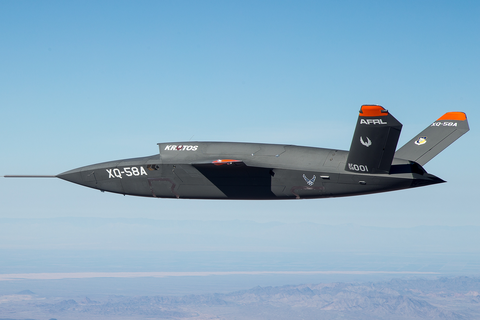
This Experimental Drone Could Change America's War Strategy


The Kratos XQ-58A Valkyrie, an unmanned and experimental combat aerial vehicle, is tough to spot on radar and could be directly linked to the F-35 through an encrypted data connection to serve as a wingman under the pilot’s control. But even with these pros, it’s the cost of the Valkyrie, not its capabilities, that could change America’s aerial warfighting strategy.

While there’s no question the U.S. boasts the largest air force in the world in terms of total military aircraft, the makeup and size of that force has shifted dramatically since the final days of World War II. At that time, the U.S. boasted some 300,000 combat aircraft. Today, the nation has only around 13,400, spread out across its various military branches.

The reason for this change is the steady progress of technology, which has dramatically increased the combat capabilities and the cost of each aircraft in service today. These parallel developments in aviation production have resulted not only in a leaner, more capable Air Force, but a change in combat strategy altogether. Gone is the World War II mindset that called for superiority through volume. On today’s battlefield, it’s technology, not numbers, that makes the biggest difference.

Sunday, February 16, 2020

Aerospace

Attention, Donald Trump: Russia’s Tu-160 Bombers Are Getting Hypersonic Ballistic Missiles


Russia’s Tu-160 strategic bombers may be armed with hypersonic ballistic missiles.
The Russian military is studying whether to arm the Tu-160 (NATO code name: Blackjack) with the Kh-47M2 Kinzhal (“dagger”), a nuclear-capable missile with an estimated range of 1,200 miles and a speed of up to Mach 10. If true, it would vastly extend the Blackjack’s target reach.
“The possibility of deploying Kinzhal missiles on Tu-160 aircraft is being considered,” said Russian news agency TASS, quoting an unidentified source in the defense industry. “The work on this option is due to be completed this year,” the source said.
TASS is a state-owned news organization, so presumably, the “leak” indicates that Russia either plans to arm the Tu-160 with hypersonic missiles—or wants the rest of the world to think so.

Sunday, February 9, 2020

Aerospace

Yes, Russia Once Had Its Own Version of the SR-71 Blackbird


It’s a cliché of the Cold War that no sooner did one superpower pioneer a new weapons technology that its rival swiftly sought its own copy, canceling out any advantage long-term. Though this frequently did occur, the Soviet Union and the West had diverging theories about precisely which platforms would most reinforce their security posture.
For example, during the 1950s and 60s, the United States invested considerably in various spy planes designed to penetrate hostile airspace such as the high-flying RB-57 and U-2, followed by the Mach 3-cruising A-12 and SR-71 Blackbirds.
However, the Soviet Union was never convinced such technically impressive penetrating strategic reconnaissance planes were a great idea. They ultimately struggled to keep up with advances in surface-to-air missile technology, and potential shoot-downs could result in embarrassing diplomatic incidents. Better to use deniable agents on the ground or orbiting satellites without risk of embarrassing Soviet leaders.
Still, brilliant Soviet engineer Pavel Tsybin came close to developing a “Soviet Blackbird”—though it, in fact, predated the A-12/Blackbird by several years and was originally conceived as a nuclear bomber.

Monday, February 3, 2020

Aerospace

Air Force Finally Releases New Images of Stealthy B-21 Future Bomber


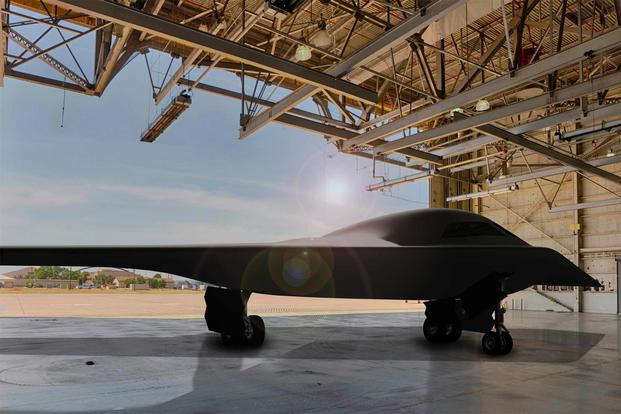
This is an artist rendering of a B-21 Raider concept in a hangar at Dyess Air Force Base, Texas. Dyess AFB is one of the bases expected to host the new airframe. (Courtesy graphic by Northrop Grumman)
New photorealistic renderings of the B-21 Long Range Strike Bomber have officially landed.
The Air Force together with the bomber's manufacturer, Northrop Grumman, published three new concepts of the next-generation bomber, showing the stealth aircraft in various hangars at bomber bases across the U.S.
One shows a concept of the B-21 tucked away in a hangar at Ellsworth Air Force Base, South Dakota, currently a B-1B Lancer base; a second shows the aircraft at Whiteman Air Force Base, Missouri, which currently houses the B-2 Spirit; and a final photo presenting the B-21 at Dyess Air Force Base, Texas, also a B-1 base.
Last year, the service announced the B-21's first operational base would be at Ellsworth and would also host the bomber's first formal training unit. Whiteman and Dyess are expected to receive B-21 Raiders "as they become available," the service said at the time.


Thursday, January 23, 2020

Aerospace

B-2 Spirit: The $2 billion flying wing

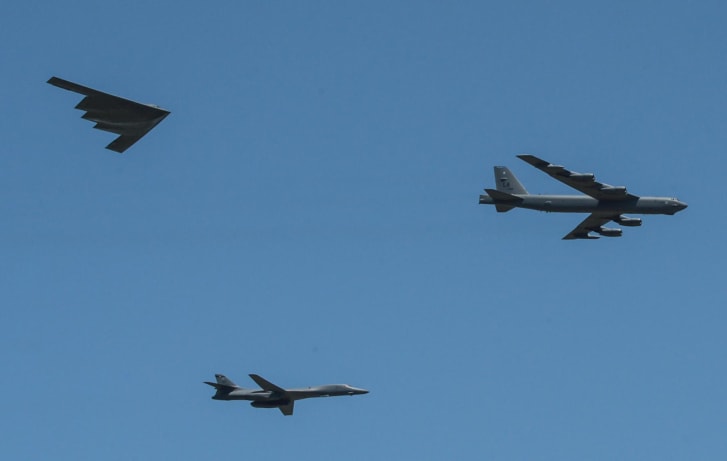
A B-1 Lancer, a B-2 Spirit and a B-52 Stratofortress perform a flyover at Barksdale Air Force Base.
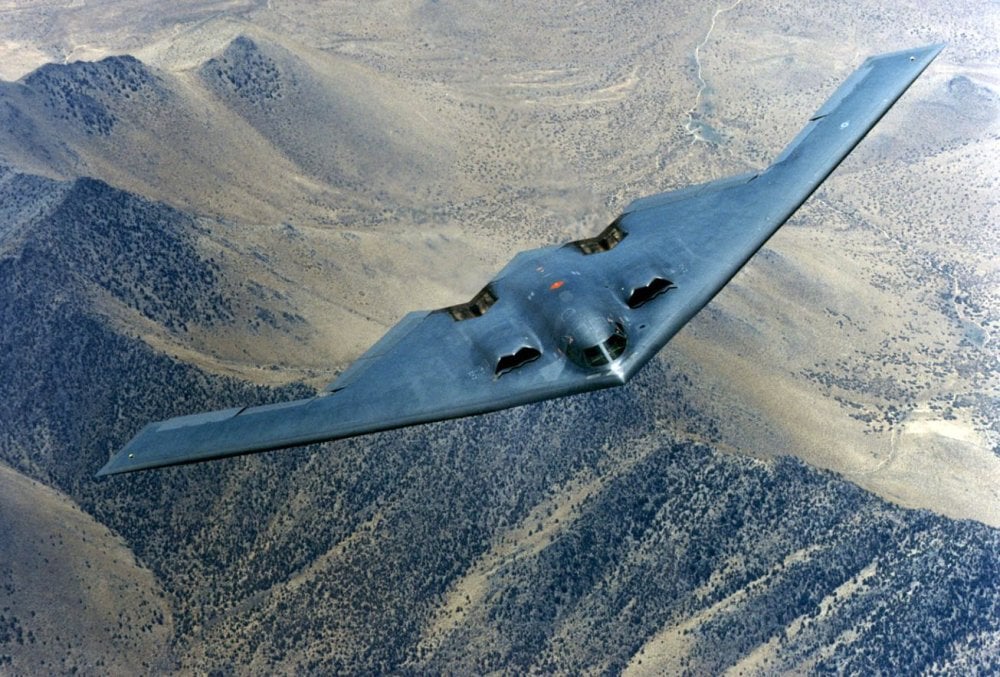
With its "flying wing" design that makes it almost invisible to radar, the B-2 Spirit bomber is truly a standout among military planes -- and also the world's most expensive, at over $2 billion per aircraft.
A product of the Cold War, it was originally designed to penetrate Soviet air defenses and carry both conventional and nuclear weapons. But shortly after its first flight, over 30 years ago in 1989, the fall of the Berlin Wall ended the Cold War and no B-2 has ever flown inside Russian airspace.
Nevertheless, it has seen its fair share of combat. The first B-2 was delivered in 1993 to Whiteman Air Force Base in Missouri, where the fleet is based and still operates, and its first operational use was during the 1999 Kosovo War.
One of the most sophisticated flying machines in existence, the B-2 can reach a target anywhere in the world and return to base, refueling in mid-air. No B-2 has ever been lost in combat.

Tuesday, January 21, 2020

Aerospace

The Air Force's New B-21 Stealth Bomber Will Be a High-Tech Doomsday Machine

On October 27, 2015, nearly thirty-four years to the day after Northrop Grumman was awarded the contract to develop the first stealth bomber, the U.S. Air Force awarded Northrop a contract for a new bomber: the B-21 Raider. While many of the details of the Raider are shrouded in mystery, we do know a few things about it, and can infer others.

The B-21 Raider bomber takes its name from both the twenty-first century and the legendary 1942 raid by Gen. James “Jimmy” Doolittle’s force of B-25 Mitchell bombers against targets in and around Tokyo, Japan. In invoking the Doolittle Raid, the Air Force is drawing attention to attack’s audacious nature, the strategic and tactical surprise, and the epic distances General Doolittle and his “raiders” flew to accomplish their mission.

A tailless, batlike aircraft, the official rendering of the B-21 Raider released by the Air Force bears a superficial resemblance to the B-2 Spirit bomber. There are important distinctions, however. The B-21 moves its engines closer to the wing root, where they occupy the juncture between wing and fuselage, whereas the B-2’s twin pairs of General Electric F118-GE-100 engines are distinctly apart from the fuselage on the wing. The Raider’s engine air intakes are angled and not serrated like those on the B-2 Spirit.
Aerospace

The B-52 Will No Longer Carry Certain Nuclear Weapons. Here's Why


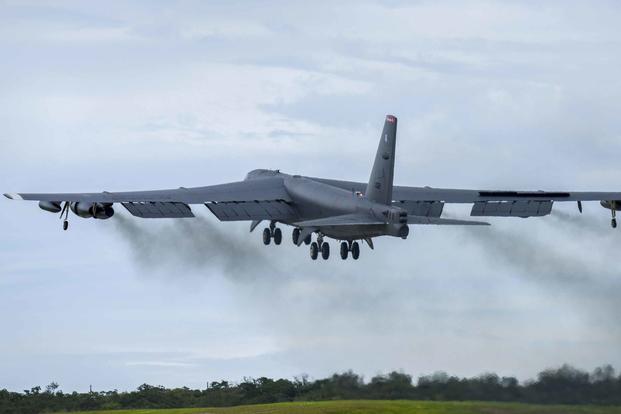
A B-52 Stratofortress in Guam.
The B-52 Stratofortress will no longer carry the B61-7 and B83-1 nuclear gravity bombs as it prepares to carry the new long-range standoff weapon, known as LRSO.
Following reports that the bomb variants had been removed from the Cold War-era aircraft's inventory, officials at Air Force Global Strike Command confirmed the move is in line with the bomber's transition into an era of modern warfare.
"As the nature of modern warfare has changed, so have our tactics and weapons," a command spokesperson said in an email Thursday. "The B-52 remains an instrument of national security and a universally recognized symbol of American airpower, able to deliver the widest variety of stand-off and direct-attack nuclear and conventional weapons for the nation."
"As a multi-role platform, the B-52 offers diverse capabilities including delivery of the most advanced precision-guided weapons. The Air Launched Cruise Missile (ALCM) continues to be our main nuclear deterrent.