Страницы

Showing posts with label International cooperation. Show all posts

Saturday, May 16, 2020

International cooperation

NASA’s ‘Artemis Accords’ set forth new and old rules for outer space cooperation


nasa-artemis-astronauts
NASA’s  plan to return to the Moon is ambitious enough on its own, but the agency is aiming to modernize international cooperation in space in the process. Today it published a summary of the “Artemis Accords,” a new set of voluntary guidelines that partner nations and organizations are invited to join to advance the cause of exploration and industry globally.
Having no national affiliation or sovereignty of its own, space is by definition lawless. So these are not so much space laws as shared priorities given reasonably solid form. Many nations already take part in a variety of agreements and treaties, but the progress of space exploration (and soon, colonization and mining, among other things) has outpaced much of that structure. A fresh coat of paint is overdue and NASA has decided to take up the brush.

Thursday, April 30, 2020

International cooperation


Mexico’s Initiative to Ensure Global Access to Medicines, Vaccines and Medical Equipment to Face COVID19

Un, United Nations, Organization Of The United NationsOn March 26, the G-20 held a virtual summit focusing on the COVID-19 pandemic. In that meeting, the President of Mexico Andrés Manuel López Obrador made three concrete proposals, the first of which was the intervention of the United Nations to ensure that all countries have equal access to medicines and medical equipment which, because of the ongoing pandemic, are being hoarded by those States with an economic advantage. He also indicated that the U.N. should intervene to avoid economic speculation regarding the purchase and acquisition of medicines and medical equipment. A few weeks later, on Monday April 20, this Mexican proposal, endorsed by 179 countries as co-sponsors, would be adopted by consensus as General Assembly resolution 74/274, entitled “International cooperation to ensure global access to medicines, vaccines and medical equipment to face COVID-19.”

Friday, February 7, 2020

International cooperation

Iraq considers deepening military ties with Russia


Iraq and Russia discussed prospects for deepening military coordination, Iraq’s Defense Ministry said Thursday, amid a strain in Baghdad-Washington relations after a U.S. airstrike killed a top Iranian general inside Iraq.
The ministry statement followed a meeting in Baghdad between Iraqi army chief of staff Lt. Gen. Othman Al-Ghanimi and Russian Ambassador Maksim Maksimov, as well as a newly arrived defense attache.
The meeting comes during an uncertain moment in the future of Iraq-U.S. military relations, following the Jan. 3 U.S. drone strike that killed Iran’s most powerful military commander, Gen. Qassem Soleimani, and Iraqi senior militia leader Abu Mahdi al-Muhandis near Baghdad airport. The attack prompted powerful Shiite parties to call for an overhaul of the existing strategic set-up between Iraq and the U.S.-led coalition.

Wednesday, January 1, 2020

International cooperation

Rachel Marsden: Russia and America should become permanent partners in fighting terrorism


Russian President Vladimir Putin called U.S. President Donald Trump on Sunday to thank him for America’s help in saving Russian lives. And it’s not the first time.
In both instances, two years apart, U.S. intelligence services provided their Russian counterparts with information that thwarted holiday terror plots targeting civilians in Russia’s cultural mecca, St. Petersburg. Earlier, Russia had warned the U.S. about the danger posed by the Tsarnaevs, the Chechen brothers who perpetrated the Boston Marathon bombings (though American officials didn’t act in time).
Russia is a target for the Islamic State, given its role in fighting the terrorist group in Syria and the sympathies for ISIS in the Russian republic of Chechnya. At his annual press conference just before Christmas, Putin noted that Russian natives account for the second-largest number of Islamic State fighters imprisoned in Syria.
It’s not hard to imagine what a terrorist attack in Moscow would look like. When I was Christmas-shopping in the giant Evropeyskiy Mall recently, the FSB federal security service and Russian police executed a counterterror operation in the building, rounding up five terror suspects.

Saturday, November 9, 2019

International cooperation

Putin Is Swayed By China As New ‘Technological War’ Intensifies

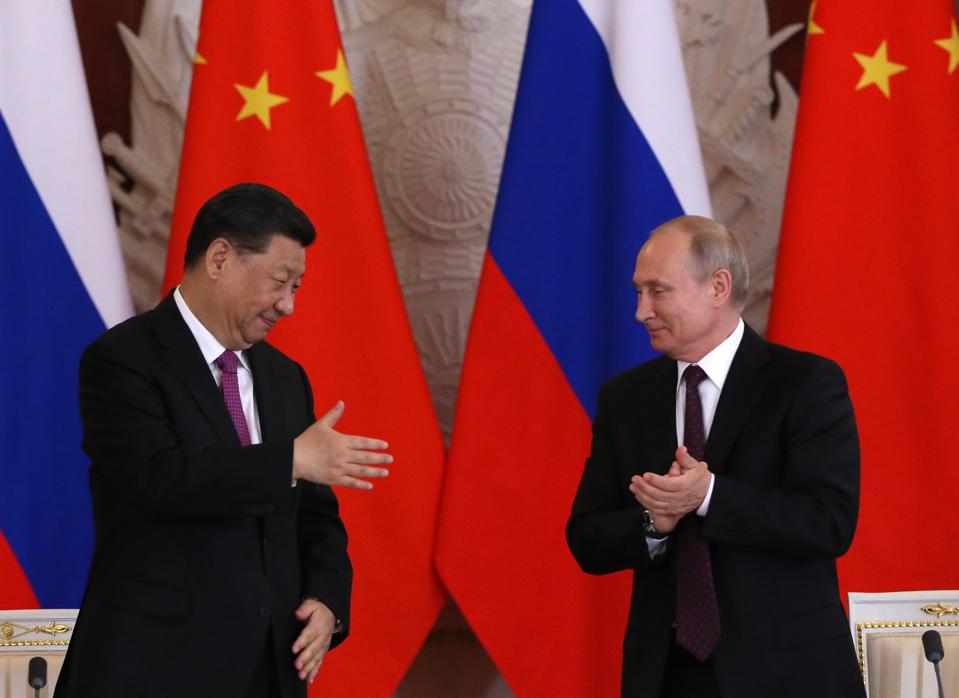
Russian President Vladimir Putin receives Chinese President Xi Jinping at the KremlinIn June, Putin met China's President Xi Jinping at the St Petersburg International Economic Forum to cement the strengthening “strategic relationship” between the two countries that represent the greatest threat to the U.S. and its allies. The leaders signed a joint statement announcing that “the China-Russian relationship has entered a new era, and is facing new opportunities for greater development.” According to China’s state media, “the objective of such a new kind of partnership is for both sides to give more support to each other as they seek to take their own development paths, preserve respective core interests, and protect sovereignty and territorial integrity.”
Putin used the event to take aim at Washington’s clampdown on China’s tech giants, specifically Huawei, but it could as easily have been Hikvision or Dahua, SenseTime, Yitu or Megvii. He said of Trump’s campaign against Huawei that “in some circles, it is even called the first technological war of the coming digital era.” And it was clear where Russia was positioned in that technological war. Huawei and other giants such as Tencent and Alibaba are investing heavily in the country. Huawei is the leading smartphone supplier to the country, with almost the same market share as in China, and the company is helping to deploy new 5G networks.

Thursday, November 7, 2019

International cooperation

India, Russia agree to further expand bilateral defence co-operation

New Delhi and Moscow have agreed to imminently upgrade after-sales service facilities for Russian materiel in service with the Indian military and advance an intergovernmental agreement (IGA) on reciprocal logistics support between the two countries' militaries.

During a 6 November meeting of the 19th India-Russia Inter-Governmental Commission on Military and Military Technical Cooperation (IRIGC-M&MTC) in Moscow, the two sides also agreed to allow India's state-owned Ordnance Factory Board (OFB) to imminently start licence-building 750,000 Kalashnikov AK-203 7.62 mm assault rifles.

The Indo-Russian Rifles Private Limited joint venture, which was formed in March to manufacture the rifles, has been awaiting a formal agreement before starting production at the OFB unit in Korwa, about 680 km southeast of New Delhi.

Monday, November 4, 2019

International cooperation

Putin’s Top Spy: We’re Teaming Up With D.C. on Cybersecurity

Following a recent conference of foreign security and law enforcement agencies, the head of Russia’s State Security Service, the FSB, made the surprising announcement that Russia and the United States have resumed cooperation on cybersecurity.

“We are maintaining working contacts by our experts and special unit heads with the Central Intelligence Agency, the Federal Bureau of Investigation and the Drug Enforcement Agency,” said Gen. Alexander Bortnikov, noting that such contacts should always occur, regardless of the foreign policy situation.

Behind-the-scenes cooperation with the Trump administration, particularly when it comes to cybercrime and terrorism, is a theme the Kremlin likes to push onto center stage every so often. And according to our sources there is indeed some consultation at a practical level, but for Washington’s intelligence professionals it’s a very delicate, very dangerous game, complicated enormously by the inclinations and prejudices of President Donald J. Trump.

In response to queries about Bortnikov’s statement, spokespersons for both the CIA and the DEA told The Daily Beast that they had no comment, and the FBI has not responded at all.

Friday, October 18, 2019

International cooperation

French, German leaders provide fresh top cover for new warplane, tank projects


German and French officials emerged from a meeting in Toulouse, France, this week with fresh promises that a next-generation aircraft program and new European battle tank spearheaded by the two countries would advance soon.
The summit declaration follows repeated reports that both projects are at risk of failure due to political and industry-related differences. In the case of the Future Combat Air System — a next-generation fighter jet with sidekick drones — Berlin and Paris have long been at odds about the exportability of the future weapon, with Germany favoring a more restrictive stance than France. Airbus and Dassault are the two main industry players in FCAS.
The Main Ground Combat System — the two countries’ idea for a European tank ready for action in the late 2030s — had been caught up in a maneuver by German manufacturer Rheinmetall to take over the Franco-German industry team of Nexter and Krauss-Maffei Wegmann, called KNDS. According to a report in Germany’s newspaper Frankfurter Allgemeine Zeitung, officials recently came to an agreement in which Rheinmetall would become a subcontractor in the project, receiving 25 percent of the work share, with Nexter getting 50 percent and KMW getting 25 percent.

Thursday, October 17, 2019

International cooperation

US provided information on terrorist plotters in Russia, says FSB chief

Washington provided Moscow with information on a number of individuals who plotted to commit terrorism-related crimes in Russia, Director of Russia’s Federal Security Service (FSB) Alexander Bortnikov told a press briefing after the 18th session of the heads of intelligence, security and law enforcement agencies that are partnering with the FSB.
"Not so long ago, the Americans tipped us off about certain individuals and their plans to carry out terrorist attacks in our country," he said, when speaking about cooperation with the United States. Bortnikov declined to specify when Russia had received the information from the US but pointed out that it hadn’t been the first time that such information had been provided.
In 2017, the US helped in the investigation of a plot to carry out a terrorist attack in the Kazan Cathedral in Russia’s St. Petersburg, while Moscow assisted in investigating the Boston Marathon blasts. According to Bortnikov, Russia maintains counterterrorism cooperation with other countries’ intelligence agencies as well. "We continue activities in this area, engaging intelligence agencies of the Commonwealth [of Independent States], European and Middle East countries," he emphasized.

Saturday, October 5, 2019

International cooperation

China, Russia Deepen Technological Ties

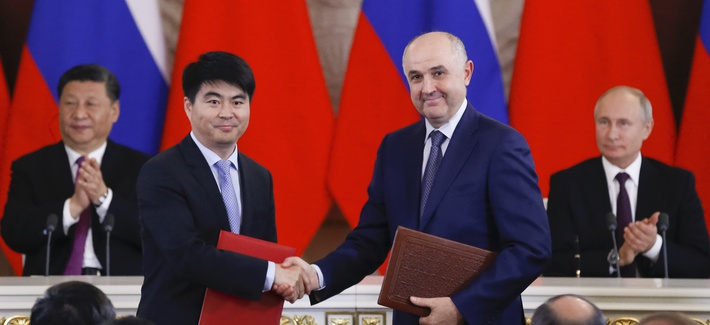
Deputy Chairman of Huawei Guo Ping shakes hands with Alexei Kornya, president of Russia's MTS mobile network operator, at the Kremlin in Moscow on June 5, 2019, as Russian President Vladimir Putin and Chinese President Xi Jinping look on.
China and Russia are deepening and expanding their ties — economic, military, technological — as external pressures limit their access to overseas markets and technology. Both countries hope the collaboration will help to compensate for domestic deficiencies and to compete successfully with the United States in today’s critical technologies.

This bilateral relationship, currently celebrating its 70th anniversary, has ebbed and flowed in the decades since the Soviet Union and the People’s Republic of China opened diplomatic relations. This relationship, now upgraded to and characterized as a “comprehensive strategic partnership of coordination for a new era,” is continuing to evolve amid today’s great power rivalry.

For Moscow, certain Chinese products, services and experience may be the lifeline for its industry, government, and military need to wean themselves from high-tech Western imports.

For Beijing, Russia’s skilled engineers and mathematicians are a valuable resource for tech and defense industry giants that are hungry for talent and faced with increasingly unfavorable conditions in the United States and Europe. And its military hopes to draw on Russian proficiency in designing advanced weapons and experience using emerging capabilities on today’s battlefields.

Monday, April 29, 2019

International cooperation

Russia, Turkey jointly developing aircraft and helicopters

Russia and Turkey are jointly working on creating promising aircraft and helicopters, and also components for the armor, the press office of Russia’s state arms seller Rosoboronexport (part of the state hi-tech corporation Rostec) reported on Monday.
"We have a number of joint projects for developing promising aircraft and rotorcraft platforms, components for the armor and the after-sale maintenance of the armaments supplied," the press office quoted Rosoboronexport CEO Alexander Mikheyev as saying.

Turkey also shows interest in the newest Russian combat modules, air defense systems with different range capabilities and anti-tank weapons. Despite the rivals’ interference in the bilateral relations, Russia and Turkey are coping with the difficulties that arise, the chief executive stressed.
"At present, we are discussing with the Turkish partners the implementation of some most important projects in the sphere of military and technical cooperation and in the civilian industry… We are undoubtedly ready for various formats of technological cooperation, including in such science-intensive spheres as the aerospace industry,

Tuesday, April 9, 2019

International cooperation

UK, Dutch spy agencies curb intel flow to Austria over Russia ties: MP

Картинки по запросу Freedom Party (FPO)
British and Dutch spy agencies have heavily restricted the amount of intelligence they share with Austria, mainly because of ties between the ruling far-right Freedom Party and Russia, an Austrian opposition lawmaker said on Tuesday.

The Freedom Party (FPO) is the junior coalition partner to Chancellor Sebastian Kurz’s conservatives but it controls much of the country’s security apparatus. Its ministers head the Defence Ministry and the Interior Ministry, which in turn oversees Austria’s main intelligence agency, the BVT.

Ties between the FPO and President Vladimir Putin’s United Russia party, including a formal cooperation agreement, have long been of concern to Western security services, many of which see Russia as a dangerous adversary.

“Individual Western intelligence agencies are rejecting cooperation with the BVT,” left-wing lawmaker Peter Pilz, who has been strongly critical of FPO Interior Minister Herbert Kickl, told Reuters.

Thursday, April 4, 2019

International cooperation

Lithuania is first Baltic nation to sign U.S. defense-cooperation pact

 The United States and Lithuania have signed a defense-cooperation agreement aimed at beefing up bilateral training and information sharing against the backdrop of a resurgent Russia.
Kathryn Wheelbarger, the U.S. acting assistant secretary of defense for international security affairs, and Robertas Sampronas, the Lithuanian defense ministry's policy director, signed the pact on Tuesday, the Pentagon announced.
The “road map” describes five broad policy objectives for the two countries between 2019 and 2024: strengthening cooperation in training, exercises and exchanges; deterrence in the Baltic Sea region, including improved maritime domain awareness; intelligence sharing; cooperation in multinational operations; and cyber defense.
The plan to sign defense-cooperation agreements with the three Baltic states stems from the U.S.-Baltic Strategic Dialogue in November 2018. Estonia and Latvia are working with Pentagon officials to sign similar agreements.

Sunday, March 24, 2019

International cooperation

Italy joins China's New Silk Road project


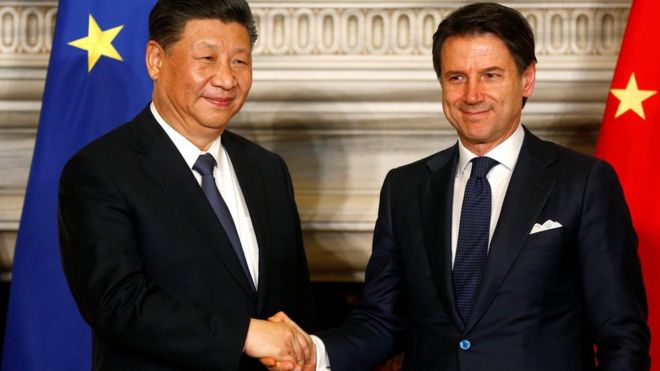
Italian Prime Minister Giuseppe Conte and Chinese President Xi Jinping shake hands after signing trade agreements at Villa Madama in Rome,
Italy has become the first developed economy to sign up to China's global investment programme which has raised concerns among Italy's Western allies.
A total of 29 deals amounting to €2.5bn ($2.8bn) were signed during Chinese President Xi Jinping's visit to Rome.
The project is seen as a new Silk Road which, just like the ancient trade route, aims to link China to Europe.
Italy's European Union allies and the United States have expressed concern at China's growing influence.

What is the Chinese project about?

The new Silk Road has another name - the Belt and Road Initiative (BRI) - and it involves a wave of Chinese funding for major infrastructure projects around the world, in a bid to speed Chinese goods to markets further afield. Critics see it as also representing a bold bid for geo-political and strategic influence.

Thursday, March 21, 2019

International cooperation

Russian influence in UK is bad… except for the $11bn Russian investors have poured into the economy


Global investors like Russia even if Western governments don’t
As British politicians and journalists continue to see Russia’s nefarious hand around every corner and warn daily of the dangers of Russian influence in the UK, there is one thing about Russia that they still seem to like: money.
Russian President Vladimir Putin met with a group of UK business leaders at the Kremlin on Wednesday to review British investments in Russia as well as Russian investments in Britain – and to discuss potential future cooperation.
Putin noted that accumulated British investments in the Russian economy amount to 23.8 percent, while Russian investors have poured more than $11 billion into the British economy. Curiously, Russian ‘influence’ of the financial variety is still more than welcome in Britain, despite tensions between the two countries.
British businesses are welcome to participate in the implementation of new national projects across Russia, too, Putin said. Hundreds of billions of dollars will be invested in the redevelopment of the most important sections of the economy and social sphere, he said, providing great opportunities for growth.
“I am sure that your [British] companies could participate in this work, the market is big enough,” he told the businessmen, who didn’t seem too disappointed by the prospect.
Perhaps some intrepid reporters at the BBC or Guardian could look into the Kremlin’s offer, in case it’s some kind of scary Russian influence plot – just to be on the safe side.

Sunday, August 5, 2018

International cooperation

“Seven Capital Vices” of China in Africa: How Capital Are They Really?


Xi Jinping 732c0The recent tenth BRICS Summit in Johannesburg and the forthcoming China-Africa Cooperation Summit in Beijing bring the Chinese-African relations to the center of political and academic discussions.  The Chinese advance in Africa since the turn of the century have been spectacular: from a relatively low key player, Beijing has grown into the largest trading partner and into one of the main sources of FDI for African countries, by far surpassing highly volatile US investments.  This trend is hardly surprising – the booming Chinese economy needs more and more energy and raw materials, it is aggressively cultivating foreign markets to sustain its export-led industries. With significant excess capacities, Chinese financial institutions are relentlessly exploring new opportunities to park their huge currency reserves. So, why not Africa? However, the Chinese role in the continent – like any Chinese step beyond its borders – is subject to a scrutiny by foreign politicians and experts, who are not always unbiased and fair to Beijing. Let us go through a standard list of “seven capital vices” or “seven deadly sins”, which they in the West routinely attribute to the Chinese posture in Africa.

Friday, July 13, 2018

International cooperation

Spy chiefs from Russia, China, Iran and Pakistan hold high-level meeting


Sergei NaryshkinIntelligence directors from Russia, China, Iran and Pakistan met on Tuesday to discuss regional cooperation with particular reference to combating the Islamic State in Afghanistan. Information about the high-level meeting was revealed yesterday by Sergei Ivanov, media spokesman for the Russian Foreign Intelligence Service (SVR). Ivanov told Russia’s state-owned TASS news agency that the meeting was held in Pakistan and included the participation of SVR director Sergei Naryshkin. TASS reported that the meeting was held under the auspices of Pakistan’s powerful Inter-Services Intelligence (ISI) Directorate and was attended by “senior intelligence officials” from Pakistan, Russia, Iran and China.
Ivanov said that discussions during the meeting “focused on the dangers arising from a buildup of the Islamic State on the Afghan territory”. The Islamic State announced the formation of its Afghan province (wilayah in Arabic) in January 2015, using the term “Khorasan Province”. By July 2016, two of its most prominent leaders had been killed in coordinated drone strikes by the United States, but the group continues to launch operations to this day. Its core is thought to be made up of nearly 100 fighters from the Islamic State’s former strongholds in Syria and Iraq. According to Russian reports, security officials in China, Russia, Pakistan and Iran are concerned that the Islamic State’s Afghan command is becoming stronger as fighters from the group are leaving the Middle East and moving to Afghanistan.

Tuesday, July 3, 2018

International cooperation

CHINA MILITARY TELLS RUSSIA THEY WILL ‘JOINTLY DEAL WITH THREATS AND CHALLENGES’ AS TENSIONS WITH U.S. RISE


China's defense minister has pledged his country's support to the Russian army in the latest in a series of high-level contacts between the top U.S. military rivals.
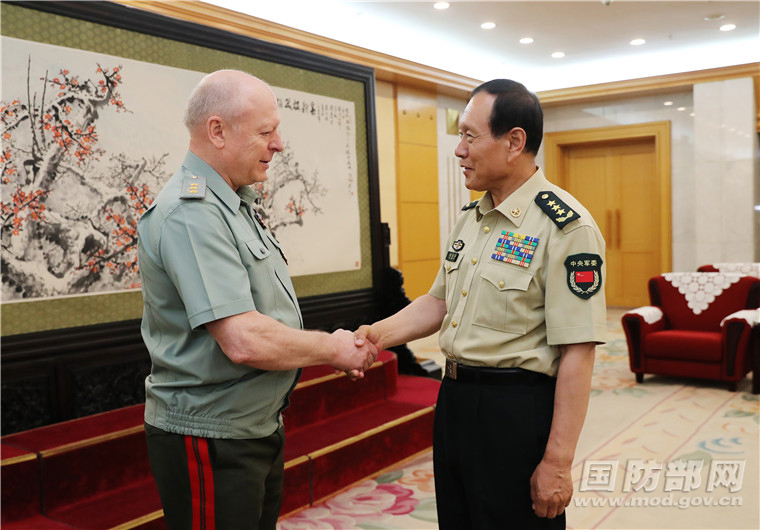
Chinese State Councilor and Defense Minister General Wei Fenghe met Tuesday with Russian Ground Forces Commander-in-Chief Colonel General Oleg Salyukov in Beijing. The meeting came less than a month after Russian President Vladimir Putin met his Chinese counterpart Xi Jinping in the capital city and Fenghe emphasized that the military leaders "expand and deepen cooperation in all areas, and push for greater development of China-Russia relations on a higher level in the new era," according to a statement by the official China Military Online.
"Gen. Wei noted that under the care and guidance of the heads of state of both countries, the friendly cooperation between Chinese and Russian militaries has maintained a sound momentum of high-level development, and the two armies have yielded great results in such fields as personnel training, joint training and exercises, and military competitions," the statement read.
"He expressed the hope that the two sides would firmly support each other, strengthen all-round cooperation, jointly deal with threats and challenges, and safeguard regional and world peace and stability," it added.

Saturday, June 9, 2018

International cooperation

EU, Russia Need Joint Security System to Keep 'Islamic Extremism at Bay' - AfD

Armed police is seen on patrol as police and airport's own security personnel have increased patrols at Copenhagen Airport, Denmark March 22 2016
Europe and Russia can start cooperation by addressing common security challenges, in particular, by creating a joint structure of counterterrorism organizations to address the global threat of extremism, Gerold Otten, a member of the German Bundestag's defense committee from the Alternative for Germany party (AfD), told Sputnik on Friday.
"The first issue which comes to mind is keeping Islamic extremism at bay. This threat is common to both the European Union and Russia… One possible step in the direction of cooperation could be the establishment of a joint structure of anti-terrorist organizations, in order to combat extremism and crime," Otten suggested.
He added that Russia and the European Union did have a platform for tackling security threats jointly —the Organization for Security and Co-operation in Europe. However, Otten found the frequency of the OSCE meetings insufficient to provide an appropriate response to he modern crises.

Tuesday, May 29, 2018

International cooperation

What the CIA and Britain's MI6/SIS should learn from each other
ciaLike any major organization, a spy service must constantly endeavor to improve. But unlike most other industries, learning from competitors is not that easy in the spy business. After all, organizational methodology and operational tactics are some of an intelligence service’s most closely guarded secrets.
But there are two human-intelligence focused spy agencies can learn from each other: the CIA and its British equivalent agency, the Secret Intelligence Service. With many shared interests, these two services work together to define the special relationship between the two countries. Only the NSA and its British equivalent, GCHQ work more closely together. Thanks to that trust, the two services have the ability to scrutinize each other for their own improvement.
For a start, the SIS could learn from the CIA’s recent focus on expanding its workforce diversity. While the SIS is focusing more on the espionage benefits of this diversity, it should copy the CIA and appoint a diversity-lead who has open-door access to the SIS chief Alex Younger. Doing so would emphasize diversity not just as an institutional priority but as a mission necessity.