Страницы

Showing posts with label Geoengineering. Show all posts

Saturday, July 25, 2020

Geoengineering

Harvard Profs Plan Geoengineering Experiment, Igniting Ethics Debate


Mt. Pinatubo eruptionWhen Mount Pinatubo erupted in June of 1991, it shot 20 million tons of sulfur dioxide 22 miles into the atmosphere. As the gas spread around the world, it cooled the Earth by about half a degree Celsius. Now two Harvard professors say they are planning to inject calcium carbonate dust into the air over Arizona to see what effect it has on the amount of solar radiation reaching the Earth below. The dust “would reflect away a little bit of sunlight, just the way a very thin cloud reflects away a little bit of sunlight … to offset some of the warming that comes from the slow buildup of carbon dioxide from our industrial activity, David Keith, a professor of applied physics at Harvard, tells WBUR.


Thursday, December 12, 2019

Geoengineering

Geoengineering is no climate fix. But calling it a moral hazard could be counterproductive


sunrise over clouds
Desperate times call for desperate measures. In recent years and in the face of unprecedented changes in the climate system, some previously unknown and risky solutions have been proposed to put a halt to the chain of climate disasters, or at least to slow down the speed of their onslaught. These methods, lumped under the heading of geoengineering, aim to reduce the impact of greenhouse gases on global temperatures, and thus on sea-level rise.
Many experts are already worried that public discussion of geoengineering might dissuade policy makers from making harder but more substantial choices to reduce greenhouse gas emissions. This is commonly called the “moral hazard” problem, and it has become a major argument against even pursuing further research into geoengineering technologies. However, we should be cautious about applying the moral hazard framework to geoengineering, because it may actually elevate it to a standing it shouldn’t have and distract us from discussing more fundamental ethical problems associated with it.

Saturday, December 7, 2019

Geoengineering


Turns Out a Wild Geoengineering Plan to Refreeze Arctic Sea Ice Isn't the Best Idea

Картинки по запросу arcticAs the world spins closer to climate catastrophe, fringe ideas are inching toward the mainstream. Geoengineering is among the topics that were once verboten but are now finding traction. And that includes some pretty out-there ideas, including ones focused on saving polar ice by pumping massive amounts of seawater onto the surface of ice, where it will refreeze quicker and strengthen all icepack against melting.
The refreezing idea has been proposed for both poles and would be massively expensive. But a new study shows that, in the Arctic, saving sea ice would do little to slow the climate crisis elsewhere. And it would unleash shocking and unintended consequences in the Arctic itself.
The paper, published in Earth’s Futures on Thursday, takes its inspiration from a previous study that first raised the prospect of an Arctic geoengineering project. That study outlined a proposal to install wind turbines across the Arctic that would power pumps to draw water to the surface of the remaining sea ice, where it would refreeze more quickly than from the bottom-up.
Illustration for article titled Turns Out a Wild Geoengineering Plan to Refreeze Arctic Sea Ice Isnt the Best Idea

Saturday, September 7, 2019

Geoengineering

Build a Wall? A Wild Geoengineering Idea to Save the Glaciers

glacier geoengineering environment
...Faced with this grim, slow-moving catastrophe, some scientists are questioning whether we might consider radical action to save the Antarctic glaciers: a kind of targeted geoengineering that might slow down or even prevent this ice sheet from melting, buying time for humanity to adapt its coastal settlements to a world with a few meters of sea level rise.

One way you might seek to do this is fairly intuitive: build a wall, a large underwater barrier that prevents warm water from melting and undermining the base of the glacier. In simulations conducted by Dr Mike Wolovick and Professor John Moore, building such a barrier was able to preserve the Thwaites glacier even after the marine ice sheet instability had been triggered and the glacier had begun to collapse. Even smaller interventions, such as providing a sill or a few isolated “pinning points” of rock for the glacier to reground itself on, had a 30 percent chance of saving the glacier once the marine ice sheet instability had already begun.

Of course, it’s comparatively easy to simulate what might happen if you built a gigantic wall across the mouth of a glacier; the actual engineering project is a much more difficult undertaking. Antarctica is not an ideal environment for large-scale building projects, although research stations on the desert continent are increasingly impressive. Blocking water flow to the Thwaites glacier could require a wall 120km long, with a depth of 600 meters: by comparison, the One World Trade Center building is 540m tall, and Hadrian’s Wall between Scotland and England is around 120km long. If such a glacier stabilization project were ever pursued, it would easily be the largest engineering project humans have ever conducted.

Thursday, May 9, 2019

Geoengineering

Is solar geoengineering crazy, or just crazy enough to work?


The UN Environment Assembly recently considered a proposal to research solar geoengineering, as it’s known, an outlandish scheme to cool the Earth by blanketing the heavens with aerosols –chemicals that would reflect a small measure of sunlight back into space, lowering the average global temperature. The measure failed, not because countries were wary of investigating geoengineering, but because some, like the United States, feared the plan would unduly limit research.

This dispute isn’t confined to diplomatic meetings. Scientists, ethicists and members of the public are wrestling with the full implications of solar geoengineering, and many are embracing the idea. At a recent debate at Hunter College in New York City, four leading intellectuals sparred over whether scientists should do more to investigate the potential benefits and dangers of solar geoengineering. At the start of the night, Intelligence Squared U.S., which organized the debate, asked how many in the audience thought researching this was a crazy idea. More than 6o% agreed that it was. At the end of the night, just 25% said so.

Tuesday, April 23, 2019

Geoengineering

Geoengineering is risky and unproven, but soon it might be necessary


Algae bloom, Geoengineering using Ocean FertilizationChanging the complex system that is our planet sounds difficult. That much is clear. However, the good news — if melting ice-caps and increasing numbers of freak weather events can ever be considered “good” — is that we know it can be done. We’ve done it before. The industrialization which led to our current level of climate change was a form of geoengineering, albeit an unintentional one.
Fortunately, today’s geoengineering proposals aren’t quite as apocalyptic as Harry Wexler’s meteorological bombing campaign. Broadly speaking, they fall into one of two camps. The first is what is known as Solar Radiation Management (SRM) or solar geoengineering: Reflect some of the Sun’s energy back into space, thereby offsetting the temperature rise caused by the increased levels of greenhouse gases in the atmosphere.
Two of the leading suggestions for carrying out solar geoengineering involve space reflectors for blocking some sunlight before it reaches Earth, or using stratospheric aerosols containing small, reflective particles to bounce sunlight from the upper atmosphere.
In the other corner is what is termed Greenhouse Gas Removal (GGR) or carbon geoengineering. This seeks to remove carbon-dioxide and other greenhouse gases from the atmosphere by sucking it out of the air. This could be achieved (among other potential methods) through massive tree-planting efforts, adding nutrients to the ocean to draw carbon-dioxide from the atmosphere, or building large machines which remove carbon-dioxide from ambient air and store it.

Sunday, April 7, 2019

Geoengineering

7 Geoengineering Solutions That Might Cause More Damage Than Good


7 Geoengineering Solutions That Might Cause More Damage Than Good
Today we celebrate World Geology Day and nothing makes more sense than to stop for a few minutes and reflect on some good old geoengineering solutions that we have devised for the betterment of humanity. How good are these solutions?
Can they do more harm than good in the long run? Today, we will check out the top 7 geoengineering solutions that might be primed for a failure! But first, let us answer a few vital questions!
Geoengineering, in simple terms, can be defined as the manipulation of a particular process or a number of processes on a large scale in order to control the climate of the Earth. The purpose of these experiments is to get some form of benefit out of them in view of the global climate scenario.
Therefore, geoengineering or climate engineering, in other words, aims to intervene in the world’s natural systems in order to combat climate change directly and effectively.       
Geoengineering schemes are essentially projects that are designed to tackle some of the most dangerous effects of climate change. These schemes work towards restricting the amount of sunlight that reaches the surface of the planet or eliminating carbon dioxide from the air.
Although most critics claim that geoengineering is not a realistic idea, countless geoengineering solutions suggest otherwise.

Monday, March 25, 2019

Geoengineering

Risky geoengineering research deemed safe, blocked by US


New study conducted by Harvard, MIT and Princeton claims that releasing sulfur dioxide into the atmosphere to cool the climate could be safe, only if gas injections are limited to only cooling temperatures by half of what is needed to stop global warming. About two weeks later, the U.S. and Saudi Arabia blocked a United Nations proposal to commission further research on the emerging technology— called geoengineering— a move that both supporters and opponents of the technology see as blatant protection of the fossil fuel industry at the potential peril of the world.

What is geoengineering?

Geoengineering is a term used for a collection of technologies to artificially alter the earth’s climate. Other climate engineering technologies include ocean fertilization, carbon dioxide removal, marine cloud brightening, cirrus cloud thinning and ground-based albedo modification. These strategies are incredibly controversial both because of the unprecedented and unknown risks at a global scale, but also for ethical reasons of how humans should intervene in the earth’s climate.
The concept of injecting sulfur dioxide into the atmosphere mimics the gases naturally released by volcanoes. The gases block the sun’s rays and cool the earth’s climate. Millions of tons of cooling aerosols would need to be released to limit temperatures to the recommended 1.5 degrees above pre-industrial levels.


Friday, March 15, 2019

Geoengineering

THE SIDE EFFECTS OF SOLAR GEOENGINEERING COULD BE MINIMAL

IT SOUNDS LIKE a drastic course of action: inject stuff high into Earth’s atmosphere to reflect a little sunlight and help counteract global warming. Then again, injecting a bunch of greenhouse gas into the atmosphere and warming the planet was pretty drastic, too.
The key to thinking sensibly about this “solar geoengineering” is to avoid the extremes and consider the most plausible-use scenarios. That means we can ignore things like using solar geoengineering to cancel out allwarming while still emitting as much CO2 as we please—it simply isn't plausible.
There are a number of reasons to take it off the table. There’s the fact that the cooling influence of atmospheric injections is only temporary—quitting quickly reveals the full force of the warming you’re offsetting. There’s also the fact that this scheme only counteracts warming—the acidification of the oceans would continue apace. And for another example, the mismatch in physics between solar-geoengineering-driven cooling and greenhouse warming means that precipitation can decline even if temperature stays the same.

Thursday, March 14, 2019

 Geoengineering 

The case for spraying (just enough) chemicals into the sky to fight climate change


If you think pumping the sky full of chemicals sounds like a weird way to fight climate change, you’re not alone. Solar geoengineering — the idea of injecting aerosols into the high atmosphere to reflect sunlight back into space and make for a cooler planet — is very controversial. And not just because it seems so offbeat.
Although geoengineering is not yet being deployed in the real world, past computer modeling studies have suggested it could produce unintended effects like droughts. Some have worried that it might create new climate inequities, worsening the weather in some regions even as it improves conditions in others. It’s incurred so much backlash that until recently it’s been taboo among scientists, and even today, much less attention is devoted to exploring this strategy than to cutting emissions.
But a study published this week in Nature Climate Change argues that the strategy could be highly successful — it’s all a matter of how much geoengineering we use. Yes, spraying a huge quantity of aerosols aimed at totally eliminating global warming can produce unwanted effects. Yet applying the right “dose” — just enough to cut global warming in half — could do the trick without causing negative side effects, the scientists say.

Tuesday, March 12, 2019

Geoengineering

The Very Optimistic New Argument for Dimming the Sky


The year is 2055, and climate change has fully set in. Months-long heat waves regularly kill infants and the elderly, and food shortages are testing governments on every continent. While the world is finally reducing its carbon emissions, the cuts aren’t happening fast enough, and scientists say Earth will keep rapidly warming for at least another century.
To stave off a crisis, China and the United States jointly propose an audacious scheme: They will inject sulfate aerosols into the high atmosphere to dim the sun’s rays, as happens naturally after a huge volcanic eruption. The two countries say the plan will restore order and lower the planet’s fever. But critics assert that the aerosols will distort the planet’s climate even further, weakening the monsoon and setting off droughts across Asia and Africa.
The scenario may sound like science fiction, but the debate over the prudence of this technique—called solar geo-engineering—has already begun.
On Monday, a new paper from a team of researchers claimed that it is possible to dim the sky in such a way that no region of the planet will be made significantly worse.

Tuesday, January 8, 2019

Geoengineering

China's Mind-Blowing Weather Modification, Geoengineering, & ELF Transmitter Projects!

China's Mind-Blowing Weather Modification, Geoengineering, & ELF Transmitter Projects!
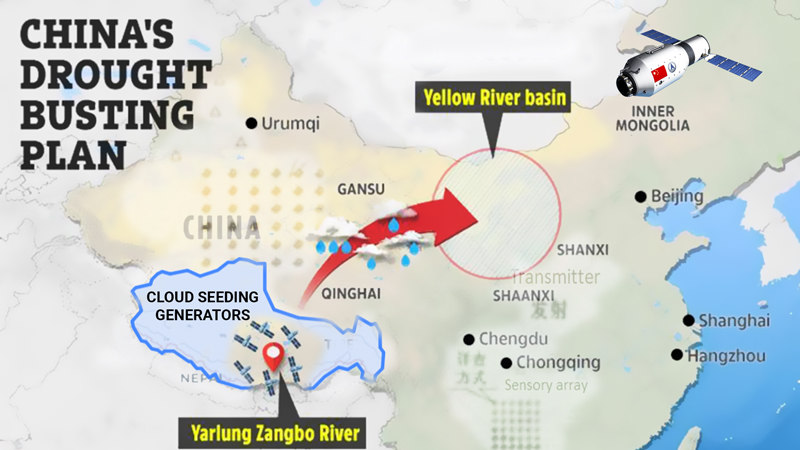
China is planning on deploying thousands of silver iodide burning cloud seeding generators to generate snow on the Tibetan plateau in an attempt to alleviate water shortages. The massive scale of these experimental devices is troubling enough, but the ETC Group warned that these devices could easily be converted for geoengineering purposes:
This year we’ve been tracking a few high-profile geoengineering experiments in Arizona, Alaska, California, and Chile. Another massive project recently came to light on the Tibetan plateau: new research exposes what might be the largest geoengineering project to date, a weather modification project in the Himalayas, which is also part of an alarming pattern of dispossession of the Indigenous inhabitants. While a weather modification project at this scale is alarming enough the infrastructure used could easily transfer over to stratospheric aerosol injection.

Tuesday, December 22, 2015

Geoengineering

CIA Admit To Using Weather Modification As A Military Weapon
Rutgers University climatologist Alan Robock claims that his department at the New Jersey-based university were hired by the CIA to control other nations’ climates.The climatologist also says the callers asked: 
“If we control someone else’s climate, would they then know about it?”
Robock told the consultants that any large-scale weather manipulation would be detectable.
Obviously, the CIA seems to have a very keen interest in the subject of weather modification. In fact, Robock appears to confirm the rumor that the agency contributed to funding for a recently-published U.S. National Academy of Sciences report on geoengineering.