Страницы

Showing posts with label Modern warfare. Show all posts

Tuesday, December 31, 2019

Modern warfare

THE RETURN OF THE TUNNEL BOMB: A MEDIEVAL TACTIC ON THE MODERN BATTLEFIELD


The Return of the Tunnel Bomb: A Medieval Tactic on the Modern BattlefieldThere has been an explosion of underground warfare in the last five years. From sophisticated cross-border Hezbollah attack tunnels discovered in northern Israel to defensive tunnels that criss-cross the urban battlefields of SyriaIraq and the Philippines, a tactic familiar to history buffs has emerged as a characteristic of modern war. That’s why a group of scholars and practitioners recently gathered at the Interdisciplinary Center Herzliya in Israel for the first Subterranean Challenges in War and Peace conference and the inaugural meeting of the International Working Group on Subterranean Warfare. One of the many characteristics of subterranean warfare discussed at the conference stood out in particular—the use of tunnel bombs.
Tunnel bombs—or tunnel-borne improvised explosives devices (TBIEDs), to borrow from the nomenclature used to describe the many manifestations of improvised explosive devices—are exactly what they sound like: tunnels dug under enemy forces or fortifications for the purpose of blowing them up from underneath. And when executed effectively, the results can be devastating.

Tuesday, December 3, 2019

Modern warfare

THE FUTURE OF WAR TECHNOLOGY WHISPERS TO US FROM THE PAST, AND WE MUST LISTEN BETTER


Trying to anticipate the future of technology is a fool’s errand, is it not? After all, even Dr. Vannevar Bush, a renowned architect of the American science establishment, predicted back in 1945 that intercontinental missiles would be impossible for many years. And Thomas Watson, the President of IBM (yes, the artificial intelligence system “Watson” was named after him), is said to have predicted in 1943 that there would be a world market for maybe five computers. The list of laughably wrong predictions about future technologies is endless. Surely we should not be too hard on ourselves when ambitious weapon programs keep failing because, in part, the necessary technology turns out to be too far away. How could we know?
I disagree. The future of military technologies — with implications for the future of the warfare itself — is not an unknowable and random mystery. Granted, examples of erroneous forecasts are numerous. And yet, quantitative research shows that the accuracy of predictions in military technologies — even long-term predictions looking 30 years into the future — are correct surprisingly often, about 70-80 percent of the time. Even the numerical measures of systems’ performance grow over time in a fairly consistent, reasonably predictable manner — the figure above is but one example.

Friday, November 8, 2019

Modern warfare

AI AND IRREGULAR WARFARE: AN EVOLUTION, NOT A REVOLUTION


How will artificial intelligence change the way wars are fought? The answer, of course, depends. And it mainly depends on what type of wars are being fought. AI could very well change the fundamental nature of conventional conflicts between states. Technologies enabled by AI could become so powerful and ruthless that war as we now it becomes too deadly and costly to contemplate. But what about the shadow wars? What about irregular wars between states, non-state groups, and proxies? In other words, how will AI affect the type of wars that the United States is most likely to fight?
Regardless of advances in AI, states will continue to seek advantage through limited, irregular wars prosecuted through insurgency, resistance, coercion, and subversion. This competition below the level of state-to-state armed conflict — as it always has — allows antagonists to achieve military objectives without risking escalation into more costly wars with uncertain outcomes.

Friday, October 25, 2019

Modern warfare

The U.K.’s Top General Says Britain Is Already At War With Russia

There has been no formal declaration of war. No rockets landing on London or submarines sinking British ships. But Britain’s top military commander says Britain is at “at war every day” with Russia and other nations.
But Britain’s top military commander says Britain is at “at war every day” with Russia and other nations.
The weapons aren’t explosive but digital, the battlefield cyberspace instead of mud. But to General Sir Nick Carter, Chief of Defense Staff, the distinction has come obsolete.

“The changing character of warfare has exposed the distinctions that don’t exist any longer between peace and war,” Carter said during a speech at the Cliveden Literary conference. “I feel I am now at war, but it’s not a war in the way we would have defined it in the past. And that is because great power competition and the battle of ideas with non-state actors is threatening us on a daily basis.”

How Russia and China interpret international rules governing conflict threaten “the ethical and legal basis on which we apply the rule of armed conflict,” according to Carter. “Russia is much more of a threat today than it was five years ago. The character of warfare is evolving… there’s a debate we need to have about what does the future of warfare look like.”

Wednesday, September 25, 2019

Modern warfare

The drone attacks in Saudi Arabia have changed the nature of global warfare

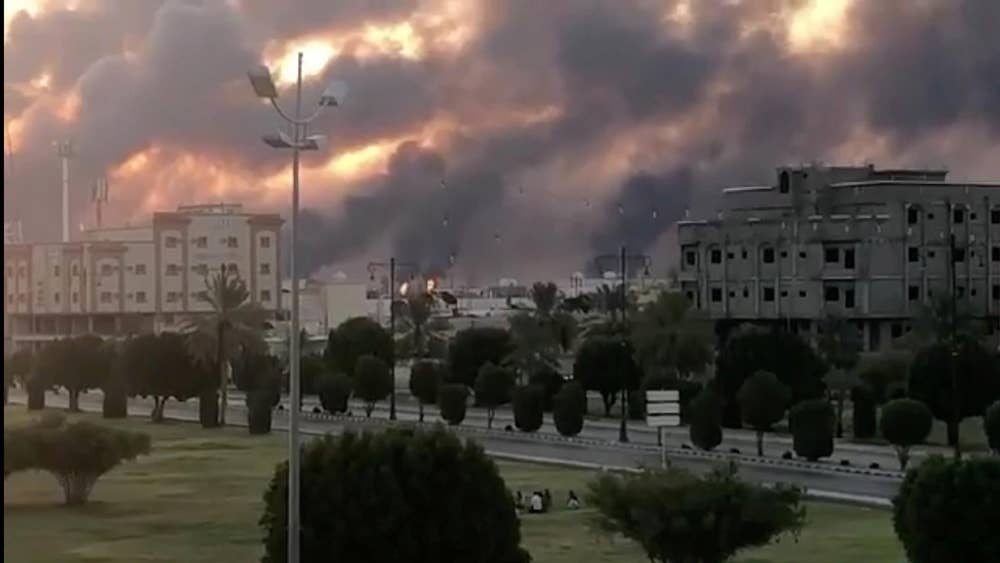
The devastating attack on Saudi oil facilities by drones and missiles not only transforms the balance of military power in the Middle East, but marks a change in the nature of warfare globally.
On the morning of 14 September, 18 drones and seven cruise missiles – all cheap and unsophisticated compared to modern military aircraft – disabled half of Saudi Arabia’s crude oil production and raised the world price of oil by 20 per cent.
This happened despite the Saudis spending $67.6bn (£54bn) on their defence budget last year, much of it on vastly expensive aircraft and air defence systems, which notably failed to stop the attack. The US defence budget stands at $750bn (£600.2bn), and its intelligence budget at $85bn (£68bn), but the US forces in the Gulf did not know what was happening until it was all over.   
Excuses advanced for this failure include the drones flying too low to be detected and unfairly coming from a direction different from the one that might have been expected. Such explanations sound pathetic when set against the proud boasts of the arms manufacturers and military commanders about the effectiveness of their weapons systems.

Thursday, March 21, 2019

Modern warfare

Countdown to “Full Spectrum Dominance”


The US is formally committed to dominating the world by the year 2020. With President Trump’s new Space Directive-4, the production of laser-armed fighter jets as possible precursors to space weapons, and the possibility of nuclear warheads being put into orbit, the clock is ticking…

Back in 1997, the now-re-established US Space Command announced its commitment to “full spectrum dominance.” The Vision for 2020explains that “full spectrum dominance” means military control over land, sea, air, and space (the so-called fourth dimension of warfare) “to protect US interests and investment.” “Protect” means guarantee operational freedom. “US interest and investment” means corporate profits.

The glossy brochure explains that, in the past, the Army evolved to protect US settlers who stole land from Native Americans in the genocidal birth of the nation. Like the Vision for 2020, a report by the National Defense University acknowledges that by the 19th century, the Navy had evolved to protect the US’s newly-formulated “grand strategy.” In addition to supposedly protecting citizens and the constitution, “The overriding principle was, and remains, the protection of American territory … and our economic well-being.”

Sunday, March 3, 2019

Modern warfare

The Pentagon’s Technology Chief Is an Utter F*cking Fool

For the past 17 years, as the U.S. military has invaded, bombed, and attempted to pacify a fair-sized swath of the map, the assortment of military theorists, practitioners, profiteers, chroniclers and critics known as the “defense community” has engaged in a navel-gazing debate about its future.

Donald Rumsfeld, enraptured with a war in Afghanistan he never bothered to complete, marveled after the invasion that soldiers could lead a cavalry charge while also calling in airstrikes. A few years later, colonels and generals waging another war Rumsfeld couldn’t complete pushed a recalcitrant Army to embrace an imperial and intimate theory of urban war. When that theory fell out of fashion due to its immense commitment of blood, treasure, and time, a fallback version advised building and mentoring foreign armies as proxies. Thousands of miles away, in the Pentagon, the Army leadership treated the wars that it fought as diversions from the great-power conflicts it was used to fighting; then hedged with an all-of-the-above concept called “Full Spectrum Operations”; and finally persisted to see a national defense strategy re-prioritize great-power conflict.

Saturday, March 2, 2019

Modern warfare

The U.S. Military's Next Super Weapon: Tactical Tunnels

The U.S. military hates tunnels.

The Japanese used them on Iwo Jima to ambush American soldiers. So did the Viet Cong, forcing American “Tunnel Rats” to ferret them out. North Korea and Iran use them today to protect their nuclear weapons programs, while ISIS tunnels have been a deadly thorn in Afghanistan, Iraq and Syria. Even Israel has discovered Hezbollah and Hamas tunnels penetrating beneath its borders.

But in the spirit of “if you can’t beat ‘em, join ‘em,” the U.S. military wants to build its own tunnels on the battlefield.

The Defense Advanced Research Project Agency (DARPA)’s Project Underminer aims to “demonstrate the feasibility of rapidly constructing tactical tunnel networks that enable secure, responsive resupply,” according to the DARPA program announcement .

It’s not that the United States lacks tunnel knowhow. American industry knows how to build tunnels for everything from highways to utilities. The Pentagon devotes considerable effort today to developing technology to detect and destroy tunnels.

But what is lacking is expertise in building battlefield tunnels. “No DoD Military Occupational Specialty (MOS) includes offensive tactical tunneling, nor does any technology or equipment support tactical tunnel creation or exploitation,” DARPA explains. “In addition, current tunneling operations primarily rely on exploratory bores and above ground guidance beacons, both closely-coupled with human operators to guide drilling/boring routes.

Friday, February 8, 2019

Modern warfare

Pentagon Looking to Step up Its Disinformation Warfare

Army Staff Sgt. Matthew Millham, 31, from New Paltz, N.Y., a former reporter for the military newspaper Stars and Stripes, checks a Facebook site in Kabul, Afghanistan as part of a new communications effort to reach a non-newspaper reading Internet audience. (AP/Musadeq Sadeq)
US Department of Defense officials are looking to weaponize disinformation, by looking for new “influencing tools” against “enemy propaganda,” military.com reported.
The Pentagon wishes to expand its capabilities in irregular warfare, which according to Defense officials is a critical tool for defeating near-peer adversaries preemptively.
As a department, we have often exhibited a historical preference in the past century for traditional high-end force rather than irregular solutions,” Andrew Knaggs, deputy assistant secretary of defense for Special Operations and Combating Terrorism said on February 5th.
“As DoD shifts to meet the demands of great power competition … we are hard at work institutionalizing the substantial expertise in [irregular warfare, or IW] that we have over the last 17 years of irregular conflict.”

Saturday, April 7, 2018

Modern warfare

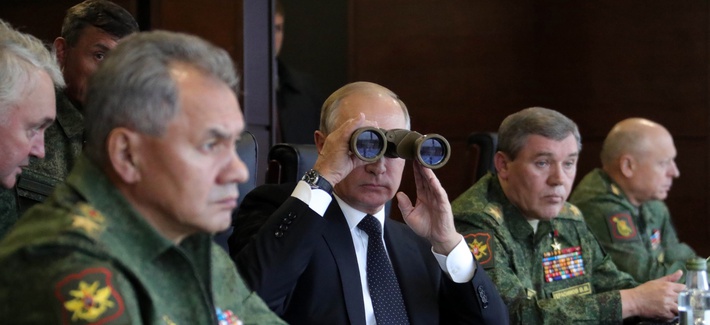
Russian President Vladimir Putin, center, Defence Minister Sergei Shoigu, left, and Chief of the General Staff of the Russian Armed Forces Valery Gerasimov, second right, watch a military exercise at a training ground at the Luzhsky Range. Sept, 2017.Russian Military Chief Lays Out the Kremlin’s High-Tech War Plans

The U.S. military isn’t alone in its plans to pour money into drones, ground robots, and artificially intelligent assistants for command and control. Russia, too, will be increasing investment in these areas, as well as space and information warfare, Russian Army Gen. Valery Gerasimov told members of the Russian Military Academy of the General Staff last Saturday. In the event of war, Russia would consider economic and non-military government targets fair game, he said.

The comments are yet another sign that the militaries of the United States and Russia are coming more and more to resemble one another in key ways — at least in terms of hyping future capabilities. The chief of the General Staff said the Russian military is already developing new drones that could perform strike as well as reconnaissance missions. On the defensive side, the military is investing in counter-drone tech and electromagnetic warfare kits for individual troops.

Monday, April 2, 2018

Modern warfare

Military documents reveal how the US Army plans to deploy AI in future wars


Military documents reveal how the US Army plans to deploy AI in future wars
Tomorrow’s wars will be fought with a lethal combination of soldiers, drones, and AI-powered systems. The Internet of Battle Things, as it’s being called, is a vast battlefield network of machines and humans — and the US Army is working to make it a reality.
In what reads like a list of kill-streak perks in a Call of Duty game, the Army described what the “things” in its “Internet of Battle Things” would be in a just-released white paper:
Most of such intelligent things will not be too dissimilar from the systems we see on today’s battlefield, such as unattended ground sensors, guided missiles (especially the fire-and-forget variety) and of course the unmanned aerial systems (UAVs). They will likely include physical robots ranging from very small size (such as an insect-scale mobile sensors) to large vehicle that can carry troops and supplies. Some will fly, others will crawl or walk or ride.

Sunday, March 25, 2018

Modern warfare

US Army’s Futures Command sets groundwork for battlefield transformation


It’s the beginning of a new era in Army acquisition in which soldiers might not have to wait 10 years or longer to see a new weapon or capability in the field, but instead could get modern, new systems in their hands within just a few short years.
That’s at least what service leaders tasked to come up with new road maps for the Army’s top modernization priorities are thinking is possible.
The newly vigorous pace is fueled by the frustration created by years of painful acquisition blunders, sluggish bureaucratic processes and wasted dollars, all on top of the fact that near-peer adversaries like Russia haven’t waited to develop weapons systems that would create serious dilemmas for the U.S. Army and its Middle East-tuned equipment if it had to face off in a conflict.
The Army’s new Futures Command — designed to keep the service laser-focused on six major modernization priorities — hasn’t been officially established yet, but the leadership in charge of those priorities see for many cases creative ways to get capability into the hands of soldiers in the field in just a couple of years.

Tuesday, October 24, 2017

Modern warfare

Urban combat promises future comms snags


Military leaders have asserted that future wars will likely be fought in mega cities, cities with more than 10 million people.

“It’s highly probable that the military forces armed conflict will occur in highly dense urban complex terrain, physical terrain,” Army Chief of Staff Gen. Mark Milley, said in May, adding that today there are 10 to 15 of these cities, while in 2050 there might be over 50.

Noting that his service is not optimized to fight in these environments – a realization shared across the branches – he explained the Army must change. Urban environments pose several unique warfighting challenges to the military, one in particular is communication.

For one, the variety of sensors and communications equipment needed to navigate the large, concrete buildings that comprise cities eat up bandwidth. While the military – and even commercial industry – are looking at employing swarm technology with small unmanned aerial systems, interference and propagation issues can cause major command and control problems, Lt. Col. Jeffrey Kawada, who works electronic warfare, offensive cyber and information operations with headquarters Marine Corps, said during a panel at the annual MilCom conference in Baltimore on Oct. 23.

Monday, August 14, 2017

Modern warfare

DIA Director: We are preparing to fight the last war


DIA Director: We are preparing to fight the last war

Does warfighting in the information age still look like two armies clashing on a battlefield – a violent clash between hostile forces each trying to impose their will on the other? In part yes, Stewart said during a keynote address at DoDIIS 2017 in St. Louis Monday. The nature of warfare hasn’t changed. War remains an act of force to compel an adversary – nothing less, but the battlefield isn’t always physical these days.

“All too often we find ourselves fighting warfare in the ways that are not purely kinetic,” he said.

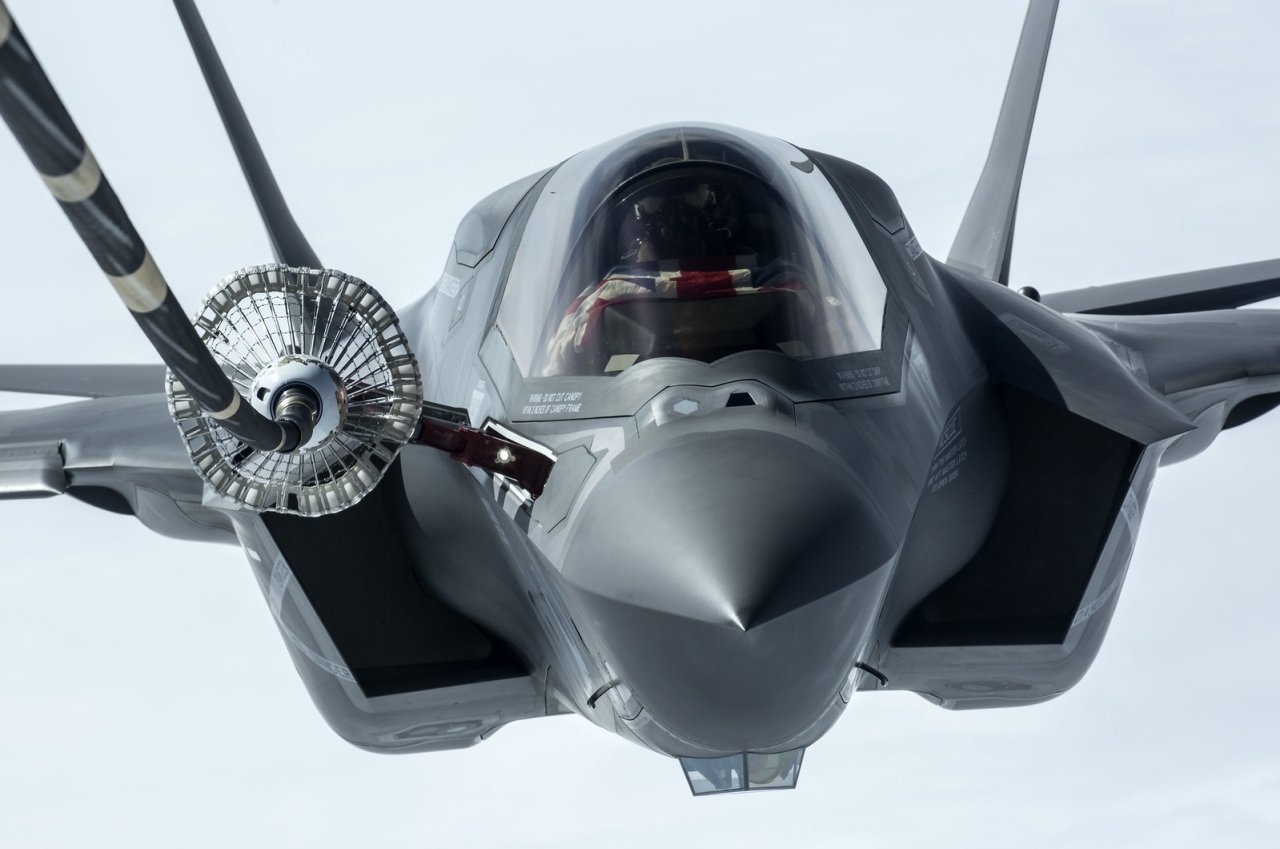
As opposed to specific platforms like the F-35 Joint Strike Fighter, Stewart said for him fifth generation war is about the fight for information.

Providing a history lesson of sorts, Stewart explained how the first generation of warfare was the mastering of firepower; the second generation was the early modern technology tactics of small units operating independently; the third generation focused on late modern technology leveraging speed, stealth and combined arms; and the fourth generation was post-modern and turned to decentralized warfare such as terrorism.

The fifth generation will be cognitive warfare, he said.

Thursday, February 2, 2017

Modern warfare

IT’S TIME TO CREATE A MEGACITIES COMBAT UNIT

It’s Time to Create a Megacities Combat UnitA 2016 United Nations report estimated 54.5 percent of the world’s population lived in urban areas. By 2030, that percentage is projected to rise to 60 percent. As a result of this rural-to-urban migration, cities themselves are growing. In 2016, there were 512 cities with at least one million inhabitants globally. By 2030, a projected 662 cities will have at least one million residents. And the number of “megacities” in the world—those with ten million residents or more—is projected to grow from thirty-one to forty-one in the same period.
In 2014, the chief of staff of the Army’s Strategic Studies Group (SSG) chose megacities to be the organizing theme for its yearlong research projects. Concept teams looked at the unique characteristics and challenges of a megacity, future maneuver and mobility concepts, Army force design considerations, personnel talent management, and other topics, assessing the requirements for operating in megacities. The conclusions of the SSG research are clear: megacities are unavoidable, they are potentially the most challenging environment the Army has ever faced, and the Army is unprepared to operate in them. The SSG also recommended that the Army, charged with the mandate of preparing forces for sustained operations on land, take the lead in training, organizing, and equipping forces for megacities.

Wednesday, December 14, 2016

Modern warfare

GRENADE LAUNCHERS AND BED SHEETS: AN INVISIBILITY KIT FOR URBAN COMBAT

Grenade Launchers and Bed Sheets: An Invisibility Kit for Urban CombatThere are promising research developments in camouflage, including cloaking fabrics that one day will make soldiers and their equipment literally invisible. For instance, a Canadian camouflage maker, Hyperstealth Biotechnology, regularly demonstrates a metamaterial to US military groups that reportedly bends light waves around a target. But this remains a future capability, and on the battlefield today, a dismounted force sent into a city has little that is designed especially for urban terrain.
This leaves obscuration as the most viable option. Obscuration, according to US Army doctrine is “the employment of materials into the environment that degrade optical and/or electro-optical capabilities within select portions of the electromagnetic spectrum in order to deny acquisition by or deceive an enemy or adversary.” In practical terms, and in the context of the urban battlespace, it keeps forces from being seen. The standard device carried by dismounted soldiers for obscuration is a smoke grenade, a piece of equipment that hasn’t changed since World War II. They emit only 50–90 seconds of smoke and can be thrown 35 meters by an average soldier. There are some vehicle variants that offer smoke generators or smoke grenade dischargers but these are not common to all formations, and in dense, urban environments, are simply unfeasible.

Saturday, November 26, 2016

Modern warfare

Terrain Dominance Technologies – Enhancing Readiness on Battlefield

In the contemporary world, characterized by sophisticated  battlefield warfare as well as  dense urban warfare, information and intelligence become a major resource. When the main threat is terrorism, a-symetric warfare, the Terrain Dominance concept is vital to any modern and advanced army.
Terrain Dominance is an operational intelligence concept based on advanced technology aimed at a complete intelligence command within a defined area for a prolonged period of time. It is intended for achieving superiority at a certain territory, whether it is a border area or combat area. It relates to places where a complete knowledge is required continuousely regarding what happens in a certain area.
Terrain Dominance is achieved through a multi-layered approach covering vast territories using C4I – Command, Control, Communications, Computers, & Intelligence. This means the use of a variety of advanced sensors mounted on different platforms – on the ground, sea, air and space – in order to supply threat alerts and offer wasy to combat the threats.

Thursday, November 24, 2016

Modern warfare

War in the Information Age

We are on the eve of a new era in the business of warfighting and combined arms. In this information age of warfare, advantage will be achieved through the speed and integration of information. If we follow the right path, tomorrow’s commanders will seamlessly direct joint and coalition forces in a way that simultaneously capitalizes on our advantages on land; at sea; and in the air, space, and cyberspace. The primary warfighting attributes will be decision speed and operational agility. In short, our asymmetric advantage in future battles depends on harnessing the vast amount of information our sensors can generate, fusing it quickly into decision-quality information, and creating effects simultaneously from all domains and all functional components anywhere in the world.

Thursday, July 7, 2016

Modern warfare

ARE WE AT THE START OF A TECH WORLD WAR?

Electron...The man introduced himself as a former government spy, offered up some impressive credentials, and said that he had seen some dark things in his lifetime, but the darkest was still to come.
The next major war, he said, wouldn’t be fought with bombs, men, or even robots. It wouldn’t be waged on a battlefield or in the sky. Instead, it would be a silent war. He explained that during the past couple of decades, most of the world’s private and public infrastructure had become predominantly digital. And that the next major war could decimate that infrastructure. Water-treatment facilities, oil pipelines, dams, electrical grids, telecommunications platforms, food shipments, public and private transportation, traffic lights, prisons, every single drip of media—and a long, long list of other things we need for survival but take for granted—would all be vulnerable.

Friday, June 10, 2016

Modern warfare

Gray Zone: Why We’re Losing the New Era of National Security

Pro-Russian rebels rest inside a shelter at their position outside Donetsk, eastern Ukraine, Friday, Aug. 22, 2014. Tensions between Russia and Ukraine escalated sharply on Friday as Moscow sent more than 130 trucks rolling across the border.
Whether American strategists recognize it or not, global defense competition and conflict are changing. Three core assumptions define the new era: First, the United States and the U.S.-led status quo will encounter persistent and deliberate resistance for the foreseeable future. Second, that resistance will commonly manifest as “gray zone” threats and challenges. Finally, these gray zone challenges will confound U.S. defense strategists and institutions that fail to adapt.

The gray zone is the awkward and uncomfortable space between traditional conceptions of war and peace. It is here that the United States faces fundamental challenges to American and partner security. Adversaries working to revise or reject the status quo are employing hybrid methods and capabilities — unique combinations of influence, intimidation, coercion, and aggression — to crowd out resistance, establish local or regional advantage, and manipulate perceptions of risk.