Страницы

Showing posts with label Food security. Show all posts

Sunday, May 3, 2020

Food security

Italy fury erupts as mass starvation fears spark chaos in third biggest eurozone economy

ITALYTENSIONS in Italy have triggered a furious response from citizens who fear mass starvation and financial collapse in the third biggest economy in the eurozone.

Italy - one of the hardest-hit countries from the coronavirus pandemic - will start to ease its two-month strict lockdown from Monday. However, tensions across the country are still intensifying with many residents in fear that the virus chaos may still spark mass starvation. In recent days, fury has erupted with fights breaking out between shoppers at a series of supermarkets.
One incident that went viral on social media showed a desperate family pleading with a police officer after they were unable to withdraw their grandmother's pension - the family's sole income.
In another video, supermarket shoppers erupted into a brawl after several people attacked one shopper for refusing to wear a face mask.
One Priest told the Guardian: "Now people are more afraid — not so much of the virus, but of poverty. Many are out of work and hungry. There are now long queues at food banks."

Sunday, March 29, 2020

Food security

Coronavirus measures could cause global food shortage, UN warns


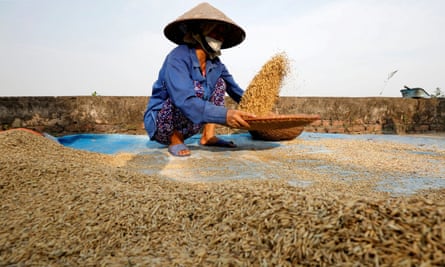
Farmer in rice field outside Hanoi, Vietnam
Protectionist measures by national governments during the coronavirus crisis could provoke food shortages around the world, the UN’s food body has warned.
Harvests have been good and the outlook for staple crops is promising, but a shortage of field workers brought on by the virus crisis and a move towards protectionism – tariffs and export bans – mean problems could quickly appear in the coming weeks, Maximo Torero, chief economist of the UN Food and Agriculture Organisation, told the Guardian.
“The worst that can happen is that governments restrict the flow of food,” he said. “All measures against free trade will be counterproductive. Now is not the time for restrictions or putting in place trade barriers. Now is the time to protect the flow of food around the world.”

Tuesday, March 17, 2020

Food security

Nuclear conflict anywhere on Earth would cause global crop crisis

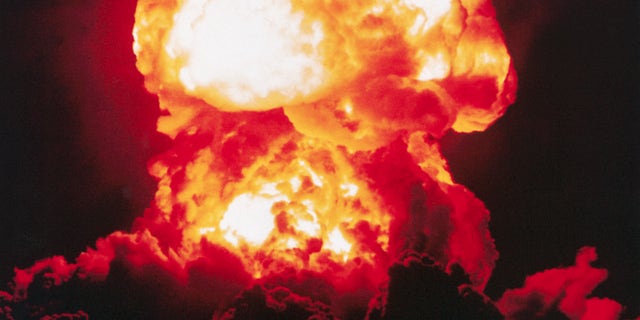
A new study concludes that even a small scale nuclear conflict would cause a global crop crisis. Above, the detonation of the atomic bomb nicknamed "Smokey," as part of Operation PLUMBBOB in the Nevada desert. 1957. (Photo by © CORBIS/Corbis via Getty Images)A nuclear conflagration between India and Pakistan would devastate global food supplies, a new study claims.

A new study led by a University of Chicago scientist finds that such a conflict would have horrifying consequences well beyond that region of the world.

Researchers combined climate, agriculture and economic models to show that a limited nuclear conflict would produce a decade of global cooling and a severe decline in crop production that would compromise global food security.

"The impact is very stark," first author Jonas Jägermeyr, a postdoctoral researcher in University of Chicago's Department of Computer Science and NASA's Goddard Institute for Space Studies, said in a statement.

According to the study, by year four after the nuclear conflict, 132 of 153 countries -- with a total population of 5 billion people -- would experience food shortages above 10 percent.

Tuesday, January 14, 2020

Food security

Nuclear winter would trigger a global famine, but one expert says his doomsday diet could save humanity

The detonation of the atomic bomb nicknamed "Smokey," as part of Operation PLUMBBOB in the Nevada desert. 1957. (Photo by © CORBIS/Corbis via Getty Images)
A full-scale nuclear war would likely trigger a worldwide period of cold and darkness that could spark a famine.

However, David Denkenberger, a mechanical engineer at the University of Alaska who runs the nonprofit Alliance to Feed the Earth in Disasters (ALLFED), told Business Insider that it would still be possible to save humanity with some type of sustainable "disaster diet."

Experts have warned that a nuclear war between India and Pakistan would unleash a global catastrophe that would result in 50 to 125 million direct fatalaties and cause a sharp drop in the global temperature -- devastating the world's food supply.

Researchers found "that if Pakistan attacks urban targets in 2025 with 150-kiloton nuclear weapons and if India responds with 100-kiloton nuclear weapons, smoke from burning cities would release 16 to 36 teragrams of black carbon into the atmosphere, blocking out sunlight and cooling the global surface by 2 to 5°C (3.6 to 9°F)," according to a news story on the website of the American Association for the Advancement of Science.

Tuesday, October 22, 2019

Food security

Why Pork Pushed China to a Deal

Why Pork Pushed China to a Deal
On Friday, U.S. President Trump and China’s Vice Premier Liu He announced a trade agreement that saw Washington suspend tariff increases while China agreed to purchase some $40-$50 billion of agricultural products, including pork. Behind this seemingly positive development, the financial markets rallied; the Dow Jones rose some 320 points or 1.21 percent. Trump billed the agreement as “phase one” of a broader trade agreement, but behind the soaring rhetoric belies a key motivation for the deal: The Chinese need pig imports.

The truth is that even before the deal, Chinese imports of pigs from the United States was already increasing. According to the United States Department of Agriculture, Chinese imports of pork from the United States more than tripled from 23.4 to 93.4 million pounds from January 2019 to August 2019, with the imports generally increasing throughout this period.

The increased imports are because China’s pigs are suffering from an African swine fever epidemic. African swine fever is a highly virulent virus that, although harmless to humans, can cause death within a week in pigs. So infectious is this disease that Dutch bank Rabobank predicts China could lose 20-70 percent of its domestic pig herd this year, potentially around 350 million pigs or a quarter of the world’s pigs. To prevent further transmission of the virus, more than 1 million pigs were culled. Since China annually slaughters about 700 million pigs a year, this virus has affected nearly half of the country’s annual consumption worth of pigs. As a result, China’s pig prices have hit multi-year highs of 28 yuan ($3.96) per kilogram, up 47 percent from last August; Rabobank predicts that prices may further increase past 30 or 40 yuan per kilogram. Furthermore, pig price increases have squeezed the Chinese consumer, pushing food inflation to nearly 10 percent.

Monday, April 29, 2019

Food security

Glyphosate in Food: Complete List of Products and Brands Filled with Popular Cancer-Causing Weed-Killer


Concern over glyphosate in food is on the rise after Monsanto was found guilty in covering up their cancer-causing product, Roundup. Monsanto has been under scrutiny ever since they were ordered to pay $289 million in damages to plaintiff, Dewayne Johnson.
Just after the first successful trial in taking down Monsanto, the Environmental Working Group (EWG) published a haunting report on the levels of glyphosate in food. According to the independent laboratory tests commissioned by the EWG, popular oat cereals, oatmeal, granola and snack bars come with a heavy dose of the cancer-causing weedkiller, Roundup.

Why Should We Care About Glyphosate in Food?

Glyphosate is the main ingredient found in the popular weed-killer Roundup. Back in 2015, a famous study published by the International Agency for Research of Cancer (IARC) came to the conclusion that glyphosate is “probably carcinogenic to humans (1).”
The link between glyphosate and Non-Hodgkin’s lymphoma is particularly strong. One study, published in 2008 by Swedish researchers, found that exposure to glyphosate tripled the risk of a subtype of non-Hodgkin called small lymphocytic lymphoma...

Thursday, April 11, 2019

Food security

J. C. Cole: Is a US Food Security Crisis Coming Soon? 13 Gray Swans and More….What happens if there is no food east of the Mississippi?


Most Americans are not aware that the national food grid is in this very dangerous situation. Especially vulnerable is the area between Boston to Washington, DC. Fifty percent of our food is imported into America. Of the other 50% that we produce inside the country, 80% of that is grown by large farms in the mid-west and 20% of that is grown in California. All of it is transported by a JIT delivery system. The average unit of food in America travels 1,500 miles. States east of the Mississippi River do not produce enough food to sustain their populations.
The bottom line is basically that if anything shuts down the JIT delivery system in America for more than a week, it is likely that our inner cities will start to riot and burn. This is not fear mongering, but rather “history”. If shipping is shut down for an estimated 3 weeks, then the majority of the country runs out of food, and probably a civil war would erupt. There are 320 million people with more than 320 million guns and if they have no food, that is a recipe for disaster. America’s JIT delivery system is America’s “Achilles Heel”.

Saturday, October 27, 2018

Food security

China successfully harvests saltwater rice that could feed another 80 million people


China successfully harvests saltwater rice that could feed another 80 million people
Chinese scientists have harvested alkali-resistant ‘sea rice’ planted in east China’s Shandong Province, marking initial success of an ambitious plan to boost the country’s rice production and feed an additional 80 million people.
The new type of rice, successfully harvested by a group of scientists in the seaside city of Qingdao, eastern China, was revealed a year ago. Sea rice that is able to grow in tidal flats or saline-alkali land was developed by crossbreeding different varieties of rice.
“If there are natural disasters, as China has a large population, it's difficult to rely on importing food from abroad as there are logistical barriers. If the Chinese go hungry because of crop failures caused by natural disasters, there will be social unrest and destabilizing factors for the world,” Deputy Director of Qingdao Sea Rice R&D Centre Guodong Zhang told RT's Ruptly video news agency.
According to the scientist, turning barren land into fertile farmland will enable China to feed the entire country and will therefore be beneficial to peace and stability.
“Wheat and rice are the staple food of the Chinese people, and 60 percent of them depend on rice,” he said.

Sunday, April 15, 2018

Food security

Climate Change Is Messing With Your Dinner

World map showing areas of wheat yield loss or gain projections for 2050
The world’s dinner tables are seeing the impact of climate change.
As cold regions become warmer, and warm places hotter still, farming and fishing are shifting. An evolving climate means big changes for people who grow, catch and rear for a living, and everyone else who buys and eats what they produce.
There are winners and losers. There are rich-world problems (less cod, more lobster) and poor (drought and pestilence). There are threats to the quality of the world’s basic staples including wheat and corn, as well as such nation-defining luxuries as Bordeaux wine and Java coffee. And whether through dearth or deluge, supply shocks can shake up prices.
As temperatures rise, the best growing conditions for many crops are moving away from the tropics, and from lower lying land to cooler climbs. Fish and other underwater catches, too, are migrating to colder seas as their habitats warm.

Friday, April 14, 2017

Food security

Six foods threatened by climate change


Coffee
Climate change isn’t just threatening our planet; it’s also threatening some of our favourite food and drink.
Co-creator of YouTube channel ASAP Science, Greg Brown, told CTV’s Your Morning that as weather become less predictable farming becomes more difficult.
The rise in global temperatures also means more pests and funguses that threaten the plants and the overall result is lower quality food at a higher price.
So which tasty foods, and drink, might not be around for much longer?
Coffee yields are down in places such as Costa Rice, Ethiopia and India. That’s because of an increase in temperature, dryness and drastic rainfall, according to Brown, a popular online science educator. The unpredictability means it’s hard for coffee farmers to know how their coffee beans are going to grow.
While other parts of the world could become coffee producers, it might be hard to determine where those areas are before it is too late, Brown added...

Saturday, March 18, 2017

Food security

HUMOR: The glowing threat of radioactive pigs


Малых дикого кабана
Six years after an earthquake and subsequent tsunami damaged the Fukushima Daiichi Nuclear Power Plant, experts who will probably never live anywhere near it say radiation is now low enough that former residents can safely return home. The problem is, with no humans around, wild boars in the area have bred like rabbits and the aggressive—and potentially radioactive— creatures freely roam the abandoned towns.
“It is not really clear now which is the master of the town, people or wild boars,” Tamotsu Baba, mayor of Namie, told Reuters this month. “If we don’t get rid of them and turn this into a human-led town, the situation will get even wilder and uninhabitable.”

Thursday, August 4, 2016

Food security

How One GMO Nearly Took Down the Planet


Occupy MonsantoOn Friday, President Obama signed bill S.764 into law, dealing a major blow to the movement to require GMO labeling. The new law, called the "Deny Americans the Right to Know" (DARK) Act by food safety groups, has at least three key parts in it that undermine Vermont's popular GMO labeling bill and make it nearly impossible for you and me to know what's in our food.
The law claims to set a federal labeling standard by requiring food producers to include either a QR bar code that can be scanned with a phone, or a 1-800 number that consumers can call to find out whether a product contains genetically modified ingredients.
But according to the Institute for Responsible Technology, this bill doesn't require most processed foods to have a label, the bill defines genetic engineering so narrowly that most GMOs on the market don't qualify, and the bill gives the USDA two more years to come up with "additional criteria" -- also known as "more loopholes."

Sunday, July 24, 2016

Food security

Half of all US food produce is thrown away, new research suggests

Discarded food is the biggest single component of US landfill and incinerators, according to the Environmental Protection Agency.
Americans throw away almost as much food as they eat because of a “cult of perfection”, deepening hunger and poverty, and inflicting a heavy toll on the environment.
Vast quantities of fresh produce grown in the US are left in the field to rot, fed to livestock or hauled directly from the field to landfill, because of unrealistic and unyielding cosmetic standards, according to official data and interviews with dozens of farmers, packers, truckers, researchers, campaigners and government officials.
From the fields and orchards of California to the population centres of the east coast, farmers and others on the food distribution chain say high-value and nutritious food is being sacrificed to retailers’ demand for unattainable perfection.

Sunday, June 19, 2016

Food security

Why You Should Want to Know Who’s Making Your Food and How


If you want to eat well, it pays to make friends with a farmer. Supermarket stickers can be misleading, and while the label “organic” can be a sign of quality, it’s no guarantee.
Peter Martens, an organic grain farmer in upstate New York, says he would choose no-label produce grown by someone he knew over vegetables labeled “organic” at a store. One reason: Food grown under organic guidelines may have traveled for weeks before landing on your plate.
“I would personally buy local before I bought organic from China,” says Martens, who helps run Lakeview Organic Grain in Penn Yan, N.Y. “Knowing where it came from is more important than just having a stamp on it.”

Monday, May 9, 2016

Food security

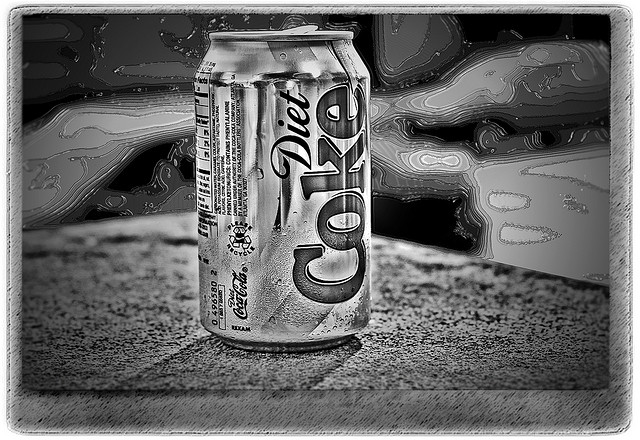
Coca-Cola Funded Study Claims Diet Soda May Be Healthier Than Water

437111955_9c462abcfa_z
A new study claiming diet beverages may be more beneficial to weight loss than water was funded by Coke, Pepsi, and other soft drink conglomerates. The analysis, published in November in the International Journal of Obesity by a professor at the University of Bristol, concluded that low energy sweeteners (LES) in place of sugar “in children and adults, leads to reduced EI [energy intake] and BW [body weight], and possibly also when compared with water.
The study, a “systematic review” titled, “Does low-energy sweetener consumption affect energy intake and body weight?” disclosed it was partly funded by the International Life Sciences Institute-Europe (ILSI). Though the name seems neutral — and its board of directors includes qualified scientists — other members’ positions on the board suggest ulterior motives. Doctors from Nestle, Mars, Unilever, Pepsi, and Coca-Cola serve on ILSI’s board of directors. Further, these directors elect the board’s officers, three of five of whom represent corporations.
Food security

Removing environmental pollutants from raw meat


Removing environmental pollutants from raw meatSix months ago, the International Agency for Research on Cancer associated consumption of red meat and processed meat to cancer risk. However, in its analysis, it made no reference to some carcinogenic environmental pollutants that are already present in raw or unprocessed meat. A study now shows that cooking processes that remove fat from meat can reduce the concentrations of these substances.
When the International Agency for Research on Cancer (IARC) announced last October that the consumption of both red meat and processed meat was associated with an increased risk of cancer, there was widespread alarm.
The specialist institution of the World Health Organization (WHO) reviewed more than 800 studies and classified red meat as "probably carcinogenic to humans" and processed meat as "carcinogenic to humans," with sufficient evidence that its consumption can cause colorectal cancer.
According to the study published six months ago in The Lancet Oncology, the carcinogenic substances in processed meat are generated by salting, fermentation, curing and smoking processes, or when the meat is heated to high temperatures, releasing suspected carcinogens such as nitrous compounds, polycyclic aromatic hydrocarbons (PAHs) and heterocyclic aromatic amines, among others.

Friday, May 6, 2016

Food security

Michigan man sprayed poison on food in several Ann Arbor grocery stores, FBI says

The suspect was caught on video entering the store before allegedly spraying food with poison.
The FBI said Tuesday the serial spray suspect is in custody, but his identity has not been revealed. No criminal charges have been announced and no motive has been specified.

The suspect was caught on camera spraying a sickening mixture of alcohol-based hand sanitizer, water and Tomcat-brand mouse killer on prepared food and produce in the past two weeks, the FBI said. Authorities said he contaminated food at three Ann Arbor locations, including a Whole Foods.

Authorities said the man was seen at a dozen other grocery stores and restaurants in the past few months — including a second Whole Foods, two Walmarts and a Cupcake Station — and all of those eateries are now being investigated for possible poisoning.

Thursday, March 10, 2016

Food security

Locals eating radioactive food 30 years after Chernobyl - Greenpeace tests


Картинки по запросу chernobyl
Economic crises convulsing Russia, Ukraine and Belarus mean testing in areas contaminated by the Chernobyl nuclear disaster has been cut or restricted, Greenpeace said, and people continue to eat and drink foods with dangerously high radiation levels.
According to scientific tests conducted on behalf of the environmental campaigning group, overall contamination from key isotopes such as caesium-137 and strontium-90 has fallen somewhat, but lingers, especially in places such as forests.
People in affected areas are still coming into daily contact with dangerously high levels of radiation from the April, 1986 explosion at the nuclear plant that sent a plume of radioactive fallout across large swathes of Europe.

Thursday, February 25, 2016

Food security

US Confectioner Mars on Tuesday ordered a massive recall of products including Mars and Snickers bars from 55 countries after a piece of plastic found in one bar was traced back to its Dutch factory.

Картинки по запросу mars and snickers
"As far as we know there are 55 countries involved," Eline Bijveld, Mars corporate affairs coordinator for the Netherlands told AFP.
She added that the recall "only involves the products that are made in the Netherlands" at the Mars factory in the southern town of Veghel.
Mars said the recall affected all Mars and Snickers products, as well as Milky Way Minis, Miniatures and Celebrations confectionery boxes with best-before dates ranging from June 19, 2016 to January 8, 2017.
The chocolate giant did not indicate the total volume of the affected products, or what the financial impact of the recall would be...

Friday, February 5, 2016

Food security

France becomes world’s first county to ban supermarkets from throwing away food


In an effort to tackle the dual problems of food waste and poverty, France just passed a groundbreaking law that requires supermarkets to donate unsold food to charity, give it away as animal feed, or face fines of up to €75,000 ($82,324) and two years in jail. The law, which was passed unanimously this week by the French senate, is part of a greater drive to halve the 7.1 million tons of food wasted in the nation each year—some of which is intentionally destroyed by retailers to prevent ‘dumpster diving’ by those in need.