Страницы

Showing posts with label Robots. Show all posts

Sunday, May 3, 2020

Robots

Robots Will Replace Soldiers In Combat, Says Russia
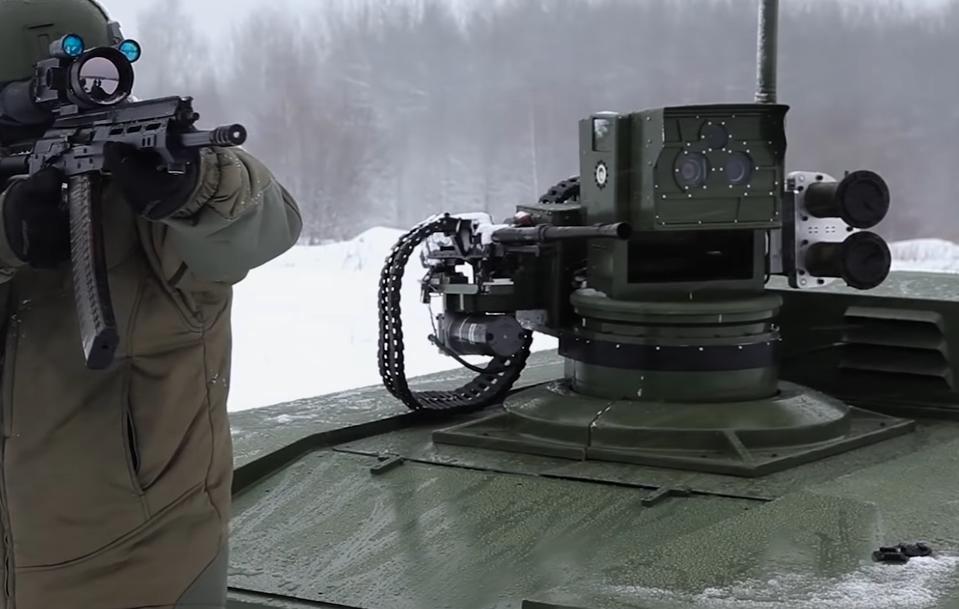
A soldier with a rifle and a robot tank.
For Russia, the question of robots taking over the role of soldiers on the battlefield is a matter of when, not if.
“Living fighters will gradually begin to be replaced by their robotic ‘brothers’ who can act faster, more accurately and more selectively than people,” Vitaly Davydov told RIA Novosti on April 21. Davydov is the deputy director of Russia's Advanced Research Foundation, its DARPA analog. 
Developing robots for war is an international phenomenon, and Davydov’s remarks fall into a broader pattern of Russia seeking to augment its existing military with new, autonomous capabilities.

Monday, February 24, 2020

Robots

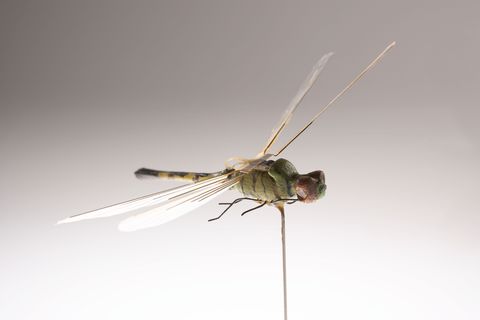
In the 1970s, the CIA Created a Robot Dragonfly Spy. Now We Know How It Works.

image
...Despite being a star attraction at the CIA’s museum, many details about the bug remained a secret for decades until John Greenwald, founder of the anti-secrecy website The Black Vault, put in a request for documents under the Freedom of Information Act (FOIA) in the summer of 2013.
“I've learned over the years, the U.S. military and government often will acknowledge something or confirm something exists, and many times that largely satisfies the public's curiosity,” Greenwald told Popular Mechanics. “However...we often don't get the full story. So I go after documents never-before-released to tell either more of the story, or the real story.”
Seven years later in January 2020, Greenwald received a stack of documents detailing the dragonfly’s design and construction—and the story stretches back into spying’s peak during the Cold War.

Saturday, February 22, 2020

Robots

Robot surgeons to begin work in NHS hospitals

Emergency, Emergency Services, Hospital, Medicine
A "next generation" British-made robot will perform surgeries for the NHS in a European first.

The robot, called Versius, is hailed as a huge "leap forward" and is designed to make surgery less painful for patients.

Built by Cambridge-based start-up CMR Surgical, it will also allow surgeons to perform for longer periods due to reduced fatigue, as it can be operated sitting down.

It comes after the Telegraph revealed last year that three quarters of surgeons have suffered back pain due to carrying out procedures by contorting themselves into awkward positions for hours at a time.

One in five surgeons from a poll of more than 450 warned they could be forced to retire early.

Friday, February 21, 2020

Robots

Robot Artillery Gunners: The ARMY Wants Its Big Guns to Be Self-Loading

https://www.reutersconnect.com/all?id=tag%3Areuters.com%2C2019%3Anewsml_RC2SND9HTSA6&share=true
Key point: Robots are cheaper than soldiers and don't get tired. The question is whether they can successfully replace the men and women who load America's artillery.

Will the U.S. Army’s future artillery be operated by robot gunners?

A new Army research project calls for developing autonomous systems that can perform functions such as loading shells into cannon. It also follows another project that aims to replace forward observers, who call in artillery fire, with robots.

The research solicitation calls for developing “autonomous robotic systems that are capable of semi- and fully autonomous munitions handling inside a weapons system. Its functions would support loading of projectiles into the cannon breech, setting of charges and propellants, and management of excess case materials inside of the weapons system.

A M109A6 Paladin, a self-propelled 155-millimeter howitzer, is operated by a crew of four: a commander, driver, gunner and loader. It is not clear which crewmen could be replaced by robots should this technology come to fruition, though the gunner and loader would seem to be prime candidates. At the same time, given advances in self-driving vehicles, it is conceivable that the driver could be replaced by a robot, which would leave the commander as the human element of the system.

Friday, February 14, 2020

Robots

War with robots: how battle bots will define the future of ground combat

Explosive Ordnance Disposal has been a key mission for small unmanned ground robots during the wars in Iraq and Afghanistan. (Poto by Sgt. Anthony L. Ortiz/U.S. Marine Corps)
Hunkered down behind a thick stone wall, the squad leader hears the rumble of tank treads ahead as a robot breacher plows through city street obstacles followed by its control vehicle a few blocks behind.
The staff sergeant signals squad mates to launch a handheld drone that peeks around dangerous corners, scouting enemy fire positions.
A larger overhead drone, run by the battalion, uses thermal sites to scan the building ahead of them floor-by-floor and spot threats.
One soldier pulls a throwbot from the robotic pack mule that carries most of the team’s gear, ammo, water and batteries and runs around the corner to chuck it through an open window as the squad leader toggles between drone views on a ruggedized tablet.
Another team has tossed a ground robot equipped with chemical sensors and its own thermal cameras down a manhole into the intricate city sewer system. That bot is scouring the dark for potential fighters that could pop out at any moment, or worse, explosive-packed tunnels set to blow when one of the units or enough vehicles pass to trigger detonation.

Monday, February 3, 2020

Robots

Army seeks robots to supply its big guns with ammunition


Before a howitzer can fire a shell, a series of humans have to put it in place. For all the advancements made from early cannons to modern artillery, it is still humans that do the transportation, lifting, loading, and launching of the explosives. The Army is looking to automate more of this process.
Through the Field Artillery Autonomous Resupply (FAAR) cohort, the Army is looking to change how resupply happens from the Battalion Supply Area forward to the artillery crew. This process leaves intact existing supply chains that develop and make the munitions, instead focusing just on how those munitions can get from their in-country warehouse to where they’re most immediately needed.
“The way artillery is resupplied has not changed much in the last 40 years,” said Chris Isch, an artillery officer working in long range precision fires. “This is a physically demanding task and can be time consuming. What’s more, all along the way, Soldiers must maintain paper inventory sheets to track the number and types of rounds. “

Saturday, February 1, 2020

Robots

DARPA DEPLOYS SWARMS OF AUTONOMOUS ROBOTS TO CARRY OUT URBAN RAID


DARPA drone swarmA swarm of autonomous robots has been deployed by researchers from DARPA to test how the technology could be used as part of an urban raid. The experiment was part of a project to find ways to map environments and gather real-time intelligence using aerial and land based robots.
In the not-so-distant future, hundreds of unmanned drones and on-the-ground rovers could swoop into an area of interest and spew crucial data to human military operators faced with limited sight lines or tasked with navigating unpredictable spaces, researchers the Defense Advanced Research Projects Agency (DARPA) said this week.
Military experts say the aim is to transmit "critical insights to small ground units" from swarms of up to 250 collaborating autonomous robots.
A third field experiment was recently conducted at the Camp Shelby Joint Forces Training Center based in Mississippi, spearheaded by DARPA.
The program, led by Timothy Chung, is known as Offensive Swarm-Enabled Tactics (OFFSET).
In the most-recent test, rovers and drones were sent out into the training facility with the objective of locating items and areas of interest, marked in this instance by a form of barcode.

Thursday, December 5, 2019

Robots

Robotics researchers have a duty to prevent autonomous weapons

Robotics is rapidly being transformed by advances in artificial intelligence. And the benefits are widespread: We are seeing safer vehicles with the ability to automatically brake in an emergency, robotic arms transforming factory lines that were once offshored and new robots that can do everything from shop for groceries to deliver prescription drugs to people who have trouble doing it themselves.
But our ever-growing appetite for intelligent, autonomous machines poses a host of ethical challenges.

Rapid advances have led ethical dilemmas


These ideas and more were swirling as my colleagues and I met in early November at one of the world’s largest autonomous robotics-focused research conferences – the IEEE International Conference on Intelligent Robots and Systems. There, academics, corporate researchers, and government scientists presented developments in algorithms that allow robots to make their own decisions.

Sunday, September 29, 2019

Robots

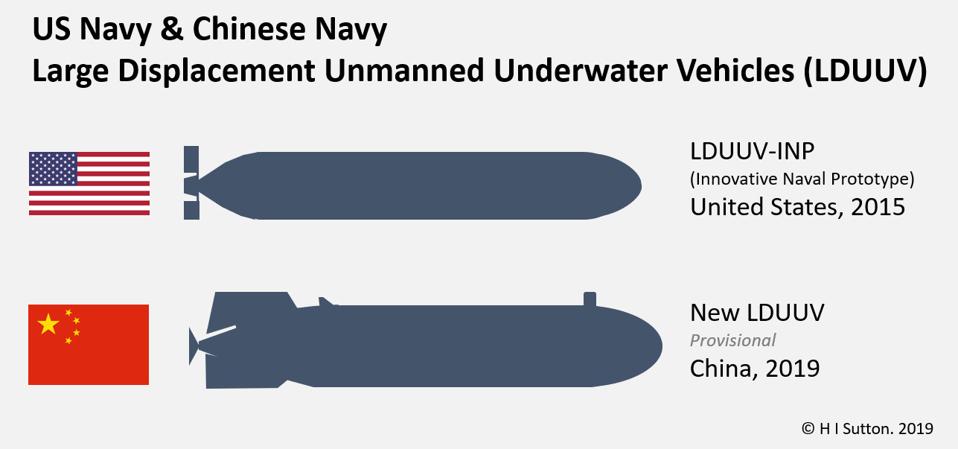
New Intelligence: China’s Navy To Unveil Large Underwater Robot


The New Chinese underwater robot is similar in size to the US Navy's LDUUV.China is about to show the world what it has been working on. The government is expected to put on its largest military parade ever October 1 in Beijing’s Tiananmen Square to mark the 70th anniversary of the founding of the People’s Republic of China. It will be jam-packed with the latest weapons technologies. Much of the new equipment that will be on show is still under wraps, literally. Pouring over grainy candid smartphone photographs of the rehearsals posted on Chinese language social media, military watchers have spotted something hiding under a canvas that I believe will be significant.
One of the camouflage tarpaulins barely hides the outline of what appears to be a very large new underwater robot. Autonomous underwater vehicles, known as AUVs, are the naval equivalent of the killer drones that have rapidly become part of the air warfare landscape. Already a staple of U.S. war-fighting, weaponized unmanned air vehicles (UAVs) are now cropping up in the hands of non-state actors from Syria to Colombia. AUVs, on the other hand, are still the domain of serious navies. And large AUVs are even more elite – most AUVs in service are still very small.

Saturday, September 21, 2019

Robots

Microsoft President Calls for 'Urgent Global Action' to Tackle ‘Unstoppable’ Rise of Killer Robots

A woman holds a poster against drones during a demonstration against the upcoming visit of United States President Barack Obama in Berlin, Monday, June 17, 2013Despite public concern and criticism, numerous countries are developing military drones and autonomous weapon systems that are capable of destroying targets on their own and possibly also of replacing humans on some missions. As the chief of one of the world’s leading tech companies suggests, the global community is unprepared for the shift.
Microsoft President Brad Smith has told The Telegraph that governments urgently need to come up with new rules of the game for using “lethal autonomous weapon systems” being developed by numerous military powers. According to him, these killing machines, which include all kinds of drones with various types of weapons, ranging from guns to bombs, must "not be allowed to decide on their own to engage in combat and who to kill".
He insisted that the world needs a new global convention that will introduce guidelines for this sphere as soon as possible, because, according to his prognosis, killer robots "ultimately will spread… to many countries".
“The safety of civilians is at risk today. We need more urgent action, and we need it in the form of a digital Geneva Convention, rules that will protect civilians and soldiers”, Smith said at the presentation of his new book, Tools and Weapons.

Tuesday, September 3, 2019

Robots

Coming Soon to a Battlefield: Robots That Can Kill

Wallops island—a remote, marshy spit of land along the eastern shore of Virginia, near a famed national refuge for horses—is mostly known as a launch site for government and private rockets. But it also makes for a perfect, quiet spot to test a revolutionary weapons technology.
If a fishing vessel had steamed past the area last October, the crew might have glimpsed half a dozen or so 35-foot-long inflatable boats darting through the shallows, and thought little of it. But if crew members had looked closer, they would have seen that no one was aboard: The engine throttle levers were shifting up and down as if controlled by ghosts. The boats were using high-tech gear to sense their surroundings, communicate with one another, and automatically position themselves so, in theory, .50-caliber machine guns that can be strapped to their bows could fire a steady stream of bullets to protect troops landing on a beach.
The secretive effort—part of a Marine Corps program called Sea Mob—was meant to demonstrate that vessels equipped with cutting-edge technology could soon undertake lethal assaults without a direct human hand at the helm. It was successful: Sources familiar with the test described it as a major milestone in the development of a new wave of artificially intelligent weapons systems soon to make their way to the battlefield.

Saturday, May 11, 2019

Robots

The “third revolution in warfare” is weapons that can decide to kill on their own


Killer robots must be stopped, says PaxIf there’s one thing we’ve learned in recent years, it’s that humans aren’t great at predicting the consequences of technology. After all, social media platforms, which began as a way for friends to connect online, are today being used to radicalize terrorists and potentiallyswing presidential elections.
Imagine, then, the chaos that could ensue with new technologies that don’t even pretend to be friendly. The advent of lethal autonomous weapons—“killer robots” to detractors—has many analysts alarmed. Equipped with artificial intelligence, some of these weapons could, without proximate human control, select and eliminate targets with a speed and efficiency soldiers can’t possibly match.
Seven nations are known to be pursuing such weapons: the US, China, Russia, Britain, France, Israel, and South Korea. Projects include AI-equipped tanks, fighter jets, and machine guns.

Wednesday, May 8, 2019

Robots

Report: Kill the idea of “killer robots” before they kill us


A protest against killer robots in Berlin, Germany
The global competition to develop fully autonomous weapons systems guided by artificial intelligence risks developing into a full-blown arms race, according to a new report from a Dutch peace group.
Lethal autonomous weapons, or “killer robots,” as they are described by Pax, the anti-war NGO behind the report, are designed to select and engage targets without proximate human control. Their advent has been called the “third revolution in warfare” by AI experts—a successor to the invention of gunpowder and the creation of nuclear bombs.
Seven countries are known to be developing lethal autonomous weapons: the US, China, Russia, the UK, France, Israel, and South Korea. Right now, US military policy mandates some level of human interaction when actually making the decision to fire. The other countries maintain they support a ban on fully autonomous lethal weapons. China, however, supports a ban on their use but not on their development.

Saturday, April 13, 2019

Robots

Robot Companions to Carry Gear for Infantry Soldiers

SMET
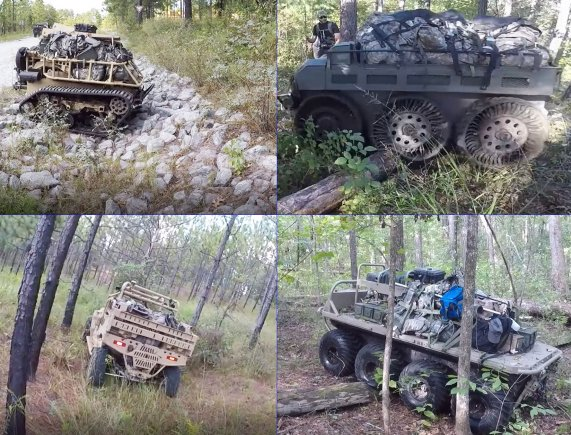
One of the bigger physical hardships an infantry soldier deals with is the burden of carrying his heavy gear dozens of miles. Soldiers today are overburdened, with new technological innovations in weapons and gear that soldiers need to bring with them, some soldiers can find themselves carrying over 60% of their body weight during training exercises and war. The extra weight slows squad movement and tires out soldiers before even making it to the battle, because of this the U.S. Army has created the Squad Multipurpose Equipment Transport (SMET) program.
The idea of the SMET program is to produce a robot that is capable of carrying 1,000 pounds of equipment for a nine man squad. The robot needs to be able to travel up to 60 miles, over 72 hours and be able to provide up to a kilowatt of electrical power for squad devices. The robot is supposed to be controlled by one of the squadmates via a handheld controller.
As part of the SMET program, Textron Systems is developing a robot companion capable of carrying ammunition, weapons, mines, medical equipment, food, water, and practically anything else a soldier will need to bring along with him to battle. The robot, named Grizzly, helps make ground forces more armed and at the same time more agile.

Tuesday, April 9, 2019

Robots

MEET THE PEOPLE FIGHTING BACK AGAINST MILITARIZED KILLER ROBOTS


After winning the Nobel Prize for getting anti-personnel landmines banned, activists Jody Williams and Mary Wareham are leading the charge against killer robots.
The two women are pushing back against the common narrative that autonomous soldiers and killer drones are an inevitable product of technological progress, according to a new profile in The Guardian.
“It’s men getting hard-ons over new weapons,” Williams told The Guardian. “They’re doing it simply because they can. They’re doing it because they want to see where it can go.”
The two activists are trying to get Western nations to sign onto international treaties against fully-autonomous weapons. Most countries in the world support such a treaty, but the U.K., U.S., Russia, and China are pushing toward killer drones and robots.
“Anything is inevitable if you do nothing to stop it,” Williams told The Guardian, drawing a comparison to her anti-landmine activism.

Thursday, March 21, 2019

Robots

Germany urged to champion global treaty to ban 'killer robots'

Картинки по запросу Germany urged to champion global treaty to ban 'killer robots'
Nobel Peace Prize laureate Jody Williams and other activists warned on Thursday that fully autonomous weapons could be deployed in just 3-4 years and urged Germany to lead an international campaign for a ban on so-called “killer robots”.

Williams, who won the Nobel in 1997 for leading efforts to ban landmines, told reporters Germany should take bold steps to ensure that humans remained in control of lethal weapons. “You cannot lead from the rear,” she said.

Critics fear that the increasingly autonomous drones, missile defense systems and tanks made possible by new artificial intelligence could turn rogue in a cyber-attack or as a result of programming errors.

German Foreign Minister Heiko Maas called last week for action to ensure human control of lethal weapons, but is pushing a non-binding declaration rather than a global ban, given opposition by the United States, Russia and China.

Monday, March 11, 2019

Robots

US Army addresses controversial killer robot program


The use of autonomous weapons systems, aka killer robots, is a contentious subject—for obvious reasons. It’s proved particularly controversial for the US Army, which plans to use AI to help identify and engage targets. But the DoD says humans will always have the final say on whether the robots open fire.
The Defense Department is holding an industry day this week to provide industry and academia an opportunity to overview and aid in developing the Advanced Targeting and Lethality Automated System (Atlas), which is designed for ground combat vehicles.
The Army says it wants to use recent advances in AI and machine learning to develop “autonomous target acquisition technology, that will be integrated with fire control technology, aimed at providing ground combat vehicles with the capability to acquire, identify, and engage targets at least 3X faster than the current manual process.”
Back in 2017, Elon Musk was one of 116 experts calling for a ban on killer robots—the second letter of its kind. It arrived not long after a US general warned of the dangers posed by these machines.

Sunday, January 20, 2019

Robots

Robotic Solution for Tunnel Warfare

Some U.S. Army leaders believe future wars will take place underground and in tunnels. A new Swiss robot may be a solution for this kind of warfare. The four-legged robot named ANYmal which was tested exploring the tunnels below Zurich, could by the future of maintenance work and military missions.
ANYmal, developed by Switzerland-based ANYbotics and the ETH Zurich Robotic Systems Lab, resembles the BigDog family of robots by Boston Dynamics. Like them, ANYmal is bouncing mess of limbs that results in a sort of unsettling gait. Special actuators and gait-balancing software enable the whole production, and if need be, a limb can rotate a 360 degrees, according to c4isrnet.com.
The robot reaches a speed of around 2 mph. Its battery holds power for three hours, and the robot can lower itself onto a charging station when it needs to power up. It can be carried into place on a small vehicle or by a couple of people.
The robot’s limbs can push buttons and push open doors, though it would likely take extra modifications to get an ANYmal to manipulate doorknobs.
For the tunnel exploration, the 20-inch tall robot was lowered into place, and then guided by a joystick. Autonomous movement is possible, but using a remote control allowed the human observers to keep a closer eye on what, exactly, the machine was doing underground.

Friday, August 24, 2018

Robots

Using 'killer robots' in war would breach international law, advocates say

(Credit: Paramount)
Fully autonomous weapons would breach international law if used in a theater of war, advocates say, claiming there is a “moral imperative” to ban robots that are programmed to kill.
As the U.S., China and Russia push to become leaders in weapons powered by artificial intelligence, longstanding calls for a ban on killer robots, which experts fear could lead to all-out, highly destructive warfare, have grown.
A new report published by Human Rights Watch and Harvard Law School’s International Human Rights Clinic claims that such autonomous weapons would violate the Martens Clause—a provision of humanitarian law that's widely accepted worldwide.

Sunday, April 29, 2018

Robots

What Happens When Your Bomb-Defusing Robot Becomes a Weapon

An Italian Carabinieri explosive expert gives the thumbs up sign near a bomb disposal robot after it detonated an unattended bag near Grazioli palace, former Italian Premier Silvio Berlusconi residency, in Rome, Oct. 8, 2016.
Micah Xavier Johnson spent the last day of his life in a standoff, holed up in a Dallas community-college building. By that point, he had already shot 16 people. Negotiators were called in, but it was 2:30 in the morning and the police chief was tired. He’d lost two officers. Nine others were injured. Three of them would later die. In the early hours of July 7, 2016, the chief asked his swat team to come up with a plan that wouldn’t put anyone else in Johnson’s line of fire.

Within 30 minutes, their Remotec Andros Mark 5A-1, a four-wheeled robot made by Northrop Grumman, was on the scene. The Mark 5A-1 had originally been purchased for help with bomb disposal. But that morning, the police attached a pound of C4 explosives to the robot’s extended arm, and sent it down the hallway where Johnson had barricaded himself. The bomb killed him instantly. The machine remained functional.