Страницы

Showing posts with label Foreign trade security. Show all posts

Sunday, May 24, 2020

Foreign trade security

US dependence on Chinese imports posing potential threat on national security, think tank says
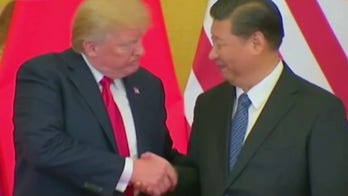
US dependence on Chinese imports posing potential threat on national security, think tank says
A new report by a British think tank shows that the U.S. is strategically dependent on China for 414 categories of imports, of which 114 service its critical national infrastructure -- and in some cases, these could pose a national security risk.

China has steadily increased its share of many markets over the years under the increasingly authoritarian leadership of President Xi Jinping, who has made clear his ambitions for global dominance

Today, the U.S. is strategically dependent on China for antibiotics, including penicillin and chloramphenicol; essential batteries including lithium; rare earth metals and critical elements like tungsten; vitamin supplements and even shipping containers, as well as safety glass, laptops, cell phones, life jackets and anchors.

Strategic Dependency is defined here as when "[a] country is a net importer of a particular good; it imports more than 50 percent of its supplies from China, and China controls more than 30 percent of the global market of that particular good," according to the report.

As China continues to bully economies, Matthew Henderson -- director of the Asia Studies Center at the Henry Jackson Society, and one of the authors of the report -- said that to turn this around requires a "decoupling" of the U.S. and Chinese economy and the forming of new partnerships in the Indo-Pacific region.

Monday, April 29, 2019

Foreign trade security

Illicit global trade of counterfeit goods is national security threat


Illicit global trade of counterfeit goods is national security threatThere is quite literally an army of pirates overseas that is plundering the intellectual property of American and European citizens and businesses. Last week, President Trump issued an executive memorandum about combating pirated goods that calls for a detailed study of counterfeit trafficking and how the United States can better defend its intellectual property. The White House order is one of many initiatives by the United States and European Union to secure our democracies and free markets from the onslaught of authoritarian corruption, kleptomania, and crime.
Who are the victims of this systematic thievery? A recent report by the Organisation for Cooperation and Economic Development showed that innovators in the United States bear the brunt of the costs, as almost 25 percent of all seized goods have American intellectual property rights. France, Italy, Switzerland, Germany, and Japan are under assault as well. Their total losses represent more than 50 percent of the total seizures of counterfeit goods. In many cases, foreign trade zones are key facilitators. The tidal wave of counterfeit and pirated goods, accounting for more than 3 percent of global trade in 2018 according to the report, comes from, you guessed it, China. In fact, China accounts for over half of total fake goods in the world and more than 75 percent if you include Hong Kong.

Thursday, November 23, 2017

Foreign trade security

Fake goods confiscated at Savannah Port

(Source: WTOC)
Ports all across the country are seeing an increase in the number of containerships with illegal goods.
Officials say this is a year-round effort and the goal is to make sure no illegal items that could put your family in danger get on the market.
U.S. Customs and Border Protection Port Security confiscated everything from professional sports jerseys to wearable technology to toys over the past year. Area Port Director Lisa Beth Brown says toys are especially concerning.
“Toys are an issue because high amounts of lead paint could be used. Choking hazards with toys or parts that are designed for small children. Those are also safety concerns from consumers,” Brown said. 
Many of the items are confiscated because they have trademark violations or are illegal, like brass knuckles with a retractable curved blade. Officials say blocking the sales of these products not only protects Americans but also reduces the cash flow in the world of crime.
“The profits from these illegal sales often support organized crime and criminal activities such as money laundering, smuggling, and trafficking in illegal weapons and narcotics,” Brown said. 

Saturday, July 22, 2017

Foreign trade security

Pretextual Protectionism? The Perils of Invoking the WTO National Security Exception


On Wednesday, Axios wrote a piece outlining how President Trump’s own statements could threaten his trade policy objectives: “President Trump wants to invoke a national security provision to stop the ‘dumping’ of cheap steel into America, but trade lawyers believe Trump's public statements —and dubious legal reasoning—could expose the administration to significant legal problems.”
Candidate Trump spent much of the 2016 campaign criticizing free trade and threatening to renegotiate international trade agreements or pull the U.S. out of the World Trade Organization (WTO). Now, as president, Trump has instructed the Commerce Department to investigate whether steel imports threaten national security and whether to invoke an obscure national security exception to circumvent the WTO’s restrictions on tariffs and nontariff barriers.

Thursday, June 29, 2017

Foreign trade security

China concerned by U.S. probe of aluminum imports on national security grounds

FILE PHOTO: A worker walks through an aluminium ingots depot in Wuxi, Jiangsu province, China September 26, 2012.   REUTERS/Aly Song/File Photo
China is "concerned" by Washington's probe into aluminum imports from the world's top producer of the metal on national security grounds, China's Commerce Ministry said on Thursday, as the two economies' 100-day trade talks continue.

Washington is investigating aluminum imports from China under the rarely used section 232 of the Trade Expansion Act of 1962 that allows restrictions on imports for reasons of national security. The administration is also conducting a separate investigation into steel.

"The scale of 'national security' is very wide and lacking clear definition, which is easily misused and therefore posing restrictions on normal flow of international trade," Sun Jiwen, spokesman at China's Commerce Ministry, said at a weekly briefing.

His comments come after senior officials told Reuters that U.S. President Donald Trump is growing increasingly frustrated with China over its inaction on North Korea and bilateral trade issues and is now considering possible trade actions against Beijing.

Thursday, June 15, 2017

Foreign trade security

Is American National Security at Risk From Imported Military Gear?

National security has been used to justify some pretty silly protectionism in the United States. The Berry Amendment, to pick an egregious example, prohibits the Defense Department from importing any kind of clothing,  including "outerwear, headwear, underwear, nightwear, footwear, hosiery, handwear, belts, badges, and insignia." The International Trade Administration, an arm of the Commerce Dept., implausibly insiststhat the Berry Amendment "has been critical to maintaining the safety and security of our armed forces."
Sometimes, though, imports really can imperil national security. For Pentagon planners, the nightmare scenario is a war with China in which the foe stops supplying critical components to the U.S. military—or triggers malware embedded in Chinese-made computer chips that cripples missiles and fighter jets. To guard against that, the Defense Department does its best to prevent the use of Chinese microelectronics in military gear.
The key is to protect legitimate security interests without forcing taxpayers to pick up the tab for wasteful protectionism.

Monday, February 15, 2016

Foreign trade security

EU hits China with new steel anti-dumping probes


European steelmakers are reeling from a global glut and last week Luxembourg-based world leader ArcelorMittal blamed China for a colossal $8-billion (€7.1 billion) loss in 2015 while thousands of jobs are being cut.
“We cannot allow unfair competition from artificially cheap imports to threaten our industry. I am determined to use all means possible to ensure that our trading partners play by the rules,” EU Trade Commissioner Cecilia Malmström said in a statement.
The European Commission, the EU’s executive arm, had opened an investigation into imports of seamless pipes, heavy plates and hot-rolled flat steel from China, the statement said.
The Commission separately imposed anti-dumping duties on cold-rolled flat steel imports from China and Russia.
It recalled that it recently also imposed anti-dumping measures on Chinese steel bars used in the construction industry.

Thursday, June 4, 2015

Foreign trade security

Wikileaks releases ‘largest’ trove of docs exposing secret TiSA trade deal


A screenshot from https://wikileaks.org/tisa/WikiLeaks has published 17 secret documents related to a controversial trade agreement currently being negotiated behind closed doors between the US, EU and over 20 WTO members. NGO Global Justice Now called the leak “a dark day for democracy.”