Страницы

Showing posts with label Slavery. Show all posts

Sunday, August 14, 2016

Slavery

The UK Modern Slavery Act - What you need to know and do to comply


Lock
The Modern Slavery Act 2015 (the “Act”) became law in the UK on March 26, 2015 and came into force on October 29, 2015. Companies subject to the Act are now required to publish an anti-slavery statement as soon as possible (and within a maximum of six months) of the end of their financial year which falls on or after March 31, 2016.

What is the Modern Slavery Act?

The Act consolidates previous UK legislation tackling slavery, child labour, and human trafficking offences, and demands that organisations make public the steps they are taking to ensure that modern slavery offences are not taking place in either their business, or their supply chain.
Offences under the Act include:
  • slavery, bonded, forced, or compulsory labour;
  • human trafficking;
  • criminal exploitation;
  • sexual exploitation; and
  • domestic servitude.

Tuesday, June 21, 2016

Slavery

The Developed World Is Missing the Point About Modern Slavery


Rakib works in a parts making shop in Dhaka, Bangladesh JuneEarlier this month, the Walk Free Foundation — an Australian NGO — released the first ever “modern slavery index,” which hoped to highlight the countries most affected by modern slavery, and the countries that still need to resolve the problem. The countries that scored worst are, perhaps unsurprisingly, all in the developing world: North Korea, Uzbekistan, Cambodia, India, China and Qatar. The countries that performed best were all in Europe and North America.
Like many studies from Western NGOs, it would appear that Walk Free’s findings shed light on wrongs done elsewhere, but avoid looking closer to home (such as the conditions of aboriginal Australians and the labor exploitation on Australian-owned mines in Africa). Their index may be a useful data set, but charity and trafficking experts have argued that it presents an “unsophisticated” understanding of the problem — and thus risks giving the wrong impression. 

Wednesday, June 1, 2016

Slavery

Global Slavery Index reports nearly 46 million people are enslaved in 2016

The Global Slavery Index reported their annual findingson Tuesday, putting the total number of enslaved people around the world at an estimated 45.8 million, up from an estimated 35.8 million in 2014. Fifty-eight percent of those living in slavery are in India, China, Pakistan, Bangladesh, or Uzbekistan, the report found. Proportionally, North Korea, Uzbekistan, Cambodia, India, and Qatar have the highest populations of people in modern slavery, with one in every 20 people in North Korea being a slave.

Monday, May 30, 2016

Slavery

FACTBOX -From sex trafficking to forced labour, what is modern slavery?


Poverty

Modern slavery has become a catch-all term to describe human trafficking, forced labour, debt bondage, sex trafficking, forced marriage and other slave-like exploitation.

Nearly 46 million people are enslaved around the world, according to the 2016 Global Slavery Index published on Tuesday.

While there is no globally agreed definition of modern slavery, some of the key elements are defined below. Many forms of slavery involve more than one of these elements.

BONDED LABOUR: People become bonded labourers after falling into debt and being forced to work for free to repay the lender. Many will never pay off their loans, and debt can be passed down through the generations. Bonded labour has existed for hundreds of years and flourishes in South Asia in agriculture, brick kilns, mills and factories.

DESCENT-BASED SLAVERY: When people are born into slavery because their families belong to a class or caste of "slaves" in countries that have strict hierarchical social structures.

Sunday, April 17, 2016

Slavery

The Shame of the Jesuits


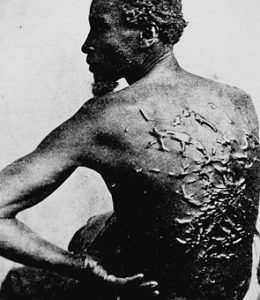
A photograph showing the whipping scars on the back of an African-American slave.Anti-war prophet Rev. Daniel Berrigan, S.J., was onto something with his “hunch” – in his 1987 autobiography, To Dwell in Peace – that “the fall of a great enterprise,” the Jesuit university, would end up “among those structures whose moral decline and political servitude signalize a larger falling away of the culture itself.”
Berrigan, a Jesuit himself, lamented “highly placed” churchmen and their approval of war, “uttered … with sublime confidence, from on high, from highly placed friendships, and White House connections. Thus compromised, the Christian tradition of nonviolence, as well as the secular boast of disinterested pursuit of truth — these are reduced to bombast, hauled out for formal occasions, believed by no one, practiced by no one.”
But that “moral decline” among Jesuit institutions of higher learning may have had deeper roots than even Berrigan understood. One of those deep roots is drawing national attention, an 1838 decision by the Jesuit leaders of the Jesuits’ Maryland Province and Georgetown College to improve the school’s financial health by selling 272 African-American men, women and children as slaves into the Deep South.