Страницы

Showing posts with label Wildlife smuggling. Show all posts

Sunday, December 24, 2017

Wildlife smuggling

These heroic rats detect land mines. Now they might help save an endangered anteater.

These heroic rats detect land mines. Now they might help save an endangered anteater.
The pangolin, an endangered anteater that is one of the world's most poached animals, could use a hero. Fortunately, a big rat is training for the job.

Actually, 11 African giant pouched rats are. At a research center in central Tanzania, the 2-foot-long rodents are learning to detect the smell of pangolins' armor-like scales, which are smuggled to Asia for use in sham traditional remedies. If the rats succeed, they and their twitching noses could eventually deploy to ports, national park borders and even highways to sniff out illegal shipments and help bust traffickers.

The species already has a strong track record in detection. The Belgian organization APOPO has been training their "heroRATS" to find land mines for 20 years, and it says the animals have helped clear more than 100,000 mines from former war zones. In the past decade, the rats have been used to detect tuberculosis, a highly infectious disease that public health facilities often miss.

Saturday, November 4, 2017

Wildlife smuggling

Smuggled, Beaten and Drugged:The Illicit Global Ape Trade

The sting began, as so many things do these days, on social media.

Daniel Stiles, a self-styled ape trafficking detective in Kenya, had been scouring Instagram, Facebook and WhatsApp for weeks, looking for pictures of gorillas, chimps or orangutans. He was hoping to chip away at an illicit global trade that has captured or killed tens of thousands of apes and pushed some endangered species to the brink of extinction.

“The way they do business,” he said of ape traffickers, “makes the Mafia look like amateurs.”

After hundreds of searches, Mr. Stiles found an Instagram account offering dozens of rare animals for sale, including baby chimpanzees and orangutans dressed in children’s clothes. He sent an email to an address on the account — “looking for young otans” (the industry standard slang for orangutans) — and several days later received a reply.

“2 babies, 7.5k each. Special introductory price.”

The trafficker identified himself only as Tom and said he was based in Southeast Asia. Mr. Stiles knew what Tom was hoping for: to sell the infant orangutans to a private collector or unscrupulous zoo, where they are often beaten or drugged into submission and used for entertainment like mindlessly banging on drums or boxing one another. Such ape shows are a growing business in Southeast Asia, despite international regulations that prohibit trafficking in endangered apes.

Wednesday, September 27, 2017

Wildlife smuggling

Traffickers find new ways to smuggle rhino horn out of Africa

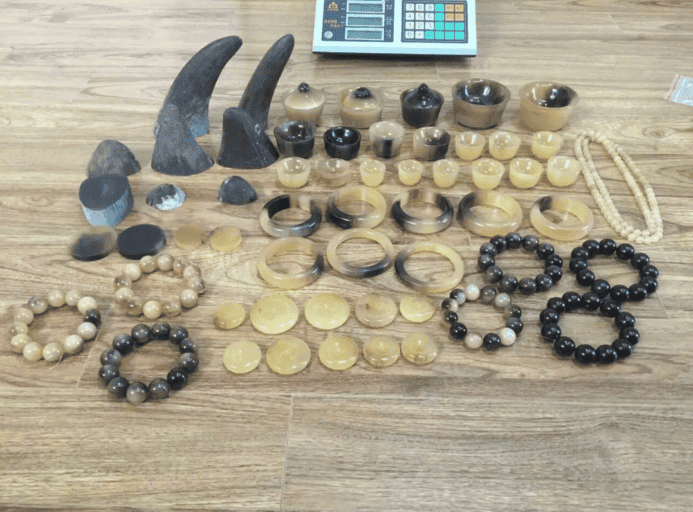
Instead of shipping poached rhino horns whole or in chunks, transnational criminal networks have started manufacturing jewelry and other rhino-horn trinkets in southern Africa, according to a new report from conservation NGO Traffic.
Beads, bangles and other carved rhino-horn trinkets have previously been found in destination countries like Vietnam and China. However, manufacturing such products before shipping them out of Africa represents a new tactic for evading detection, and indicates a possible shift in consumer demand.
“I think it makes it extraordinarily difficult for law enforcement agencies,” said Julian Rademeyer, a South Africa-based project leader for Traffic and one of the authors of the report. “They are already overstretched and under-resourced, and who’s going to be able to stop someone walking through an airport wearing a rhino-horn bracelet or bangle or beads, or carrying them in a bag? It’s not the sort of thing that law enforcement agencies and customs officials are looking for. They’re looking for whole horns or chunks of horns.”

Saturday, September 23, 2017

Wildlife smuggling

North Korea said to be revitalising African wildlife trafficking


When Mozambican police detained a suspected North Korean spy and taekwondo master along with Pyongyang’s political attaché to South Africa, they found $100,000 in cash and 4.5kg of rhino horn stashed in the diplomats’ Toyota. After Pyongyang’s ambassador to Pretoria intervened, the two were quietly released and later allowed to return to North Korea at the end of last year. The 2015 arrest, recounted in a report by the Global Initiative Against Transnational Organised Crime and corroborated by the Financial Times, is part of what researchers say is a revitalised web of North Korean state-sanctioned criminal activity focused on rhino horn, ivory and minerals in Africa. The report by the non-governmental agency, released on Friday, said Pyongyang’s “smuggling networks, front companies and state-sponsored criminal actors are sophisticated, efficient and adept at circumventing sanctions, laws and regulations”.

Tuesday, August 15, 2017

Wildlife smuggling

Crime fighters urged to step up fight against organised gangs behind multi-billion dollar wildlife trade


Dehorning program in Zimbabwe
But Thailand's decision to "follow the money" is far from common practice in wildlife crime investigation.
Wildlife crime has grown into a significant area of transnational organised crime, worth between $9 billion and $29 billion a year.
It threatens the existence of thousands of species of plants and animals, and affects almost every country in the world as a source, transit or destination for illegal products.
But a joint investigation by the Asia Pacific Group on Money Laundering and the UN Office of Drugs and Crime found despite an increase in large seizures of protected wildlife species and products, and the increased involvement of organised criminal groups, wildlife crime was too often viewed as an "emerging crime" or "outside of mainstream crime".

Wednesday, July 26, 2017

Wildlife smuggling

Man arrested after live cobras found inside potato chip cans


A king cobra snake seen coming out of container of chips in this undated handout.
A California man was arrested after a package addressed to him was found with three live king cobras hidden inside potato chip cans, US officials said.
Rodrigo Franco, 34, was arrested in Los Angeles and charged with illegally importing merchandise.
Customs officials discovered the snakes, about two-feet long, while inspecting a package that was mailed to Mr Fanco from Hong Kong in March.
The shipment also contained three albino Chinese soft-shelled turtles.

Wednesday, July 5, 2017

Wildlife smuggling

Watchdog says Chinese town is major ivory smuggling hub


FILE - In this Friday, May 29, 2015 file photo, Chinese officials watch as workers prepare ivory products for destruction during a ceremony in Beijing. An environmental watchdog group says its investigation has found that a little-known town in southAn environmental watchdog group says its investigation has found that a little-known town in southern China is a major hub for ivory smuggling by organized criminal gangs.
The Washington, D.C.-based Environmental Investigation Agency said in a report Tuesday that it uncovered a network of ivory trafficking syndicates operating out of Shuidong in Guangdong province, near Hong Kong.
The group says its investigators worked undercover posing as buyers to win the trust of a smuggling group and tracked one of its shipments from Mozambique.
Syndicate members told the EIA theirs was just one of 10-20 ivory trafficking groups operating out of Shuidong, the group said.
They claimed that 80 percent of all poached ivory smuggled from Africa to China passes through the town — a startling figure that's impossible to corroborate.

Saturday, March 4, 2017

Wildlife smuggling

Global probe into wildlife smuggling results in more than 1,300 seizures — including some in Canada


A Canadian at the head of an international body fighting wildlife smuggling says a three-week investigation was designed to provide a snapshot of what was happening in the illegal trade of wildlife and forestry products. In Canada, the hides of polar bears were seized.
A Canadian at the head of an international body fighting wildlife smuggling says a three-week investigation resulted in more than 1,300 seizures worldwide — including some in Canada.
“Wildlife crime is a worldwide phenomena,” said Sheldon Jordan, head of Environment Canada’s wildlife enforcement and chairman of the wildlife crimes working group for Interpol, the international agency that co-ordinates law enforcement.
“We’re all destination countries, but we’re all source countries as well.”
Working with law enforcement in 43 countries, Jordan’s group mounted Operation Thunderbird, which ran from Jan. 30 to Feb. 19.

Friday, March 3, 2017

Wildlife smuggling

Malaysia clamps down on wildlife smuggling: five operations in a fortnight

Wildlife authorities in Malaysia have arrested five people and seized 209 live wild animals destined for the illegal exotic pet trade, the vast majority of them songbirds, about to be smuggled out of the country by a single trader. 

In one of five separate operations in the last two weeks of February, the Department of Wildlife and National Parks Peninsular Malaysia (Perhilitan) officers foiled an attempt in the east coast State of Pahang to smuggle 156 White-rumped Shamas Copsychus malabaricus, three Common Hill Mynas Gracula religiosa and six Red Junglefowls Gallus gallus.

Sunday, January 1, 2017

Wildlife smuggling

China Seizes Massive Amount of Pangolin Scales in Biggest-Ever Smuggling Case

Customs finds 3 tons of pangolin scalesPangolin—the world's most trafficked mammal—continues to be killed in huge numbers.
On Wednesday, Chinese customs officials announced that they had seized more than three metric tons (3,000 kilograms or 6,600 pounds) of pangolin scales in Shanghai. This is the country's largest-ever smuggling case involving pangolin parts, officials reportedly said.
Customs officials discovered the massive amount of scales on Dec. 10, 2016. The scales had been packed in 101 bags concealed within a timber consignment imported from Africa. Some 5,000 to 7,500 wild pangolins are estimated to have been killed for these scales, officials told ShanghaiDaily.com.

Monday, November 21, 2016

Wildlife smuggling

Tortoise smuggling caught by Detroit border officer


Seven Indian Star turtles discovered in an illegal smuggling shipment in Cincinnati this summer are now part of an exhibit at the city’s zoo.
Seven Indian Star tortoises discovered in an illegal smuggling shipment in Cincinnati this summer are now part of an exhibit at the city's zoo.
A Detroit border official temporarily working in Cincinnati discovered the shipment in late July, according to a news release issued Monday from U.S. Customs and Border Protection.
The Indian Star tortoise is a threatened species. These seven reptiles, which were packaged and labelled as a porcelain doll, were heading to Miami Lakes, Fla., on route from Malaysia.
Officers opened the package and found a plastic container taped shut with ventilation holes punched through the top. 
"This is a vulnerable species because their population is decreasing," said Cincinnati border protection port director Richard Gillespie. "The successful interception of these seven live tortoises highlights the outstanding work of our officers and our collaborative efforts with the [U.S. Fish and Wildlife Service] inspectors."

Wednesday, November 16, 2016

Wildlife smuggling

90 illegal elephant tusks discovered in Vienna


90 illegal elephant tusks discovered in Vienna
    It’s the largest amount of illegal ivory ever found in Austria.
    90 elephant tusks measuring up to 2 metres long, some of them with intricate carvings, were discovered. A stuffed armadillo was also found. The tusks were wrapped in blankets and hidden behind boxes in the two apartments.
    Police believe the ivory was smuggled to Europe by sea, and then to Austria by road. It’s likely that the tusks were to be sold to buyers in Asia. China and Vietnam are the largest markets for ivory.
    The smuggling ring was uncovered after police were tipped off that a man was trying to sell three elephant tusks on the streets of Vienna. The buyer was identified as an Austrian who had already broken the law by buying illegal wildlife.

    Saturday, September 17, 2016

    Wildlife smuggling

    Passenger smuggling iguanas in luggage delays WestJet flight in Toronto

    A WestJet flight was grounded in Toronto after customs officers determined there were iguanas loose in the aircraft.
    WestJet spokesperson Lauren Stewart says a passenger on a flight from Cuba to Toronto was discovered to be carrying iguanas in his checked luggage.
    Stewart says the passenger had hidden four iguanas in his luggage but when they were discovered by customs officers in Toronto, only two of the lizards were in the suitcase.
    The flight crews were notified and the plane was stopped in order to have the cargo hold fumigated to prevent the escaped lizards from chewing through wires or damaging the aircraft.
    Stewart says the aircraft couldn’t fly on to Vancouver due to the delay, but passengers were transferred to another plane that left 50 minutes later.
    Stewart says this type of incident is uncommon but reminds customers to always book their pets with the airline ahead of time and bring them in proper carrying cases to ensure they are safe and comfortable.