Страницы

Showing posts with label Innovations & technology. Show all posts

Thursday, October 3, 2019

Innovations & technology

DARPA In Talks With New Robot Sat Servicing Company
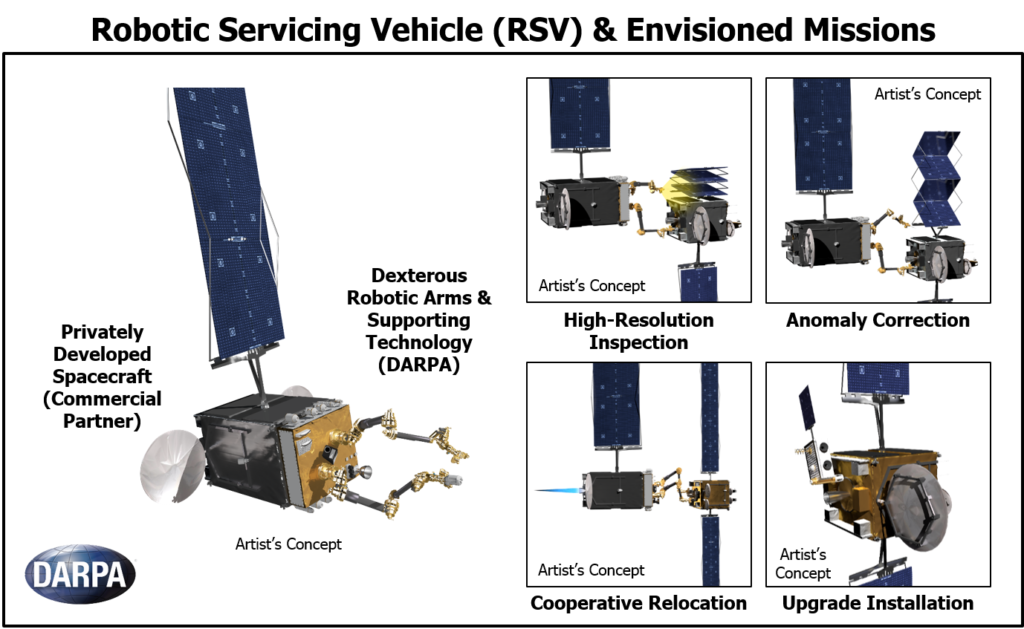
DARPA will announce a new partner to replace Maxar Technologies for its robotic servicing spacecraft program “sometime before the end of the year,” says program manager Joe Parrish. DARPA is looking at a launch date in 2022.“We’ve every good reason for optimism,” he told the 2019 Global Satellite Servicing Forum on Tuesday.

The DARPA effort, called Robotic Servicing of Geosynchronous Satellites (RSGS), is designed to create operational capability for “dexterous” robotic repair in space to increase the resiliency of the US satellite architecture. RSGS will be “a first concrete step toward a transformed space architecture with revolutionary capabilities,” he said.

The project got off to a bad start. DARPA awarded the original RSGS contract to Space Systems Loral (now part of Maxar Technologies) in February 2017, at which point Orbital ATK (now part of Northrop Grumman) sued on grounds that DARPA was violating US government policy by competing directly with its own planned servicing vehicle, called the Mission Extension Vehicle (MEV). Orbital’s lawsuit was thrown out in July 2017.

Monday, March 11, 2019

Innovations & technology

Low-cost X-60A hypersonic missile passes design review


Artist's concept of the X-60A in flightThe US Air Force Research Laboratory (AFRL) has given the green light to start building a new hypersonic rocket capable of flying at eight times the speed of sound. Being developed in partnership with Generation Orbit Launch Services, the X-60A vehicle has passed its Critical Design Review and now moves into the fabrication phase in anticipation of its maiden flight sometime in 2020.
Creating a new generation of hypersonic aircraft isn't easy and it isn't cheap. In fact, one of the stumbling blocks for creating aircraft and missiles that operate at speed of over Mach 5 (3,806 mph, 6,125 km/h) is that the bills often mount faster than the technological hurdles present themselves.
To keep the budget busting to a minimum, the US Federal Aviation Administration-licensed Cecil Spaceport in Jacksonville, Florida and the Air Force Small Business Innovative Research program are looking at ways to reduce development costs by moving flights outside of traditional US Department of Defense flight test ranges.

Monday, June 12, 2017

Innovations & technology


Study improves remote detection of hazardous radioactive substances


A recent study, affiliated with UNIST has introduced a method for the remote detection of hazardous radioactive substances. With the help of this newly-developed detection device, the detection of various types of radioactive materials can be done from a remote distance.
In their study, published in the May issue of the journal, Nature Communications, Professor Eunmi Choi of Natural Science and her team demonstrated a method with higher sensitivity that uses high-power pulsed electromagnetic-waves to detect a radioactive source.
A substance is said to be radioactive if it contains atoms with unstable nuclei and gives out nuclear radiation in the form of alpha particles, beta particles or gamma rays. Uranium-235 (U-235) is an isotope of uranium widely used for nuclear power generation and, like all other radioactive isotopes used in medicine, it has been also employed for diagnosis and treatment of diseased organs and tumors. They are essential to humankind, but can have fatal consequences if it is accidentally leaked or used as a weapon.

Friday, December 30, 2016

Innovations & technology

Keep the French in the dark: Thatcher's secret push for US military technology

Geoffrey Howe and Margaret Thatcher
Keep the French “in the dark” and raise “three cheers!” to our American allies emerge as recurrent themes in top secret documents debating how to secure advanced military technology during the 1980s.
Files released to the National Archives in Kew on Friday show how UK ministers favoured the US shuttle launch system for military satellites over Ariane rockets.
A 1983 memo from the Ministry of Defence to the prime minister warns there is “French pressure on us to be ‘European’ and go for Ariane”.
Margaret Thatcher agreed that it was better to go with the American shuttle, which was cheaper and had a better safety record.

Tuesday, December 1, 2015

Innovations & technology

Digital Barriers uses space technology to spot concealed weapons and suicide bombs


A hi-tech camera invented in Oxford’s world-famous science research facility Rutherford Appleton Laboratory (RAL) and originally designed to map the Earth’s ozone layer is now being used to find concealed weapons, contraband and suicide bombs.
ThruVision, which can detect the different heat signatures generated by the human body and concealed items, is the only technology of its kind, its inventors claim.
The system can detect threats through multiple layers of clothing, using Terahertz energy, which does not penetrate the body, and can be used at a distance.

Sunday, August 2, 2015

Innovations & technology

A Breakthrough in Bullet-Proof Armor Technology

The U.S. navy’s Naval Research Laboratory is currently in the process of developing an invisible bullet-proof protection armor. This armor is based on a material called Spinel, which is several times stronger than bullet-proof glass and can protect soldiers in all sorts of combat enironments. Dr. Jess Sanghera, one of the researchers, says that this new material will provide better protection for the military force placed in a hostile environment. Furthermore, the material’s light weight allows to use it in aerial vehicles such as UAVs. 
Innovations & technology

Laser technology is reaching awesome power outputs

Researchers at the University of Osaka have built a 2-petawatt laser — that’s 2 quadrillion watts. This power is greater than today’s most powerful military lasers.
The Osaka laser system, called Laser for Fast Ignition Experiments, or LFEX, is not intended for military use, but that amount of power has clear military applications. Compare it to today’s cutting-edge military lasers, which include the 30-kilowatt Laser Weapons System currently mounted on the amphibious warship USS Ponce in the Persian Gulf. The LaWS has never been used in combat, but it took out several moving targets in a November demonstration.

Friday, July 31, 2015

Innovations & technology

Study: Metals industry faces big change with 3-D printing


The Portland-Vancouver region's expansive metals industry needs to prepare quickly for the disruptive technological change that 3-D printing technology is about to bring to metals manufacturing, says a report released Thursday by two jobs development organizations, the Vancouver-based Columbia River Economic Development Council and the regional Greater Portland Inc.
The report, titled "Additive and Subtractive: The New Math of Metals and Machinery Manufacturing," looks broadly at imminent changes that will affect the region's metals industry, which encompasses more than 600 companies including dozens in Southwest Washington.

Thursday, July 30, 2015

Innovations & technology

Civilian Technology In a Rugged Package

Many tools used in both the civilian industry and the military one work in difficult conditions, which forces the delicate electronic equipment that’s inside these modern tools to work in a tough environment, including high or low temperature, moist, dust, shakes, hits and scratches, screen visibility in different light conditions, overcoming radio disruptions (natural or intentional) and more. 

Wednesday, July 29, 2015

Innovations & technology

3D XPoint Memory Technology Could Usher In A New Golden Age Of Electronics

3D XPoint SlideIntel INTC +2.38% and Micron jointly announced a brand new memory technology today, dubbed 3D XPoint (Cross Point) memory. 3D XPoint is fundamentally a new class of memory, the first to be introduced in many years. For more information on the technology itself, I’d recommend reading this article, as it covers many of the technical details made during today’s announcement.

Monday, July 27, 2015

Innovations & technology

SAMSUNG TO DEVELOP 5 TIMES FASTER WI-FI TECHNOLOGY


Wifi_logoSamsung has taken a big leap in this space and is developing an extremely fast Wi-Fi technology that will offer 5 times faster speeds than today’s Wi-Fi networks. The new 802.11ad Wi-Fi technology can turbo-charge network speeds five folds, from the maximum speed of 866 Mbps offered today to a whopping 4.6 Gbps.  Imagine a superfast Wi-Fi speed which will make downloading a movie file possible at the blink of an eye.

Wednesday, July 15, 2015

Innovations & technology

Russia to Surprise Rivals With Defense, Security Innovations - Putin

President Vladimir Putin visits Terra Scientia Russian Educational Youth ForumIn June, Putin said that Russia's defense industry must drive innovation, as forward-thinking is especially important for the fields of energy, engineering, communication and microelectronics, which are major sources of economic growth.


Monday, July 13, 2015

Innovations & technology

In the New Cold War, Technology Is the Enemy of the State

El dinero electrónico y aplicaciones que facilitan la vida son los nuevos desafíos para los Estados. (Ebankingnews.com)Technological innovation has put the world in a position to face a “cold war” once again. In the future, there will still be studies that examine the conflict between the United States and the Soviet Union, but as a footnote, compared to what is headed our way.+The key players will no longer be governments alone, obsessed with space, weapons, and scientific races. There’s no time for that: technology, the new enemy, has revealed that governments are becoming increasingly obsolete appendages whose vital functions are in decline. The signs are clear.

Sunday, July 12, 2015

Innovations & technology

Israeli Innovation – Next Generation

מקום ראשוןThe faculty for mechanical engineering in the Israel Institute of Technology has presented the 18 new projects developed by fourth year students who worked in collaboration with the Israeli industry. First place was won by a team of three students who build a device for the release of pre-destinated cargo from a tiny submarine. The device is meant to relase cargo from an autonomous submarine which developed in the institute and place it in a defined location on the bottom of the sea and can be used for various purposes.