Страницы

Showing posts with label Special operations. Show all posts

Friday, September 27, 2019

Special operations

MORE U.S. COMMANDOS ARE FIGHTING INVISIBLE WARS IN THE MIDDLE EAST

Green Berets assigned to 3rd Special Forces Group (Airborne) move to a landing UH-60 helicopter for extraction during a training event near Nellis Air Force Base, Nev. Aug. 26, 2019. U.S. Special Forces trained with U.S. Air Force Joint Terminal Attack Controllers and utilized weapons ranging from small arms to A-10 Thunderbolt ll aircraft.. (U.S. Army photo by Sgt. Steven Lewis)THE PERCENTAGE OF commandos deployed to the Middle East is on the rise, according to new statistics provided to The Intercept by U.S. Special Operations Command. On average, more than 4,000 Special Operations forces — Navy SEALs, Army Green Berets, and Marine Corps Raiders among them — are deployed to the region each week, more than anywhere else in the world.
The increase comes at a time when the United States is apparently planning a troop drawdown in Afghanistan, despite a peace agreement with the Taliban having fallen apart. It also coincides with President Donald Trump’s announcements that the Islamic State has been defeated and that the U.S. is “rapidly pulling out of Syria.” Gone are the military surges that brought tens of thousands of conventional U.S. forces to Iraq and Afghanistan. Gone, too, is the faddish fixation with counterinsurgency, rehabilitated from the Vietnam War dustbin (only to be deep-sixed again) and the military’s “government in a box” pipe dreams.
Today, American warfare is increasingly typified by a reliance on Special Operations Forces, private contractors, local proxies working with and for the military and CIA, and air power. These low-visibility forces make greater secrecy and less accountability more likely for U.S. military actions in the Middle East, said Daphne Eviatar, director of the Security with Human Rights program at Amnesty International USA, who views the growing reliance on commandos as both predictable and troubling.

Tuesday, September 10, 2019

Special Operations

Passing the paramilitary torch from the CIA to Special Operations Command


U.S. Special Operations Command regularly demonstrates its ability to conduct “operational preparation of the environment” activities to support counterterrorism and unconventional warfare that seemingly only differ from paramilitary activities in the authorities under which they are executed. Whereas paramilitary activities is conducted under Title 50 of U.S. Code (USC), Operational Preparation of the Environment and other military activities are executed under Title 10 USC. More practically speaking, the CIA conducts paramilitary activities with the intention to effect some sort of fundamental change against a foreign target without the U.S. government’s role ever being clearly evident, while the Defense Department conducts Operational Preparation of the Environment ostensibly in support of traditional military activities that might reasonably demonstrate a U.S. government role at some point. However, the Defense Department now arguably characterizes activities that could easily be described as paramilitary activities as Operational Preparation of the Environment “where the slightest nexus of a theoretical, distant military operation might one day exist.” Consolidation of the covert paramilitary responsibility with existing Operational Preparation of the Environment requirements would not create so much of an additional burden on U.S. Special Operations Command as it would reduce duplication of capability at both the CIA and Defense Department.


Monday, October 24, 2016

Special operations

US Special Operators Accelerate Killings of ISIS Leaders

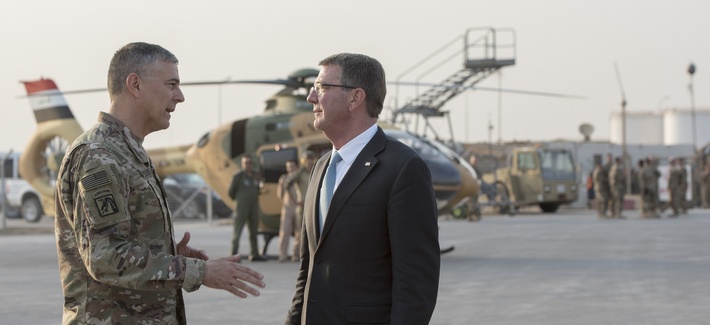
  Secretary of Defense Ash Carter and U.S. Army Lt. Gen. Stephen Townsend, commander of Combined Joint Task Force-Operation Inherent Resolve, say farewell in Erbil, Iraq, Oct. 23, 2016.
U.S. special operators in northern Iraq and Syria are killing Islamic State leaders at a faster pace, disrupting the organization’s defense of Mosul and, more importantly to Pentagon leaders, their ability to plot attacks against the United States and other targets outside the region.

Defense Secretary Ash Carter, in a Sunday visit with American and coalition forces at the Joint Operations Center in Erbil, the Kurdish capital in northern Iraq, said he commended American fighters here who are supporting “elements in Syria” and working to envelop Raqqa. Quickening the pace of targeting ISIS leaders, known in military parlance as “high-value targets” or “high-value individuals,” has hurt the terrorist group’s ability to launch external “attacks aimed at our own people, our own country, and friends and allies,” he said.

“That remains our highest priority, always,” Carter said, “those external operations.”

Thursday, January 7, 2016

Special operations

The shadowy JSOC general expected to be next leader of America’s special operations forces

It’s a big week in the world of special operations: the Army’s two most senior special operations officers, Gen. Joseph Votel and Lt. Gen. Raymond “Tony” Thomas, are the Pentagon’s new picks to lead two of its most influential four-star headquarters. The moves are not yet official, but they would put Votel and Thomas in charge of U.S. Central Command and U.S. Special Operations Command respectively, both based in Tampa, Florida.
The Washington Post has profiled Votel, who will be leaving the latter command to lead the former. But Thomas, the heir apparent to SOCOM, is a more shadowy figure. Like Votel, he is a veteran of the Army’s elite Ranger light infantry force. He has also held key posts in the top-secret counterterrorism unit popularly known as Delta Force.