Страницы

Showing posts with label Arms trade. Show all posts

Tuesday, July 7, 2020

Arms trade

China slams U.S. as it joins global arms trade treaty at U.N

pngimg.com/uploads/un/un_PNG14.png
China on Monday joined a global arms trade treaty spurned by the United States, taking a swipe at U.S. President Donald Trump’s administration by accusing it of bullying, unilateralism and undermining efforts to combat global challenges.

China’s U.N. ambassador, Zhang Jun, said he had deposited China’s instrument of accession to the treaty, which regulates a $70 billion global cross-border trade in conventional arms and seeks to keep weapons out of the hands of human rights abusers.

China, which announced its plans in September, becomes the 107th party to the pact, approved by the U.N. General Assembly in 2013. Then-U.S. President Barack Obama signed it, but it was opposed by the National Rifle Association and never ratified by the U.S. Senate.

Monday, March 23, 2020

Arms trade

Russian Arms Exports in 2019 Surpassed $15.2 Billion

Kalashnikov assault rifle
 Russia exported arms worth more than $15.2 billion in 2019, to around 50 different countries, Russian Deputy Defence Minister Alexander Fomin said.
"As of the end of last year, Russia maintains a leading position in the international arms market among the countries that are the main exporters of military products ... The volume of exports of military products amounted to over 15.2 billion US dollars", Fomin said in an interview with the Russian Izvestia newspaper.
According to the deputy defence minister, Russia exported arms to around 50 different countries in 2019.
He also added that Russia signed agreements on military cooperation with Burkina Faso, Mali, Sudan, Suriname and the Republic of the Congo last year, which brings the total number of agreements to more than 100.

Wednesday, December 11, 2019

Arms trade

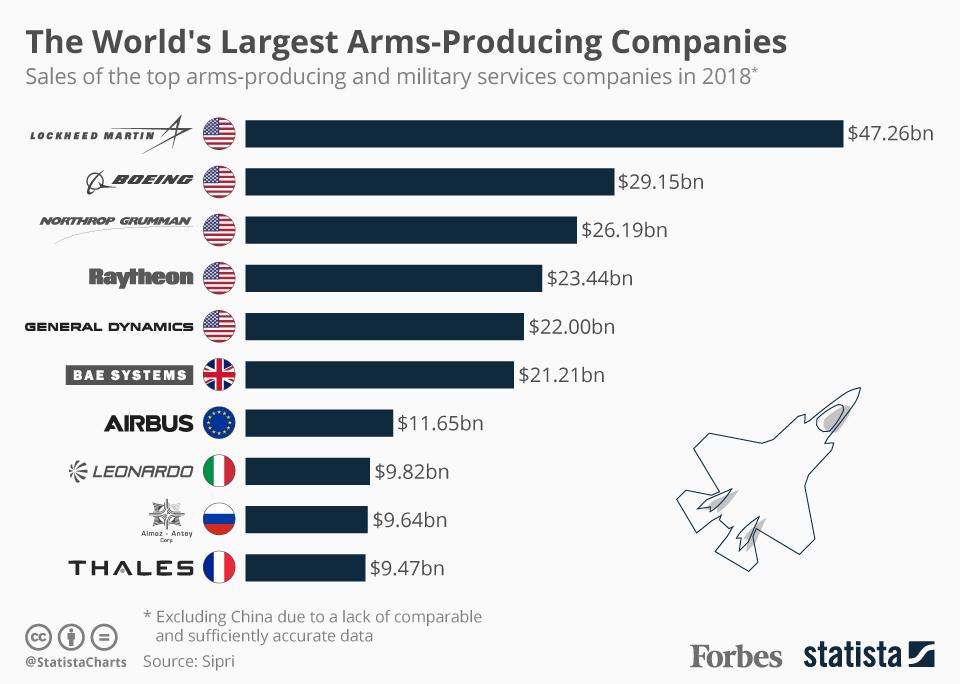
The World’s Largest Arms-Producing Companies In 2018 [Infographic]

THe World's Largest Arms_Producing Companies
The Stockholm International Peace Research Institute (SIPRI) has released its latest overview of the world's largest arms-producing and military services companies, finding that their sales increased 4.6% last year. In total, global weapons industry sales reached $420 billion, a figure that's 47% higher than in 2002. The study excluded Chinese arms manufacturers due to a lack of data to make a reliable estimate. It found that as in previous years, American companies dominated the top-100 list, with sales by all U.S. companies amounting to $246 billion - 59% of total global arms sales.
The five biggest U.S. companies - Lockheed Martin, Boeing, Northrop Grumman, Raytheon and General Dynamics - raked in $148 billion and accounted for 35% of total sales, a 7.2% increase on 2017. 2018 was the first year since 2002 that the top-five spots in the ranking were exclusively held by U.S. companies. Lockheed Martin was in first place with its sales totalling $47.26 billion while Boeing and Raytheon had the second and third-highest figures on the list with $29.15 billion and $26.19 billion respectively. Non-U.S. companies making the top-10 included BAE Systems with $21.21 billion, Airbus with $11.65 billion, Leonardo with $9.82 billion, Almaz-Antey with $9.64 billion and Thales with $9.47 billion...

Wednesday, November 13, 2019

Arms trade

A new future in global arms sales?


The last few years have seen a subtle transition in how the U.S., as the world’s dominant arms exporter, markets to the world.
Consider what we already know.
In Europe, there’s an expectation to filter more to local firms, whether through co-development or direct buys. There’s also demand for greater access into U.S. programs, and for that access to be on a level playing field.
And then there’s South Korea, now calling for foreign contractors to engage with domestic small and medium-sized enterprises. Financial support for its companies is important, according to the Defense Acquisition Program Administration, but so is guidance that helps identify technologies that will make those domestic companies more marketable. Call it a mentorship of sorts.
Look to Middle Eastern countries and we’ve historically seen more financial offsets: expectations to create jobs at home to improve the economy, grow skilled labor and expand infrastructure. That’s the same in northern Africa.

Monday, October 21, 2019

Arms trade

Turkey's operation in Syria exposed Europe's double standards


The EU is punishing Turkey for an operation that it felt forced to embark on as a result of their own questionable decision to partner with the YPG in the fight against ISIL, writes Bakeer [Reuters]The EU's swift response to Turkey's operation in Syria against the YPG exposed the 28-member body's hypocrisy when it comes to protecting "the stability and the security" of the Middle East. 
The same European countries that recently imposed sanctions on Turkey for attacking the YPG see no problem in continuing their arms sales to a country like Saudi Arabia, which is responsible for a war in Yemen that already killed tens of thousands of civilians. 
The EU has an arms export policy - the 2008 Common Position on arms export controls - which sets out the criteria by which member states must judge potential export licenses, including respect for human rights and international humanitarian law in the destination country. When the UN's experts concluded that Saudi Arabia is violating international human rights and humanitarian law in Yemen, therefore, all EU member states should have stopped their arms exports to the kingdom. 
Such an export ban, however, never materialised. 
According to the EU's own reports, EU member states issued at least 607 licences worth over 15.8 billion euros ($17.6bn) to Saudi Arabia in 2016 - a year after the start of Yemen's devastating conflict. 

Wednesday, October 16, 2019

Arms trade

Turkey, Saudi Arabia and Europe's 'double standard' in arms sales


A boy waves a Turkish flag as Turkish military vehicles drive on a street in the Turkish border town of Akcakale in Sanliurfa province [Stoyan Nenov/Reuters]
European powers have moved quickly to censure Turkey over its long-threatened military offensive in northeast Syria.
Soon after Turkish troops launched the cross-border operation on October 9 - aiming to "eliminate" Kurdish fighters it considers "terrorists" from the region - European members of the United Nations Security Council called for an immediate cessation of hostilities. In a joint statement, they said Ankara's actions could destablise the Middle East and displace even more people.
The condemnation was followed swiftly by bans on arms sales to Turkey.
Europe's top weapons exporters - France, Germany, United Kingdom, Spain and Italy - all said they would halt the export of arms that Turkey could use in its military operation in Syria.


Saturday, September 28, 2019

Arms trade

China, the world’s second largest defense spender, becomes a major arms exporter

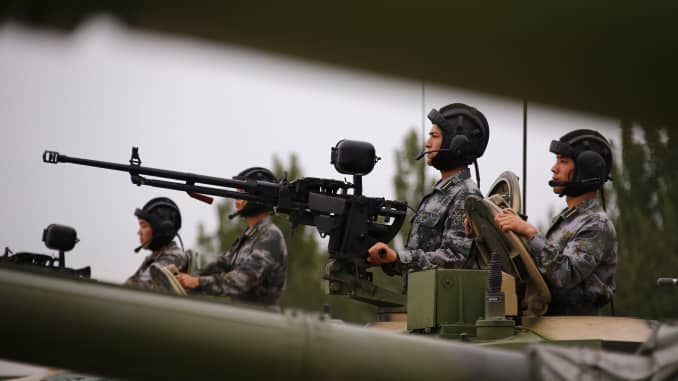
RT: Chinese military drills People's Liberation Army 140722Beijing has not only become a major defense spender, but increasingly analysts say China is also turning into a top arms exporter.
Over the past five years, China was one of the largest exporters along with the United States, Russia, France and Germany and China, according to data from the Stockholm International Peace Research Institute (SIPRI) published in March. Those nations accounted for three-quarters of the total volume of arms exported, the data showed.
China has exported 16.2 billion units of ammunition — mostly to countries in Asia, the Middle East and Africa — over the past 12 years, according to SIPRI data.
Beijing is set to commemorate the 70th anniversary of Communist China on Oct. 1. The country did not open up its economy until 40 years ago and since then quickly became the world’s second largest.

Friday, August 30, 2019

Arms trade

Turkey discussing purchase of Russian fighter jets, says Erdogan

Картинки по запросу Erdogan
Turkey is holding talks with Russia on the purchase of Russian military equipment, namely Sukhoi fighter jets, Turkish President Recep Tayyip Erdogan said on Friday, the NTV channel reports.
"Our cooperation with Russia [in the sphere of arms acquisition] is already implemented within the framework of the S-400 missile systems deal. However, after what we have witnessed at the air show [MAKS-2019], our ministries - the Ministry of Defense, the Defense Industry Directorate - carried on the negotiations with the Russian side," Erdogan said in response to whether any additional steps have been made after Erdogan was shown the Su-57 fighter jet during the 2019 MAKS Air Show.
Erdogan pointed out the "prospects of expanded cooperation in the sphere of defense industry." "For example, combat and reconnaissance drones. We take certain mutual steps in this area," he said.
Regarding Turkey’s potential exclusion from the US F-35 fighter jet program and the search for alternatives like Russian-made Sukhoi aircrafts, Erdogan noted that "these planes are very different from each other."


Tuesday, May 14, 2019

Arms trade

THE CASE FOR SUSPENDING AMERICAN ARMS SALES TO SAUDI ARABIA


Arms embargos are often dismissed as symbolic, and therefore ineffective. But just because something is symbolic, doesn’t mean that it won’t have an effect. A U.S. arms embargo against Saudi Arabia would be a clear signal of American disproval of Saudi actions in Yemen, and would be an equally important signal to Washington’s allies, who are left wondering if the United States is ambivalent or uninterested in the growing Yemeni humanitarian catastrophe.
By continuing to provide weapons, President Donald Trump tacitly endorses Saudi policies. This signal is strengthened by Trump’s recent veto of the resolution that called for an end to U.S. support for the war in Yemen. While Trump justified the veto by saying that the resolution was a “dangerous attempt to weaken my constitutional authorities,” statements from Congressional representatives show they are aware of the powerful signals sent by arms sales. Sen. Tim Kaine said that the veto “shows the world [Trump] is determined to keep aiding a Saudi-backed war that has killed thousands of civilians and pushed millions more to the brink of starvation.” An arms embargo against Saudi Arabia would be a signal both to leaders of that country, and other states, that the United States does not endorse Saudi actions. Those arguing against a ban are correct on one point: Embargos as blunt force instruments of coercion are rarely effective. But arms embargos are effective as signals of political dissatisfaction, and serve an important communication role in international politics.

Friday, April 5, 2019

Arms trade

Arms trade

Pentagon’s Focus On China and Russia Expected to Alter US Arms Sales

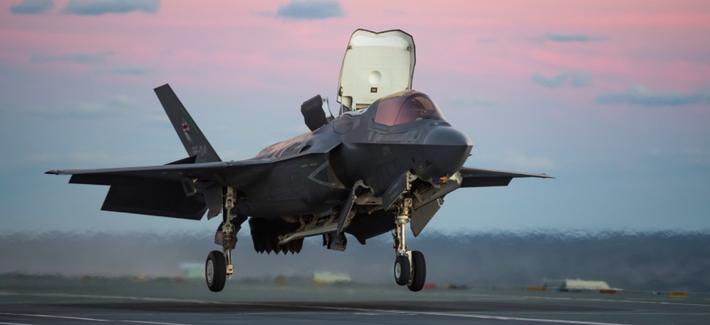
The F-35 Pax River Integrated Test Force tests aboard HMS Queen Elizabeth (R08) for phase two of the first of class flight trials (fixed wing) from British Queen Elizabeth Class carriers.
As the U.S. military shifts its focus to Russia and China, American arms exports are expected to make a similar shift to allies in Europe and Asia, experts say.

Arms export data already shows a shift away from the Middle East, where Bahrain, Kuwait, Qatar, Saudi Arabia and UAE have been scooping up American weapons.

“I would imagine that this year and next we would see an uptick in sales to Asia, but it hasn’t shown up yet,” William Hartung, director of the Arms Security Project at the Center for International Policy, said Thursday.

The total value of arms-export deals approved by the Trump administration declined from $82.2 billion in 2017 to $78.8 billion last year, according to a new report by Hartung and Christina Arabia, director of the Security Assistance Monitor.

Also declining from 2017 to 2018: the share of deals with countries in the Middle East and Northern Africa, two regions of intense focus in the past two decades of counterinsurgency- dominated wars.

Wednesday, April 3, 2019

Arms trade

Turkey's turn toward Russia mars NATO's 70th anniversary celebration

Картинки по запросу s-400 anti-aircraft missile system
The Trump administration's decision not to send cutting-edge fighter jets to Turkey could foreshadow a breakdown in military cooperation and even a U.S. blacklist against the key NATO ally due to its turn toward Russia.
Pentagon officials notified Turkey yesterday that they have stopped preparing to transfer the two F-35s Turkey has purchased, just days before this week’s summit in Washington commemorating the 70th anniversary of the transatlantic alliance. Turkish President Recep Tayyip Erdoğan has refused to cancel a deal to import Russian S-400 anti-aircraft missile defense systems, despite warnings from the United States that it would withhold the F-35s to prevent Russian specialists from learning how to track the stealthy warplanes.
“We have made very clear to Turkey that its acquisition of the S-400 will result in a reassessment of Turkey’s participation in the F-35 program and risk other potential future arms transfers — as well as potentially trigger sanctions by the United States,” a senior State Department official told reporters Tuesday. “That has been our consistent message to Turkey across the board from the Pentagon, the White House, and the State Department.”

Tuesday, March 12, 2019

Arms trade

Russia Remains Second-Largest Arms Exporter Despite Sales Drop – Think Tank

Russia remains the world’s second-largest arms exporter after the United States despite five years of declining sales abroad, the Stockholm International Peace Research Institute (SIPRI) has said in a new report that was disputed by Russia’s state-owned arm exporter.

Russia’s arms exports dropped 17 percent between 2014 and 2018 when compared to 2009-2013, contributing to a widening gap with U.S. exports, SIPRI said in the report published Monday.

The Swedish think tank said declining arms purchases by India and Venezuela played a major factor in Russia’s reduced exports.

The state-owned Rostec corporation, which includes the Rosoboronexport arms exporter in its vast portfolio, disputed the accuracy of SIPRI's calculations, saying that sales have grown throughout the past decade, RIA Novosti reported Monday.

“There are big questions regarding the methodology of the calculations,” Rostec’s press service said.

Last year, Russia surpassed the United Kingdom to become the world’s second-largest arms producer.


Monday, March 11, 2019

Arms trade

China sells arms to more countries and is world’s biggest exporter of armed drones, says Swedish think tank SIPRI

China supplied 153 armed drones to 13 countries in the past five years. Photo: Xinhua
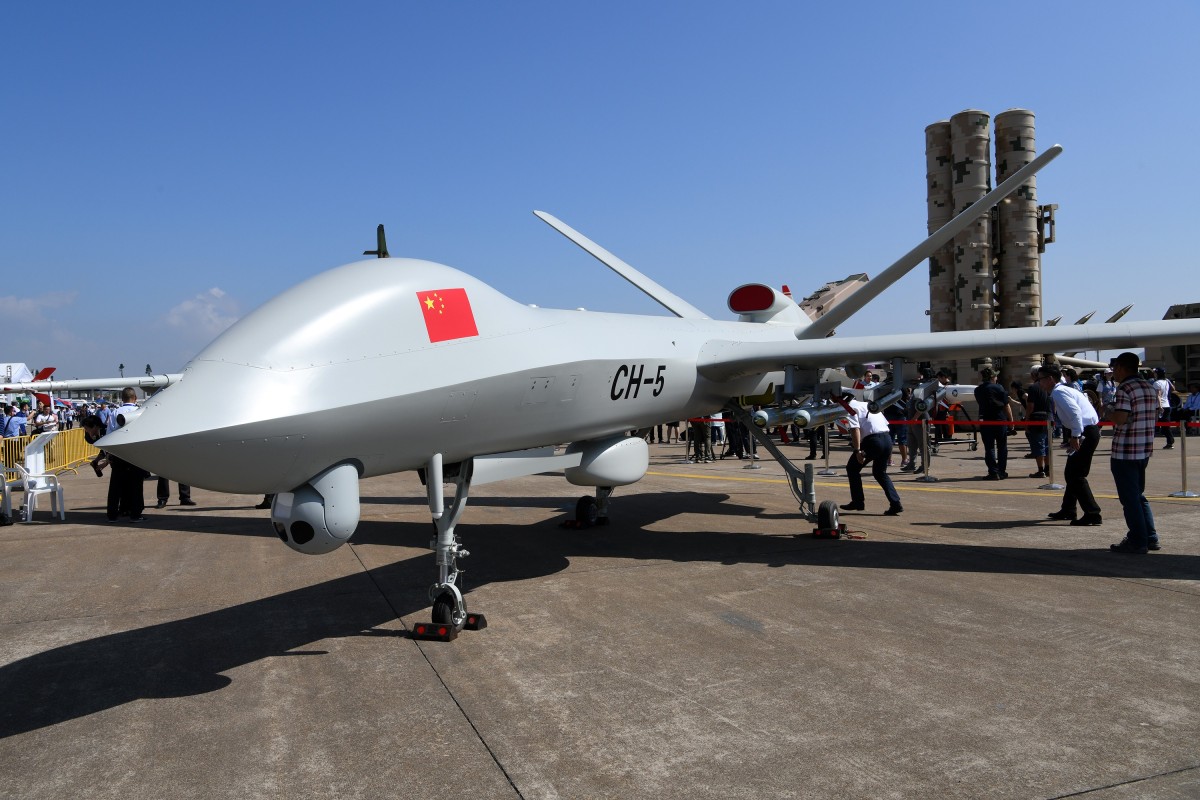
China is selling arms to more countries and is now the world’s leading exporter of armed drones, according to a report released by the Stockholm International Peace Research Institute (SIPRI) on Monday.
But the latest data from the Swedish think tank shows Chinese arms exports increased by a relatively low 2.7 per cent in the period from 2014 to 2018, compared to the previous five years.
Weapons exports from the United States, however, jumped 29 per cent in the 2014-18 period from 2009-13.
Meanwhile, China expanded its customer base to 53 countries in 2014-18, up from 41 in the previous five years.
The researchers also found that China is the world leader in sales of armed drones, or unmanned combat aerial vehicles – supplying 153 of them to 13 countries in the past five years.

Saturday, March 9, 2019

Arms trade

Pentagon warns of 'grave consequences' for Turkey if it purchases Russian missile system

A new generation air defence system S-400 Triumf, also known as a SA-21 Growler, moves during exercises at the anti-aircraft defence military unit near Elektrostal, outside of Moscow on December 2, 2010.
The Pentagon warned Friday that there would be "grave consequences" for Turkey if it goes ahead with the purchase of the Russian-made S-400 missile system.
"If Turkey takes the S-400s there will be grave consequences," acting chief Pentagon spokesperson Charles Summers told reporters Friday, saying it would undermine America's military relationship with Ankara.
Summers said those consequences would include the US not allowing Turkey to acquire the F-35 jet and the Patriot missile defense system. This appears to be the first time the Pentagon has specifically said that Turkey will not be allowed to get the jets if the S-400 purchase goes ahead.
Turkey has been involved with the F-35 development for a long time, but its acquisition of the warplane has been opposed by some members of Congress amid the deteriorating relationship between Washington and Ankara over a range of issues.

Thursday, March 7, 2019

Arms trade

Germany extends Saudi Arabia arms sales ban

The move has put a question mark over billions of dollars of military orders, including a $13.13bn deal to sell 48 Eurofighter Typhoon jets to Riyadh [Mindaugas Kulbis/AP Photo]
Germany has extended a temporary ban on arms exports to Saudi Arabia, imposed due to concerns about the kingdom's role in the killing of journalist Jamal Khashoggi.

The embargo was due to expire on March 9, but Germany's foreign minister said on Wednesday the ban was being extended until the end of March to give the government time to evaluate Saudi Arabia's military involvement in Yemen's war.

"We decided this with a view to developments in Yemen," Heiko Maas said after a meeting of Chancellor Angela Merkel's cabinet.

"We believe that the Yemen war must end as soon as possible."

"Not only will there not be any permits issued until the end of this month, but products with permits already granted will also not be delivered," he added.

There are no concrete casualty statistics for the war in Yemen. In 2017, a UN official said 10,000 civilians had been killed, though rights groups say the death toll could be five times that, due to fighting, starvation and disease. Millions are on the brink of starvation.

Tuesday, February 26, 2019

Arms trade

Heckler & Koch fined for illegal gun sales to Mexico


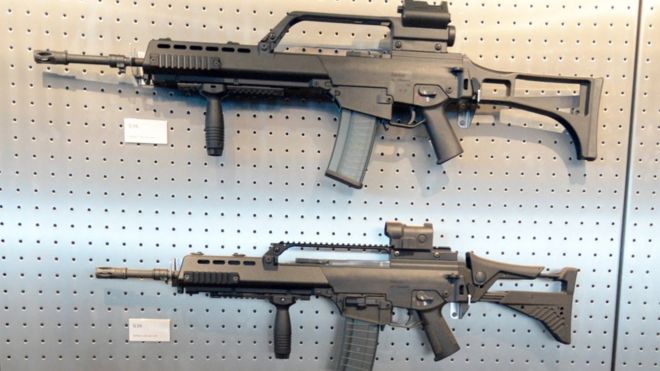
H&K G36 assault rifles, 2015 picA German court has handed suspended jail terms to two ex-employees of gun maker Heckler & Koch and fined the firm €3.7m (£3.2m) for illegal arms deliveries to Mexico.
The Stuttgart court acquitted three other H&K ex-employees.
H&K was found to have breached German arms export rules by shipping nearly 5,000 G36 assault rifles and smaller firearms to strife-torn regions.
Mexico is plagued by warfare involving drug gangs and paramilitaries.
Germany's arms export restrictions include Mexican states such as Chiapas, Chihuahua and Guerrero, which are blighted by murders and kidnappings.
The H&K deliveries took place in 2006-2009. One ex-employee was given a suspended sentence of one year and 10 months, plus a fine of €80,000. The other received one year and five months and was ordered to do 250 hours of social work.

Thursday, February 21, 2019

Arms trade

24/7 Wall St. reviewed data provided by the Stockholm International Peace Research Institute to identify the companies profiting most from war. Companies were ranked based on arms sale revenue. Chinese companies were not considered due to lack of sufficient data. Total 2017 revenue and arms sales were provided by SIPRI. Profits and total sales came from fiscal year 2017 annual financial disclosures filed with the U.S. Securities and Exchange Commission or published independently. Employee counts are the most recent available estimates, and are in some cases from corporations’ 2018 financial disclosures.
Military spending: 20 companies profiting the most from war


There was a 1.1 percent increase in global military spending in 2017, according to the Stockholm International Peace Research Institute.

The global rise was driven partially by a $9.6 billion hike in U.S. arms expenditure – the United States is the world’s largest defense spender by a wide margin. Though it is yet unclear what the growing arms investments will mean for international relations, major defense contractors around the world stand to benefit.

Total arms sales among the world’s 100 largest defense contractors topped $398 billion in 2017 after climbing for the third consecutive year. Notably, Russia, one of the countries with the fastest growing militaries over the last decade, became the second largest arms-producing country, overtaking the United Kingdom for the first time since 2002. The United States’ position as the top arms-producing nation in the world remains unchanged, and for now unchallenged.

The United States is home to five of the world’s 10 largest defense contractors, and American companies account for 57 percent of total arms sales by the world’s 100 largest defense contractors, based on SIPRI data.

Maryland-based Lockheed Martin, the largest defense contractor in the world, is estimated to have had $44.9 billion in arms sales in 2017 through deals with governments all over the world. The company drew public scrutiny after a bomb it sold to Saudi Arabia was dropped on a school bus in Yemen, killing 40 boys and 11 adults. Lockheed’s revenue from the U.S. government alone is well more than the total annual budgets of the IRS and the Environmental Protection Agency, combined.

Saturday, February 16, 2019

Arms trade

Breaking through Saudi Arabia’s defense backlog

During his first international trip as president, Donald Trump announced eye-popping international sales of U.S. military equipment to Saudi Arabia. Nearly two years later, most of the new deals have not turned into official letters of request, much less contracts. While this disconnect has been fodder for more domestic criticism of the president, for long-time observers of Saudi arms purchases the yawning gap between announcements and timely outcomes comes as little surprise.

But as regional military leaders and industry executives gather for the upcoming International Defence Exhibition and Conference, or IDEX, there are signs that the kingdom’s defense-trade apparatus may be ready to clear long-standing backlogs and move more expeditiously in the future. Western firms stand ready to benefit, though not necessarily in the ways to which they are accustomed.

While Saudi Arabia has come under extraordinary international scrutiny in recent months, the kingdom has not relented in its pursuit of Vision 2030 reforms to diversify its economy, particularly by cultivating a domestic defense hardware and services industry.

As with other regional powers ― notably Turkey and India ― Saudi Arabia is no longer satisfied with the traditional vendor-customer relationships that U.S. and European defense firms enjoyed for decades.

Tuesday, February 5, 2019

Arms trade

Official: US Trying to 'Off-Ramp' Central Asia From Russian Military Procurement

WeaponsThe United States is trying to enable countries in Central Asia to have options in obtaining US military equipment rather than relying on military procurement from Russia, but the cost of US weapons will continue to be an issue, Central Command (CENTCOM) chief Gen. Joseh Votel said in a congressional testimony on Tuesday.
"As we look to off-ramp Central Asian countries from Russian defense equipment, the higher price of US systems will remain a challenge for nations like Kazakhstan," Votel told the US Senate Armed Services Committee.
Votel noted that Kazakhstan, in particular, has expressed interest to work with the US to improve its logistical, medical, and engineering military branches, General noted.
In addition, Votel said that Uzbekistan has expressed interest in diversifying their military equipment.