Страницы

Saturday, July 2, 2016

Cyberwars

Could Online Presence Betray ISIS’ Intentions?

ISIS is well-known for its extensive use of technology and social media in the organisation’s efforts to fill its ranks. But have you ever wondered how the recruiting efforts of the jihadi army work online? So did a team of researchers from the University of Miami who have developed a model to identify behavioural patterns among online groups of ISIS supporters. These models, they hope, could help police and counter-terror agencies paint a clearer picture of their activity, including hints and indicators for when a real-world attack is imminent.
The team identified and analysed 196 pro-ISIS groups during the first eight months of 2015. They tracked second-by-second online activity and came to realise that even though most of the 108,000 members of these groups have likely never met, they were surprisingly adaptive and could extend the longevity of the groups, increase their number, quickly relaunch after being shut down, and inspire “lone wolf” attacks by people with no history of extremism.
Predictions

No, Nate Silver’s Not ‘Predicting’ Who Will Win the Presidency

Nate Silver
This hasn't been the best political year so far for pioneering data journalist Nate Silver. Partly because of the hype he earned in 2012 over the accuracy of his late projections, and partly because he shows up a lot of lazy and data-averse journalists all the time, Nate's taken a real pounding for underestimating, like virtually everybody else, Donald Trump's appeal. It could get worse for him if people keep misunderstanding what he is saying.

Today Nate's FiveThirtyEight site is releasing its first "projections" of the presidential general election. That's a regularly updated estimate of the odds of each candidate winning, mostly based on polling averages and state electoral histories. He set HRC's win probability at 79 percent, and Trump's at 20 percent, which seems reasonable at the moment.
Polls & predictions

Ranking the 2016 Presidential Primary Polls and Predictions

After more than 50 million votes cast in 100-plus nominating contests since early February, the U.S. presidential primary season is over and each major party finally has its presumptive nominee. Now, as the country prepares for the race between Democrat Hillary Clinton and Republican Donald Trump, and braces for a flood of polling and prognostications regarding who will win, how might we begin to separate the signal from the noise and avoid failing predictions, like the majority of Brexit polls that mistakenly saw Britain remaining in the European Union?

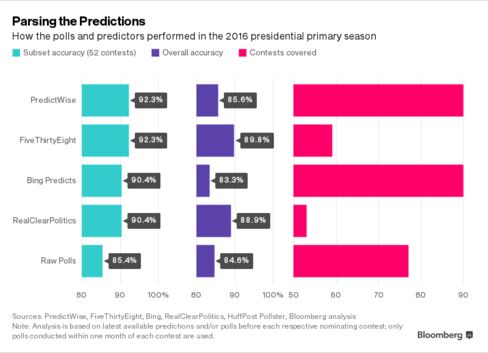
To find out which outlets did the best job of predicting the primary winners in this wild cycle, Bloomberg Politics examined hundreds of polls as well as nearly 300 final projections from four predictors across a big set of 90 nominating contests (see methodological note at the bottom of this story) and a small set of 52 contests that every predictive source weighed in on.

The verdict: a tie, when looking at the small set, between PredictWise, an aggregator of betting-market data, and FiveThirtyEight, whose “polls-plus” prediction model includes statewide polls, national polls, and endorsements. Both were right 92 percent of the time across those 52 primaries and caucuses.
Nuclear smuggling


COMBATING NUCLEAR SMUGGLING:
NNSA's Detection and Deterrence Program Is Addressing Challenges but Should Improve Its Program Plan [Reissued on June 20, 2016]

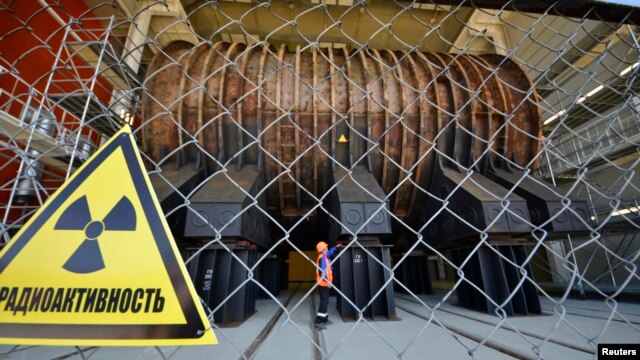
Damage to a Site in Ukraine with Installed Radiation Portal MonitorsThe National Nuclear Security Administration’s (NNSA) Nuclear Smuggling Detection and Deterrence (NSDD) program has developed a program plan that includes four 5-year goals to guide its efforts; however, NSDD cannot measure its progress toward completing key activities and achieving these goals because its program plan does not fully incorporate leading practices for program management. Leading practices include having measurable outcome-oriented goals, goals for all key activities, performance measures that align with these goals, and details for how and when key activities will be completed and goals achieved. However, NSDD's goals are not all measurable, some describe actions rather than outcomes, and they do not fully address all of the program's key activities. In addition, its performance measures are not aligned with these goals, and its program plan does not detail how it will complete key program activities or achieve its goals. Absent a program plan incorporating these leading practices, NSDD may not be able to determine when it has accomplished its mission and risks continuing to deploy equipment past the point of diminishing returns.

Border security

New European Border Agency Launched

The European Parliament, Commission and Council agreed on June 21 to establish the European Border and Coast Guard.  The new agency, which will be an expanded version of the current Frontex agency, is the latest move to deal with the migrant crisis in Europe.

Klaas Dijkhoff, Minister for Migration of the Netherlands and President of the Council welcomed the agreement.

"We urgently need an European Border and Coast Guard to strengthen our joined external borders in a structural way," said Dijkhoff. "With better border controls we have more control over migration streams and we enlarge the safety of our citizens. I'm satisfied that the member states and the European Parliament have made an effort to make sure that the European Border and Coast Guard can start as soon as possible."

The primary objective of the European Border and Coast Guard will be to ensure and implement, as a shared responsibility, the European integrated border management strategy at the external borders with a view to managing migration effectively and ensuring a high level of security within the EU, while safeguarding EU-internal free movement and fully respecting fundamental rights.
War on terror

U.S. airstrikes destroy 120 ISIS vehicles in stunning display of firepower

IRAQ-CONFLICT
A massive convoy of 120 Islamic State vehicles was hit by U.S. and Iraqi bombs Wednesday night in Anbar province, marking one of the most deadly strikes on the extremist group in recent memory, defense officials said.

The rare concentration of Islamic State vehicles was spotted east of Ramadi moving westward when it was hit by a barrage of airstrikes from U.S. and Iraqi aircraft, defense officials said.

The attack comes after Islamic State militants were pushed out of Fallujah in a five-week battle that Iraqi army officials say ended Sunday.

The militants in the convoy may have been moving east to reinforce the Islamic State forces under attack near the Iraq-Syria border town of Abu Kamal, in the Euphrates River valley, defense officials said.
Export control

Chinese national sentenced for smuggling U.S. military equipment to China


A Chinese national was sentenced to 30 months in prison after he was caught conspiring to smuggle high tech U.S. military hardware to China, according to a Department of Justice report issued Wednesday.
Kan Chen was arrested on the Pacific island of Saipan after an eight-month long investigation conducted by members of Homeland Security.
Court documents reveal that Chen was responsible for the export, or attempted export, of over 180 controlled items, including night vision and thermal imaging equipment, that are frequently used by the U.S. military.
Chen acquired these devices via the Internet and telephone.
Defense

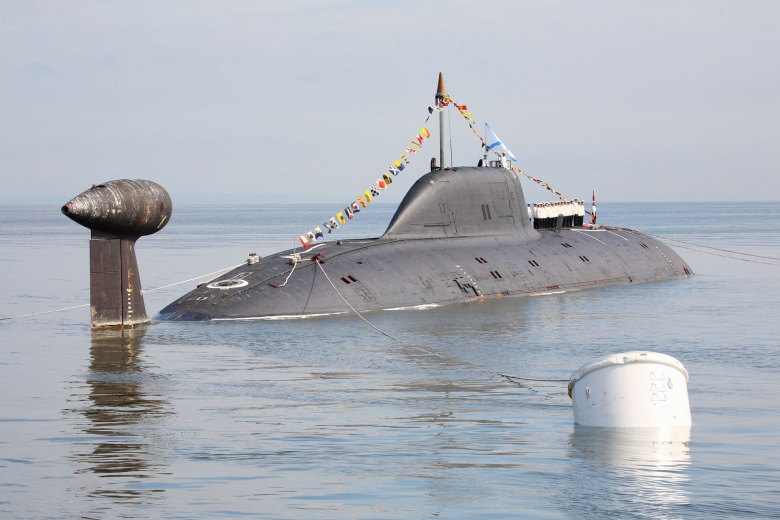
Biggest Threat US Navy and NATO Face: Russian Subs and A2/AD Bastions

The most daunting threats to the United States Navy and the NATO alliance fleet in Europe comes from Russia’s powerful submarine force and its new anti-access/area-denial (A2/AD) bastions in Kaliningrad and beyond. These tools are part of an overall Russian strategy to prevent U.S. and NATO intervention in Eastern Europe should tensions ever escalate into all-out war.
“The Russians are building a number of stealthy hybrid diesel-electric submarines and deploying them around the theatre,” Vice Adm. James G. Foggo IIIwho is simultaneously commander of the U.S. Navy’s 6th Fleet, Joint Force Maritime Component Commander Europe and NATO’s Naval Striking and Support Forces NATO, told The National Interest. These submarines are a component of the over Russian A2/AD strategy. “A2/AD bubbles also include stealthy submarines,” Foggo said.
Politics

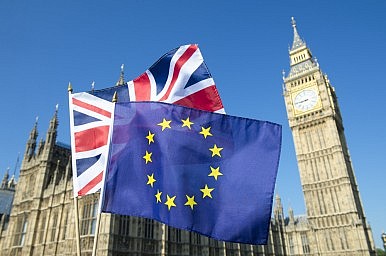
Putin dares Britain to go through with Brexit

Russia's President Vladimir Putin speaks at a meeting of Russian ambassadors and permanent representatives in foreign countries held at the Foreign Ministry in Moscow on June 30
Vladimir Putin appeared to throw down the gauntlet to British politicians to quit the European Union yesterday, questioning whether they would dare to deliver on the democratic mandate for Brexit that flows from last week’s EU referendum.

“We will see how their principles of democracy get realised in practice,” the Russian president said in an apparent expression of doubt that Britain’s political elite would follow through.

Mr Putin’s remarks came after days of discussions among disappointed ‘Remain’ supporters about the possibility of not ever invoking Article 50 proceedings to leave the EU, or signing a Norway-style trade deal that would mean accepting unrestrained EU migration.

Friday, July 1, 2016

Tortures

C.I.A. Torture Methods Once Included Christina Aguilera Music


Back in 2005, prison logs from Guantanamo Bay revealed that Christina Aguilera songs were used to torture detainees involved in the 9/11 attacks. This week, a New Yorker article called "The Sound of Hate" resurfaced those reports and delved more deeply into the practice of using music as torture. The logs revealed that Mohammed al-Qahtani, who tried to enter the U.S. to participate in the 9/11 hijackings, was kept awake using Christina music and told he could sleep "when he tells the truth." "Aguilera seems to have been chosen because female singers were thought to offend Islamist detainees," writes the New Yorker's Alex Ross. "Interrogation playlists also leaned on heavy-metal and rap numbers, which ... delivered messages of intimidation and destruction."
Navy

Massive Leadership Cull in Russia's Baltic Sea Fleet

RUSSIA_SAILORS
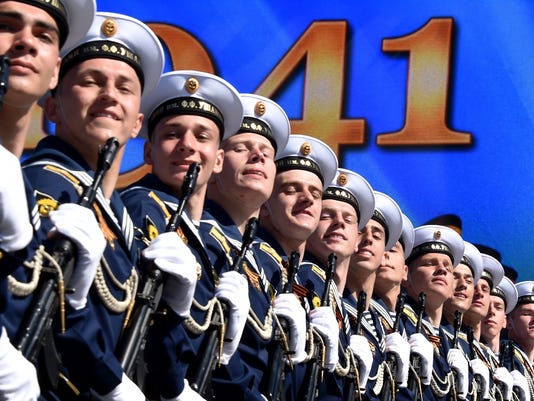
Russia's Defense Ministry on Wednesday launched an unprecedented purge of senior leadership from Russia's ailing Baltic Sea Fleet following a month-long inquiry into the fleet's command staff under the charge of Vice Adm. Viktor Kravchuk and his chief of staff, Vice Adm. Sergei Popov.

In total, some 50 senior naval officers were dismissed from military service for “dereliction of duty,” according to a Defense Ministry statement.

According to the statement, Defense Minister Sergey Shoigu said the Baltic command showed “serious shortcomings in the organization of combat training, daily activities of their forces, failure to take all necessary measures to improve personnel accommodations, inattention to their subordinates, and also distorted reports on the real state of affairs [in the fleet].”
International security

Putin hints Russia will react if Finland joins NATO

Russia's President Vladimir Putin gestures during his joint press conference with Finland's President Sauli Niinisto at Kultaranta summer residence in Naantali, Finland July 1, 2016. Lehtikuva/Jussi Nukari/via REUTERS
President Vladimir Putin suggested on Friday Russia could move its troops closer to the Finnish-Russian border if Finland joins NATO and called for measures to improve conflict prevention over the Baltic.
Finnish armed forces "would become part of NATO's military infrastructure, which overnight would be at the borders of the Russian Federation", Putin said after meeting Finnish President Sauli Niinisto.
"Do you think we will keep it as it is: our troops at 1,500 (kilometers, 900 miles) away?"
Putin's first visit to Finland since the Ukraine crisis erupted in 2014 comes amid increased Russian and NATO activity in the Baltic region, and with the militarily neutral Finland and neighboring Sweden increasing their co-operation with NATO. It also comes a week before a NATO summit in Warsaw.
Public security

The challenges of burying a mass murderer

An undated photo from a social media account of Omar Mateen, who Orlando Police have identified as the suspect in the mass shooting at a gay nighclub in Orlando, Florida, U.S., June 12, 2016.
Omar Mateen, the man who killed 49 people and wounded 53 others at the Pulse nightclub in Orlando, has been buried in an unmarked grave in northwest Miami.
And those who have loved ones buried in the Muslim Cemetery of South Florida are not happy about it.
Andrew Wade, whose wife is buried there, told local media that he “really [doesn’t] want him here.” Others have voiced similar feelings.
That's not uncommon. The question of where to bury a mass murderer is a challenging one. Towns typically don't want to become a resting place for a person with such a dark past. Burials are kept low-key or even secret in order to reduce tensions.
Ann Neumann, a visiting scholar at the Center for Religion and Media at New York University, explains that often the location of burial is not disclosed because it could become a place for protesters or sympathizers to gather.
Religion security

Pope Benedict Says ‘Gay Lobby’ Tried To Influence The Vatican


Картинки по запросу Pope Benedict
Newly released information written by Pope Emeritus Benedict has details of an alleged “gay lobby” he says tried to influence decisions at the Vatican.
Benedict is set to release a book titled “The Last Conversations,” in Italian on September 9. An Italian newspaper was able to access certain excerpts from the book and ran an article about some of the contents. “The Last Conversations” will be the first time a pope has ever judged his own pontificate after the fact.
Benedict’s papacy ended with his resignation — the first pope in six centuries to do so –and he has claimed he did so freely, without coercion. However, in the book, he speaks of a “powerful” gay lobby at the Vatican, and how he worked to dismantle it. According to The Guardian, these men “had their sexuality in common but worked together for their own ends rather than pushing the cause of gay believers.”
Benghazi  investigation.

Benghazi Just a Symptom; Interventionism Is the Disease


2012 Benghazi attack photo montage.jpgThe real story of the 800-page report that is the result of the Select Committee on Benghazi's months of investigation is not about what Hillary Clinton knew and when—though, to be sure, the inquiry presents criticisms worth serious consideration given their subject's perpetual touting of her foreign policy record.
Nor is the story found in the document's headlining revelations, like the fact that it was loyalists to the autocratic Qaddafi regime (yes, the very regime U.S. intervention aimed to overthrow) who were instrumental in saving American lives during 2012's embassy attack. Nor is it the disclosure that the CIA did not know about these pro-Qaddafi fighters until after their involvement, or that the intelligence agency copped to multiple other serious errors. Nor yet is it the report's allegation that forces within the Clinton State Department and the Obama administration more generally acted to impede transparency as the scandal around Benghazi grew.
Law enforcement

Mastermind of Istanbul Airport Attack Had Been Georgian Informant, Official Says

 Sometimes the world of terror and counterterror is amazingly small.
The day after at least 43 people were killed and more than 235 injured in a terrorist attackon Istanbul’s international airport, Turkish officials announced the arrest of the alleged mastermind behind the attack: Akhmed Chatayev, an ethnic Chechen from Russia who, in the past, had traveled extensively in Ukraine, Austria and Georgia.
Here in the Black Sea port of Odessa, in Ukraine, Police Chief Gen. Giorgi Lortkipanidze knows all about Chatayev. The general used to be the deputy interior minister in Georgia, and for a while, he says, had Chatayev on the government payroll.
“A few years ago I recruited Chatayev, who was a good informer and negotiator between us and Islamist underground of the Northern Caucasus; with his help we prevented several terrorist attacks on Georgia,” Gen. Lortkipanidze told The Daily Beast in an exclusive interview on Friday.


Brexit

Inside The Royal Family Split Over Brexit

As the Daily Beast revealed, the Queen had been a proponent of Brexit in private conversations, asking her dinner guests in the run up to the vote to give her ‘three good reasons’ why Britain should have remained part of Europe.
Brexit is a far from unwelcome political development in the UK as far as the Queen is concerned; earlier this week she told Northern Ireland’s First Minister Martin McGuinness that she was ‘still alive’ although there had been ‘a lot going on.’ 
She implied she was talking about her 90th birthday celebrations but she was undoubtedly seeking to also convey a message that post-Brexit, we should all keep calm and carry on.
Although there was a brief panic that Scotland might seek to break away from the United Kingdom as the result of the vote, this possibility has existed more strongly in the mind of Nicola Sturgeon, the nationalist first minister of Scotland, and in media scare stories, than it has in reality.  
Brexit implication

Post-Brexit, What Are the Geopolitical and Economic Consequences for Asia?


Post-Brexit, What Are the Geopolitical and Economic Consequences for Asia?For China, the United Kingdom’s decision to eventually excise itself from the European Union’s common market will be a disappointing move. Chinese Premier Li Keqiang has taken a particular interest in the U.K., reciprocated in recent years by Chancellor of the Exchequer George Osborne. Last fall, London became the first international financial hub to issue renminbi-denominated debt after Xi Jinping’s visit there. Brexit will be a setback for the ongoing internationalization of renminbi as London’s relevance as a global financial hub is diminished as a result of Brexit. (As a side note, the onus on China’s economic stewards will be higher in the wake of Brexit—if the Chinese economy wavers like it did in mid-2015, the global consequences could be catastrophic on the back of Brexit.)
Brexit could also mark a setback for China’s long-term goal of a free trade agreement with the EU. London had emerged as one of the most eager advocates for a China-EU FTA; with the U.K. now exiting the bloc, none of the other major EU states seem keen to ink a deal with Beijing. An FTA with the U.K. alone might be politically simpler to negotiate (assuming Cameron’s embrace of Beijing is also adopted by his replacement as prime minister), but won’t have nearly the same economic benefits for China...

Emergency preparedness

Is the West prepared for an Islamic State attack?


Bulletin of the Atomic Scientist 70 Years Speaking Knowledge to PowerIn January 2006, Singapore conducted Exercise Northstar 5, a drill designed to educate the public about chemical, biological, radiological, and nuclear attacks—and how best to respond to them. In April 2015, authorities followed up with another drill, Northstar 9. The Southeast Asian city-state has also established a specialist agency, the Chemical, Biological, Radiological, and Explosive Defence Group, as well as a Community Emergency Preparedness Program. Most important, it has built shelters—in the rapid-transit system, in schools and community centers, and in the Housing Development Board buildings in which most Singaporeans dwell—for the public to use in the event of an attack. In addition to other life-saving facilities, the shelters feature “protective blast doors, decontamination facilities, ventilation system[s], power and water supply systems and dry toilet system[s],” according to the Singapore Civil Defence Force.
Navy

Bubble-Enclosed Submarines Could Go Really, Really Fast


Researchers at Penn State are working to enclose the submarines of the future in a bubble of gas, allowing them to achieve top speeds faster than what is possible while moving through regular water. If successful, it could mean submarines capable of speeds of up to hundreds of miles per hour.

As submarines and torpedoes travel through seawater they are naturally at the mercy of physics, and objects traveling through sea travel encounter much more drag than objects traveling through air. The end result is that the practical speed limit of submarines is somewhere around 30 to 40 knots. Even with nuclear propulsion, that's about the best many military submarines can do.
Nuclear security

Islamic State And The Threat Of WMDs

The gravest threat would come if IS were able to get its hands on nuclear materials. The greatest danger comes from the most unstable countries with the largest amounts of documented radical activity: Pakistan, Russia, and India -- with Pakistan at the top of the list.According to an expert who participated in the forum, the danger is twofold. The gravest threat would come if IS were able to get its hands on nuclear materials. These would mean, for example, the type of enriched uranium Iran uses in its nuclear program -- from which IS could theoretically make a small nuclear bomb with further enrichment -- or existing weapons-grade plutonium, from which it could do the same.
But the probability of IS being able to do this is slim. The requisite materials are located in only 24 countries and are in highly guarded facilities. Set against this fact, however, have been several lapses in security. In 2012 an 82-year-old nun and peace activist, Megan Rice, broke into the Oakridge nuclear reservation in Tennessee. Rice never got near any nuclear material but a lot of systems had to fail for her to get as close as she did. Likewise, according to a British Ministry of Defense report, guards at one of the U.K.'s nuclear facilities were caught sleeping on the job. And then there is the problem of poor levels of security at a host of nuclear research centers in the former Soviet Union.
Tortures

Lawyer: CIA gave Romania millions to host secret prisons

Romania Europe CIA Prisons
The CIA paid Romania "millions of dollars" to host secret prisons, a rights lawyer said Wednesday as the European Court of Human Rights heard accusations that Romania allowed the agency to torture terrorism suspects in a secret renditions program under President George W. Bush.
Amrit Singh told the court on the opening day of the case that CIA prisons were in Romania from 2003-2005 with the government's "acquiescence and connivance," something authorities have denied.
Romanian government representative Catrinel Brumar countered that it takes more than "hints and speculation to establish the state's responsibilities." She said an investigation was ongoing.
The court said it would rule in a few months on whether Romania knowingly allowed CIA secret prisons where torture occurred, and whether it failed to prevent the torture of Singh's client.
Electoral security

EXCLUSIVE: Pro-Hillary group takes $200K in banned donations


Feds ask for 27-month delay in release of Clinton staff emails
A super-PAC backing Hillary Clinton has accepted $200,000 in donations from a company holding multiple contracts with the federal government — despite a ban on such contributions.
According to a review of contributions by The Hill, Boston-based Suffolk Construction made two contributions of $100,000 to Priorities USA, which is backing the presumptive Democratic presidential nominee.  
At the time it made the contributions, Suffolk held multiple contracts worth $976,560 with the Department of Defense for maintenance and construction projects at a Naval base in Newport, R.I., and the U.S. Military Academy in West Point, N.Y., according to the government website USASpending.gov.
Suffolk — which, by Forbes’s estimate, brings in some $2 billion in revenue annually — also donated $10,000 in 2015 to Right to Rise, a super-PAC that supported Republican Jeb Bush’s now-defunct presidential bid.
The donations from Suffolk highlight how a 70-year-old campaign finance law meant to prevent pay-to-play deals between public officials and companies making money from the government is often ignored by those making the donations and those on the receiving end.
National security laws

Russian human rights council asks Putin to reject controversial anti-terror bills

The Russian presidential Council for Civil Society Development and Human Rights has requested the head of state to reject a controversial package of anti-terror bills approved by the upper house on Wednesday.
"After discussing the laws adopted by the State Duma [the lower house of Russia’s parliament] and approved by the Federation Council [the upper house] and known as the anti-terror package of Irina Yarovaya and Viktor Ozerov, the Council is urging to … turn them down owing to their unconstitutionality, the inconsistency and the legal uncertainty of some of their provisions," according to the Council’s appeal to President Vladimir Putin posted on the Council’s website on Thursday.

The Federation Council approved on Wednesday a package of anti-terror bills prepared by MP Yarovaya and Senator Viktor Ozerov.
The first law of the anti-terror package was supported by 151 senators with four abstentions. The second document got the approval of 141 parliamentarians, with five votes against it and nine abstentions.
Many provisions of the bills’ initial wording caused heated discussions both in society and among parliamentarians.


Diplomats' safety

Moscow denies Washington Post report on alleged attack on US diplomat

The Washington Post’s article on alleged use of force against a US diplomat on the part of Russian law enforcers contradicts facts, Russian Foreign Ministry spokeswoman Maria Zakharova said while commenting on the publication’s article of June 29.
"Unfortunately, the Washington Post newspaper has recently been actively used by the Department of State and US special services for distribution of distorted or blatantly false information on ‘clampdowns’ that American diplomats allegedly are subjected to in Russia," Zakharova said.
"The article published June 29 went as far as inventions about an 'attack' on one of them by an ‘FSB guard’," she said.
In reality, Zakharova said, overnight to June 6, a taxi drove over to the US embassy compound, and an unknown man in a hat that closed his face ran out of it and ran to the entrance. The Russian policeman on duty there wanted to check the ID of the suspicious person to make sure he presents no threat to the diplomatic mission...


Nuclear security

Your Radiation This Week No 61


Mojave Desert California
The EPA in America just can’t or won’t resist cozying up to the pro-nuker criminals, again and again. At the first of his two Presidential terms Obama tried to push through upping all the Rad danger levels hundreds and for some vicious isotopes, thousands of times.
The American “Normals” did not quite understand that Obama was totally sold out to the nuclear industry. Well, the President stayed bought and is just another nuclear industry lobbyist.
Now he is doing it again. Because of Obama, EPA is sanctioning the slaughter of more millions of people … and their pets, too.
President Obama is just another in the long list of paid off politicians in the nukers’ bag of captured Zombified politicians. Well, the pro-nukers are cranking up the same political machine for a last shot with this Prez.
If it doesn’t work with this Prez, the pro-nukers will wait for the next one. They’ll probably get it, too, with the help of all their bought and paid for politicians and political infrastructure. Rest assured, the bought politicos will do what they are told, guaranteed.
Propaganda wars

Why Pentagon Mistook Russian GLONASS Station in Nicaragua For Spy Base


An operator by the map-board at the training command center during large-scale exercises of the Air Force and Air Defense troops
Reports that Russia is supposedly constructing an electronic surveillance site in Nicaragua disguised as a GLONASS satellite navigation tracking station are not grounded in reality, Russian experts and officials say.
The signals intelligence base is allegedly a part of an $80 million arms deal inked in 2015 that will see Moscow deliver 50 T-72 tanks to Managua, defense analyst Bill Gertz wrotefor the Washington Free Beacon, citing unnamed officials familiar with the arrangement. The Pentagon, he added, has been concerned with these developments.
The sources did not say when the site is expected to become operational. No details have been provided on the location of the spy base, but unconfirmed reports suggest that “the site could be disguised as a Russian GLONASS satellite navigation tracking station that is said to be nearing completion,” Gertz added.
Globalization

The Lesson of Margaret Thatcher’s Demise and the Brexit Vote


The Lesson of Margaret Thatcher’s Demise and the Brexit Vote
No, no, no!” British Prime Minister Margaret Thatcher (shown) told the House of Commons on October 30, 1990, to a proposal for a more centralized government in Europe.
European Commission President Jacque Delors had announced his support for centralizing power in Europe, away from national governments such as the United Kingdom. He proposed that the European Parliament become the “democratic” body of the European Community, with the Commission as the executive and the Council of Ministers the senate.
Thatcher completely rejected the idea of a European super-state, which would have seriously curtailed the national sovereignty of Great Britain. Despite her having led the Conservative Party to its longest tenure of power in decades, by winning three national elections, she almost immediately faced a rebellion and ouster within her own party.
What happened to Thatcher demonstrates the immense power of the elites who favor globalization.