Страницы

Friday, April 27, 2018

Crime

Mexico Claims Film Students Were Dissolved in Acid. Activists Want Proof

On Sunday night, the rapper QBA was due to headline a rap festival in Tijuana, northern Mexico. Instead he is behind bars in the western city of Guadalajara, accused of dissolving the dead bodies of three film students in sulfuric acid. 
The shocking crime has offered a powerful reminder that young people bear the brunt of the violence plaguing the country and have become so disillusioned with their own government that they feel unable to take its word.
Film students Javier Salomon Aceves, 25, Daniel Diaz, and Marco Avalos, both 20, were abducted on March 19. According to authorities, armed men dressed as police officers seized the trio as they were returning by car from filming for a project in a house located in a suburb of Guadalajara, the capital of Jalisco.
Authorities said the Jalisco New Generation Cartel—Mexico’s deadliest criminal organization—was behind the killings. 
Chemical security

NACD Advocate for Rail Reform & Counterterrorism Security Standards

Nearly 90 members of the National Association of Chemical Distributors (NACD) are heading to Capitol Hill to urge Congressional representatives and regulatory officials to support antiterrorism programs that keep our nation secure and to implement reforms that will help countless American businesses who rely on freight rail to remain competitive in today’s business world.

“Reauthorizing the Chemical Facility Anti-Terrorism Standards (CFATS) program and implementing meaningful freight rail reform are issues that must not go unaddressed,” said NACD President Eric R. Byer.

“Chemical distributors have a vital and significant impact on the U.S. economy, providing 70,000 high-quality jobs and generating $42 billion in economic output each year.”

“It’s essential that Congress hears directly from us about the policy issues impacting our industry.”

Korea

A Window into North Korea


A Window into North Korea
The original route of the Koryo Saram, the Korean people who migrated to the Russian Far East over 155 years ago from the province of Hamgyong in the very north of then-unified Korea, now stretches from the modern states of North Korea into the Russian Federation.
Both the symbolic and de facto border separating the Choson dynasty-run Korea from the neighboring Qing dynasty-dominated China and the Russian Empire back then was (and still is) the Tumen river or Tumangangin Korean.
Leaving Tumangang behind and carrying out this historical one-way crossing – never to return back again – became the physical and philosophical countdown for Koryo Saram as a diaspora and the cornerstone of their self-identification as overseas Koreans based in the former Soviet Union and originating from the Far Eastern Russia.  
Nonetheless, this subconscious longing for Korea runs through the genes of the Koryo Saram and manifests in an acute curiosity toward the present-day DPRK, where their ancestors originally came from. As a researcher of the overseas Korean diasporas and the descendant of the Koryo Saram myself, this was a personal journey.
This particular voyage was a first for foreign tourists: boarding a regular North Korean passenger train all the way from Pyongyang to Vladivostok, crossing the present-day DPRK-Russia border over the Tumen river in the actual North Korean town of Tumangang and arriving at Khasan.
We traveled the DPRK for a week, first from west to east – from Pyongyang to Hamhung – and then all the way up north along the coastline and to the very edge of the East Korea Bay – past the towns and fishing villages of South and North Hamgyong – to Kimchaek and Chongjin as well as the free economic area of Rason located on the present-day tri-border over the Tumen river.
Weapons

Why the world needs to regulate autonomous weapons, and soon


The Convention on Certain Conventional Weapons (CCW) at the UN has just concluded a second round of meetings on lethal autonomous weapons systems in Geneva, under the auspices of what is known as a Group of Governmental Experts. Both the urgency and significance of the discussions in that forum have been heightened by the rising concerns over artificial intelligence (AI) arms races and the increasing use of digital technologies to subvert democratic processes. Some observers have expressed concerns that the CCW discussions might be hopeless or futile, and that no consensus is emerging from them. Those concerns miss the significance of what has already happened and the opportunities going forward.
For some observers, the concerns over an AI arms race have overshadowed concerns about autonomous weapons. Some have even characterized the Campaign to Stop Killer Robots as aiming to “ban artificial intelligence” itself. I do not agree with these views, and argue in a forthcoming paper for I/S: A Journal of Law and Policy for the Information Society that various scholars and media use the term “AI arms race” to mean very different and even incompatible things, ranging from economic competition, to automated cyberwarfare, to embedding AI in weapons.
Information security

House Intel Report: James Clapper Denied, Then Admitted He Spoke to Jake Tapper About Dossier


Clapper and Tapper

Former Director of National Intelligence James Clapper admitted to congressional investigators that he spoke with CNN about the Trump dossier close to the time the outlet published a scoop, according to a House Intelligence Committee report released Friday.

The report revealed that Clapper, during an interview with House Intelligence Committee investigators on July 17, 2017, first “flatly denied” that he had discussed with journalists the dossier or any other intelligence related to the 2016 election.
But during that same interview, he later admitted discussing the dossier with CNN’s Jake Tapper and possibly other journalists.
“Clapper’s discussion with Tapper took place in early January 2017, around the time [intelligence community] leaders briefed President Obama and President-elect Trump” on the dossier, the report said.
CNN reported those briefings on January 10, 2017, prompting BuzzFeed to publish the dossier in full.
Tortures

National Security Archive Sues CIA for Gina Haspel Torture Cables


The National Security Archive filed suit under the Freedom of Information Act (FOIA) against the CIA today in federal district court in Washington. The case seeks 12 specific cables from November and December 2002 that were authored or authorized by Gina Haspel, the acting director of the CIA as of this morning. The cables describe the torture of a CIA detainee under her supervision.
The Archive filed a FOIA request with the CIA for the 12 cables on April 16, 2018. The Archive FOIA sought expedited processing, which must be granted to requests with a “compelling need...made by a person primarily engaged in dissemination of information [with] urgency to inform the public concerning actual or alleged Federal Government activity.” Expedited processing is clearly warranted in this instance, as Gina Haspel’s Senate confirmation hearing for CIA director is slated for May 9.
The CIA denied the Archive’s request for expedited processing, arguing that the request was not “made by a person primarily engaged in dissemination of information.” In the same letter, the CIA granted the National Security Archive “news media fee status.”
Korea

The inter-Korean agreement and Pyongyang's offer to Trump


Chung Eui-Yong (R), head of South Korea's presidential National Security Office, shakes hands with North Korean leader Kim Jong-Un (L) during their meeting on March 5, 2018 in Pyongyang, North Korea.North Korean leader Kim Jong-un has stepped up his peace offensive, playing a familiar game with his own particular flair. This week, South Korean presidential envoys returned to Seoul with news of having reached a six-point agreement with Pyongyang. South Korean national security advisor Chung Eui-yong then delivered the message to President Donald Trump that Kim Jong-un hopes to meet him soon—an invitation Trump accepted. The New York Times reported Thursday that White House press secretary Sarah Huckabee Sanders confirmed Trump would “meet with Kim Jong Un at a place and time to be determined. We look forward to the denuclearization of North Korea. In the meantime, all sanctions and maximum pressure must remain.”
It is certainly good news that the first-ever US-North Korea summit could take place this year. But the future remains uncertain and highly complicated because of their fundamentally opposed positions on the nuclear issue and many intertwined and complex regional issues.
Pyongyang’s latest overtures show that Kim wants to portray himself as a bold leader of a normal, peace-loving nuclear power who is willing to deal only with Washington—not Seoul—on the nuclear issue. 
Electronic warfare

The Army wants help turning down the electronic warfare noise

Success in electronic warfare requires making sense of a whole lot of noise, so the U.S. Army is launching an open competition to do just that.
The Signal Classification Challenge, a project from the Army’s Rapid Capabilities Office, invites the public to help create an artificially intelligent system that can paint a picture of the electromagnetic spectrum, allowing electronic warfare officers to cut through the excess noise and improve the reaction time and effectiveness of electronic warfare officers on the battlefield.
“This is a competition to find the ‘best of the best’ in artificial intelligence and machine learning that can do blind signal classification,” said Rob Monto, the director of the RCO’s Emerging Technologies Office. “We are hoping to attract everybody and anybody that has potential solutions in this space.”
The competition’s blind signal classification requires the classifier to posses little-to-no information about the signal being detected. The solution sought by the Army would quickly and accurately “classify the modulation, or change of a radio frequency (RF) waveform, as a first step towards signal classification.”
War on terror

No ISIS targets is no longer a problem for Central Command

Central Command is piloting a new approach for processing the ocean of data collected by the intelligence, surveillance and reconnaissance assets in theater.
CENTCOM’s deputy commander, Air Force Lt. Gen. Charles Brown, described how in his previous role as the air component commander for CENTCOM, he was having difficulty finding ISIS targets to strike.
Instead, he told an audience at the annual GEOINT symposium April 25 in Tampa, Florida, that his team struggled to assign the processing, exploitation and dissemination (PED) of the data and that directly led to the lack of targets identified to strike.
The air component then began to look at its processing procedures to specifically prioritize requirements for commanders. While this was done on an ad hoc basis, Brown, now the deputy commander at CENTCOM, explained the combatant command is taking this a step further.
The command has formalized a framework to prioritize the data processing and assigned that responsibility to the air component commander. The air component commander now has the authority for theater exploitation operations, management and direction of how the command processes the data.
Intel gathering

CIA plans to replace spies with AI


CIA plans to replace spies with AI
Human spies will soon be relics of the past, and the CIA knows it. Dawn Meyerriecks, the Agency’s deputy director for technology development, recently told an audience at an intelligence conference in Florida the CIA was adapting to a new landscape where its primary adversary is a machine, not a foreign agent.
Meyerriecks, speaking to CNN after the conference, said other countries have relied on AI to track enemy agents for years. She went on to explain the difficulties encountered by current CIA spies trying to live under an assumed identity in the era of digital tracking and social media, indicating the modern world is becoming an inhospitable environment to human spies.
But the CIA isn’t about to give up. America’s oldest spy agency is transforming from the kind of outfit that sends people around the globe to gather information, to the type that uses computers to accomplish the same task more efficiently.
This transition from humans to computers is something the CIA has spent more than 30 years preparing for.
War on terror

War on Terror Facts, Costs, and Timeline

9/11
The War on Terror is a military campaign launched by the Bush administration in response to the al-Qaida 9/11 terrorist attacks. The War on Terror includes the Afghanistan War and the War in Iraq. It added $2 trillion to the debt as of the FY 2018 budget.
President Bush announced the War on Terror on September 20, 2001, in a speech to Congress. "Our war on terror begins with al-Qaida," he said, "but it does not end there.
It will not end until every terrorist group of global reach has been found, stopped, and defeated."
Spending for the War on Terror includes three major components. First, is spending for Overseas Contingency Operations. Congress appropriates these emergency funds, and they aren't subject to budget limits such as sequestration.
Second are the significant increases in the base budget for the Department of Defense. Third are the additions to the Department of Veterans Affairs budget to treat wounded soldiers.
Spending rises along with the number of boots on the ground for these two wars. It also beefs up the domestic force that supports foreign operations. It develops new technology, such as the F-35 fighter jet and drones.
The U.S. military budget includes the DoD and VA base budgets and the OCO. It also includes supporting departments, such as Homeland Security, State Department, and the National Nuclear Security Administration.
Economic security

Illicit Trade in Oil & Fuel: an Emerging Global Policy Challenge


Illicit trade in any of its forms—alcohol, tobacco, pharmaceuticals, diamonds, timber, ivory and oil—sits at the nexus of two social-economic disorders that challenge global stability.
Firstly, the global economy remains on unsteady footing, and governments are scrambling to stimulate growth, employment and investment in infrastructure and other public programs.
Secondly, the upswing in criminal activity and lawlessness—in some cases punctuated by terrorist acts—has left us all questioning our security for this generation and the next.
Illicit trade exacerbates both problems and presents governments with an immediate challenge to address their pervasive and significantly negative impacts on our economy and our civil society.
Economic Impacts Deriving from Illicit Trade in the Petroleum Sector
Every year, an estimated $133 billion of fuels are illegally stolen, adulterated, or defrauded from legitimate petroleum companies. Roughly 30% of Nigeria’s refined fuel products are smuggled into neighboring states and pipeline fuel theft in Mexico is at record levels.
This illegal activity creates an enormous drain on the global economy, crowds out billions from the legitimate economy and dislocates hundreds of thousands of jobs.
Equally significant are associated fiscal losses from tax evasion and subsidy abuses that deprive governments of revenues for vital public services and force higher burdens on taxpayers—especially in developing countries where petroleum industry royalties and tax payments finance development.
Capital punishment

Saudi Arabia criticised for 48 beheadings in four months of 2018


Crown Prince Mohammed bin Salman
Saudi Arabia has executed 48 people in the past four months, half of them on non-violent drug charges, Human Rights Watch has said.
The US-based group urged the kingdom to improve what it called a “notoriously unfair criminal justice system”.
Saudi Arabia has one of the world’s highest rates of execution: suspects convicted of terrorism, homicide, rape, armed robbery and drug trafficking face the death penalty.
Rights experts have repeatedly raised concerns about the fairness of trials in the kingdom, which is governed by a strict form of Islamic law. The government says the death penalty is a deterrent for further crime.
Sarah Leah Whitson, HRW’s Middle East director, said: “It’s bad enough that Saudi Arabia executes so many people, but many of them have not committed a violent crime. Any plan to limit drug executions needs to include improvements to a justice system that doesn’t provide for fair trials.”
HRW said Saudi Arabia had carried out nearly 600 executions since the beginning of 2014, more than a third of them in drug cases. Nearly 150 people were put to death last year in the kingdom, where convicts are beheaded using a sword.

Thursday, April 26, 2018

Weapons

Russia claims it has a US Tomahawk cruise missile and will use it to improve its own weapons

US Navy 020823-N-9999X-002 A Tactical Tomahawk completes a test launch and target intercept.jpg
Russia has gotten its hands on a U.S. Tomahawk cruise missile and it's going to study it to improve its own weapon systems, the Defense Ministry said Wednesday,
However, the U.S. Department of Defense told CNBC that the claims from Moscow are "absurd."
An official within Russia's ministry said that an unexploded Tomahawk cruise missile and one high accuracy air-launched missile that the U.S. and its allies used in their last airstrike in Syria on April 14 has been brought to Moscow, Russian news agency TASS reported.
The chief of the Russian General Staff's main operations directorate, Colonel-General Sergey Rudskoy, told a news briefing on Wednesday that Russian military specialists were already studying the missiles.
"Some of the missiles failed to reach the designated targets apparently due to technical failures, which created the risk of destroying civilian facilities and causing civilian casualties," Rudskoy said.
Cybersecurity

The AI Cybersecurity Arms-Race: The Bad Guys Are Way Ahead


Who will win the race to adopt artificial intelligence for cyber warfare--the defenders of vulnerable corporate networks or the cyber criminals constantly inventing new ways to attack them?
The promise—or unrealistic hope—that AI will “transform the world,” has given rise to a number of significant races. Most prominent is the race among nations for AI superiority, primarily the U.S. and China, with several European countries (e.g., France) and the European Unionattempting to position themselves not too far behind.
This reminds one of the nuclear arms-race and the use of the same technology for both beneficial and destructive purposes. In a recent paperwarning of the potential of AI to “upend the foundations of nuclear deterrence,” RAND researchers wrote: “The dual-use nature of many AI algorithms will mean AI research focused on one sector of society can be rapidly modified for use in the security sector as well.”
Climate security

Melting Arctic sends a message: Climate change is here in a big way

Scientists have known for a long time that as climate change started to heat up the Earth, its effects would be most pronounced in the Arctic. This has many reasons, but climate feedbacks are key. As the Arctic warms, snow and ice melt, and the surface absorbs more of the sun’s energy instead of reflecting it back into space. This makes it even warmer, which causes more melting, and so on.
This expectation has become a reality that I describe in my new book “Brave New Arctic.” It’s a visually compelling story: The effects of warming are evident in shrinking ice caps and glaciers and in Alaskan roads buckling as permafrost beneath them thaws.

But for many people the Arctic seems like a faraway place, and stories of what is happening there seem irrelevant to their lives. It can also be hard to accept that the globe is warming up while you are shoveling out from the latest snowstorm.
Health security

Researchers can now keep a pig's brain alive outside of its body

(Credit: Reuters)
A team of scientists have recently revealed they are able to keep the brain of a pig alive outside of its body for 36 hours after it has been decapitated.

Researcher Nenad Sestan, who led the group of Yale University scientists, discussed the findings at a recent National Institutes of Health conference centered on brain research.

Though the heads were no longer attached to the bodies, Sestan and his team were able to keep the brains alive by connecting them to a closed-loop system known as "BrainEX," which pumps body-temperature artificial blood to the necessary parts of the brain to keep it alive.

Sestan declined to comment further on the findings when reached by MIT Technology Review, but the findings are significant, with Sestan calling them "mind-boggling" and unexpected, since individual brain cells were found to be capable of normal activity, even if the decapitated pigs never regained consciousness.
Innovations & technologies

I spy with my little eye ... a quantum drum with TRILLIONS of atoms


Macro-scale entanglementGravitational wave measurements, and quantum computing and communications are just two applications of an international experiment that created entanglement between objects large enough to be visible to humans.
At 15 microns, the “drumheads” described in this paper at Nature are of the scale of a human hair, much larger than the photons or atoms that have been the staple of entanglement experiments since the 1970s.
Working at the macro scale offers two important advantages. First, such objects can interact with both photons and microwaves, and could thus act as a channel between quantum communication systems (using photons) and microwave-based quantum computers.
Second, a mechanical system that can be quantum-controlled could be the basis of instruments to measure phenomena such as gravitational waves.
Defense

Mattis Highlights Efforts to Restore Military, Fight Tomorrow’s Wars


Defense Secretary James N. Mattis testifies on the Defense Department’s posture and fiscal year 2019 budget to the Senate Armed Services Committee.The United States has a clear way forward with the 2018 National Defense Strategy to restore the military’s competitive edge in an era of re-emerging long-term great power competition, Defense Secretary James N. Mattis told the Senate Armed Services Committee today.
Mattis, who spoke in a hearing on the Defense Department’s budget, highlighted the three priorities of the defense strategy: build a more lethal force, strengthen alliances and build new partnerships, and reform the department’s business practices for performance and affordability.
“The strategy is the guidepost for all our actions, including this year's strategy-driven budget request, driving meaningful reform to establish an enduring culture of performance, affordability and agility,” Mattis said.
Health security

'We are at the beginning of a revolution in healthcare'


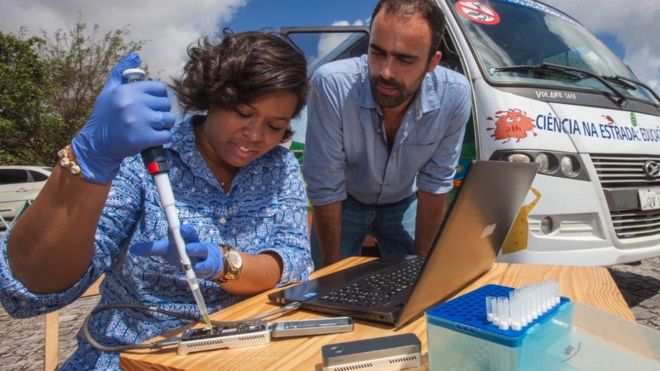
Doctor analysing virus outdoorsFifteen years ago this month, the full human genome sequence was published for the first time, heralding a new era of medicine. Since then technology has markedly speeded up genomic sequencing and reduced the cost. But have those hoped-for medical breakthroughs materialised?
"We have embarked on one of the most exciting chapters of the book of life," said Prof Allan Bradley, director of the Wellcome Trust Sanger Institute, as he welcomed the success of the Human Genome Project.
Sequencing the human genome took 10 years and cost about $30bn (£21.5bn). Now advances in computing power have seen the cost of human genome sequencing fall to under $500.
A firm called Oxford Nanopore has even developed a hand-held reader that can sequence genetic material in minutes.
Dr Gordon Sanghera, the firm's chief executive, talks about creating "the internet of living things - real time connection of live DNA information" using such portable devices.