Страницы

Thursday, May 16, 2019

Bad sign

Putin Shoots, Scores and Falls Face First on Hockey Ice

Russia’s president, Vladimir V. Putin, has long cultivated a proud image as a man in control, both at work and at play. He is known as a fierce competitor in the ice hockey rink, after learning to play the game when he turned 60 and creating the amateur Night Hockey League in 2011.

But that image slipped, just briefly, during a friendly game at the Bolshoi Ice Arena in the Black Sea resort of Sochi on Friday. Video footage shows a jubilant Mr. Putin and his team circling the rink on skates as they celebrated a 14-7 victory.

But as Mr. Putin takes his lap in front of his teammates, smiling and waving to fans, basking in the cheers of the crowd, he falls — face first — onto the ice.

Two teammates rushed in vain to save the president as it became clear that he was headed for a faceplant.
Information security

'The Shadow War': How a Chinese spy stole some of the Pentagon's most sensitive secrets

Crippling ransomware attacks targeting US cities on the rise
To his American friends and contacts, Stephen Su was an affable businessman and gregarious guy.
    "People liked him," Bob Anderson, the FBI's former head of counterintelligence, told me. "They didn't think he was an asshole and I know that sounds stupid, but people are people and that's how it started."
    Stephen Su, who also went by his Chinese name Su Bin, lived in his native China but traveled frequently to the United States and Canada, to build a business in the aviation and aerospace sectors. His company, Lode-Tech, was a small player in a field of giants. However, from 2009 to 2014, Su steadily and deliberately built a network of close business contacts inside far bigger US and Canadian defense contractors who held some of most sensitive US military contracts.
    Weapons

    ‘Ninja bomb’ is a bladed anvil that shreds terrorists with no risk of collateral damage, Pentagon says


    Collateral damage of indirect fire missions conducted against enemy targets in heavily populated urban centers has long been a criticism levied against U.S. forces.
    Never before has the role of fire support specialists ensuring artillery, air, mortar and even naval gunfire strikes hit precisely while minimizing the potential of civilian casualties.
    But over a dozen current and former U.S. officials told the Wall Street Journal last week that the possibility of collateral damage has been significantly reduced due to the secretive development of a missile capable of eliminating targets sans any explosion.
    The weapon has been in use for some time, while its existence has been kept under wraps by the Central Intelligence Agency and the Pentagon, according to the Wall Street Journal.
    Spawned from the widely-used Hellfire missile, the R9X — also known as “the flying Ginsu” or “ninja bomb” — is equipped with a non-explosive warhead capable of pummeling its target with over 100 pounds of screaming metal.
    The precision ninja bomb is also kitted out with six internal blades that can cut through buildings or cars with ease. These long blades deploy in the shape of a halo around the missile moments before it pulverizes its target like a heaven-sent anvil cheese grater, officials told the WSJ.


    Nuclear security

    Nuclear War Is Still Very Possible and Very Scary


    They have their priorities straight.
    One of the most striking facts of today’s world is that young people do not seem to worry very much about nuclear war. Climate change is by far the larger concern, while nuclear war is seen as a threat of the past. As Chapin Boyer, who is in his late 20s, wrote in the Bulletin of the Atomic Scientists a few years ago: “I cannot remember a time when the threat of nuclear weapons seemed real. … My generation grew up believing that the problem of nuclear weapons had been solved.”
    In contrast, I am inclined to think that the risk of nuclear war remains the world’s No. 1 problem, even if that risk does not seem so pressing on any particular day.
    In the 1950s and ’60s, fears of nuclear war were palpable. In 1951, the president of Harvard wrote a letter to his 21st-century successor. “There are many who anticipate World War III within the decade,” James B. Conant wrote, “and not a few who consider the destruction of our cities including Cambridge quite possible.”
    Cybersecurity

    WhatsApp security breach may have targeted human rights groups

    Картинки по запросу WhatsApp
    WhatsApp said on Tuesday that a security breach on its messaging app had signs of coming from a government using surveillance technology developed by a private company, and it may have targeted human rights groups.

    WhatsApp, a unit of Facebook, said it had notified the U.S. Department of Justice to help with an investigation, and it encouraged all WhatsApp users to update to the latest version of the app, where the breach had been fixed.

    WhatsApp, one of the world’s most popular messaging tools, is used by 1.5 billion people monthly. It has touted its high level of security and privacy, with messages on its platform being encrypted end-to-end so that WhatsApp and third parties cannot read or listen to them.
    Trade wars

    Trump could win trade battle with China but lose the war

    Since President Donald Trump started jacking up tariffs on China last year, he's argued that the U.S. has the upper hand in negotiating with Beijing. He may be right — new numbers on consumer spending and industrial production show the Chinese economy continuing to slow, in part because of the ongoing trade war between the world's two largest economies.
    "One thing is for sure, the recent trade tensions have caused real damage to the manufacturing sector, exports, production and, most worrying, investment," analysts Wei Yao and Michelle Lam of Societe Generale said in a research note assessing China's latest economic data.
    By most measures China remains enviably vibrant: Over the first three months of 2019, its economy grew 6.4% from a year ago — more than twice as fast as the U.S. grew. Nor are Mr. Trump's tariffs the main cause of China's troubles. Its economy has been slowing for years as the country shifts away from manufacturing toward consumer spending, while the most recent dip has more to do with the Chinese central bank's reluctance to ease interest rates even as growth cools. 

    Wednesday, May 15, 2019

    WWII history

    The Lies About World War II


    Картинки по запросу World war IIIn the aftermath of a war, history cannot be written. The losing side has no one to speak for it.  Historians on the winning side are constrained by years of war propaganda that demonized the enemy while obscuring the crimes of the righteous victors.  People want to enjoy and feel good about their victory, not learn that their side was responsible for the war or that the war could have been avoided except for the hidden agendas of their own leaders. Historians are also constrained by the unavailability of information. To hide mistakes, corruption, and crimes, governments lock up documents for decades.  Memoirs of participants are not yet written.  Diaries are lost or withheld from fear of retribution.  It is expensive and time consuming to locate witnesses, especially those on the losing side, and to convince them to answer questions.  Any account that challenges the “happy account” requires a great deal of confirmation from official documents, interviews, letters, diaries, and memoirs, and even that won’t be enough.  For the history of World War II in Europe, these documents can be spread from New Zealand and Australia across Canada and the US through Great Britain and Europe and into Russia.  A historian on the track of the truth faces long years of strenuous investigation and development of the acumen to judge and assimilate the evidence he uncovers into a truthful picture of what transpired. The truth is always immensely different from the victor’s war propaganda.

    Tuesday, May 14, 2019

    Energy security

    Oil Prices Rise as Saudi Energy Minister Reports Drone Attack on Pipeline

    FILE - In this June 23, 2018 file photo, Saudi Energy Minister Khalid al-Falih attends a news conference in Vienna, Austria. Saudi Arabia said on Thursday, Aug. 23, 2018 that it remains committed to an initial public offering of the state-run oil behemoth Saudi Aramco despite delays and growing speculation it may never be listed. (AP Photo/Ronald Zak, File)
    Oil prices jumped Tuesday morning on reports of a drone attack on oil pumping stations in Saudi Arabia, with the kingdom regarding the incident as a terrorist act.
    The incident is an “act of terrorism,” Saudi Energy Minister Khalid al-Falih said, according to the Saudi state news agency SPA, when describing the attacks on two oil pumping stations near Riyadh carried out with bomb-laden drones.
    Brent crude futures were up 1.7% at $71.39 a barrel. US West Texas Intermediate (WTI) crude futures settled at $61.86 per barrel, up 1.2%.
    Nuclear security

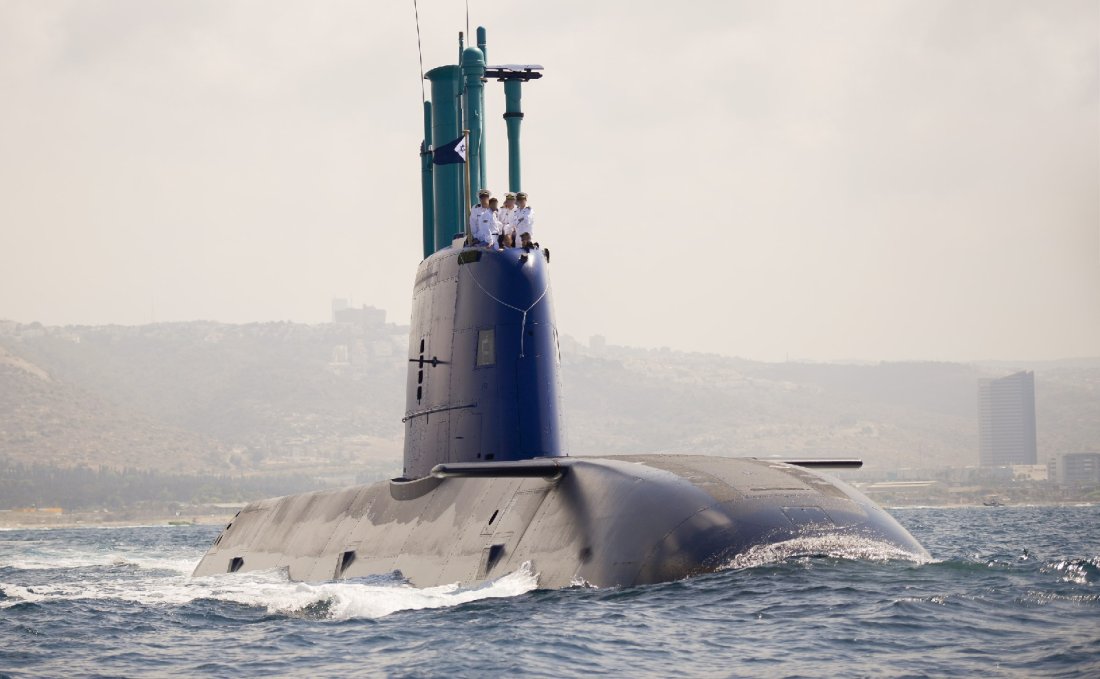
    Israel: An 'Underwater' Nuclear Power (Thanks to German Submarines)


    Israel has never officially admitted to possessing nuclear weapons.
    Unofficially, Tel Aviv wants everyone to know it has them, and doesn’t hesitate to make thinly-veiled references to its willingness to use them if confronted by an existential threat. Estimates on the size of Tel Aviv’s nuclear stockpile range from 80 to 300 nuclear weapons, the latter number exceeding China’s arsenal.
    Originally, Israel’s nuclear forces relied on air-dropped nuclear bombs and Jericho ballistic missiles. For example, when Egyptian and Syrian armies attacked Israel during the 1973 Yom Kippur War, a squadron of eight Israeli F-4 Phantom jets loaded with nuclear bombs was placed on alert by Prime Minister Golda Meir, ready to unleash nuclear bombs on Cairo and Damascus should the Arab armies break through.
    Though Israel is the only nuclear-armed state in the Middle East, Tel Aviv is preoccupied by the fear that an adversary might one day attempt a first strike to destroy its nuclear missiles and strike planes on the ground before they can retaliate. Currently, the only hostile states likely to acquire such a capability are Iran or Syria.
    Immigration security

    Despite falling numbers, immigration remains divisive EU issue

    Картинки по запросу MV Aquarius rescue ship
    Migrant arrivals to Italy have almost dried up, new asylum requests across the European Union have more than halved in three years and at the end of 2018, Hungary’s reception centers housed just three refugees.

    On the face of it, Europe’s migrant crisis appears over, but the shockwaves still resound around the continent ahead of this month’s European Parliament election, and nationalist politicians are looking to capitalize on the continued tumult.

    “The most important thing is that leaders are elected who oppose immigration so that Europe will be in a position to defend itself,” Hungarian Prime Minister Viktor Orban said on the sidelines of an EU summit in Romania last week.

    Opponents accuse far-right and populist parties of grossly exaggerating the problem, but the issue still resonates, with a YouGov poll published on Monday showing that immigration was currently the voters’ top concern, followed by climate change.
    Electronic surveillance

    Sajid Javid admits MI5 committed serious safeguard breaches

    Home secretary Sajid Javid
    MI5 has committed “serious” breaches of surveillance safeguards in the way it handles information obtained under interception warrants, the home secretary, Sajid Javid, has admitted.
    So severe was the compliance failure that the Investigatory Powers Commissioner’s Office (IPCO) sent a team of inspectors into the intelligence agency for a week to investigate, according to the human rights organisation Liberty.
    Liberty is one of a number of NGOs taking legal action over what it alleges are excessively intrusive surveillance powers. The IPCO, chaired by the appeal court judge Sir Adrian Fulford, is the official body responsible for overseeing government surveillance practices.

    Geomagnetic security

    Solar storm INCOMING: A powerful stream of energy from the Sun will strike Earth TOMORROW

    A GEOMAGNETIC storm caused by a stream of solar energy spewed by the Sun is expected to slam into the Earth by Wednesday, space weather forecasters have warned.

    A geomagnetic storm watch is now in effect for Wednesday, May 15, and Thursday, May 16. US  weather forecasters at the NOAA Space Weather Prediction Center (SWPC) expect charged particles from the Sun to wash over the Earth this week. The storm watch comes five days after the Sun released a monstrous Coronal Mass Ejection (CME) of hot gas known as plasma. The SWPC noticed three separate CME events this month, with the first two ready to strike this week.
    The forecaster said: “The G1 Minor geomagnetic storm watch is now in effect for both 15 and 16 May, 2019, due to anticipated CME effects.
    “A series of three observed Coronal Mass Ejections have taken place since May 10, 2019.
    “The first two CME events are expected to arrive on May 15 and the third is anticipated to arrive the later half of May 16.”
    There is some disagreement over when exactly the geomagnetic storm will strike, but May 15 and May 16 are the two most likely dates.
    Solemn ceremony

    Denied graves by Nazis, resistance fighters finally buried

    (From left) Rabbi Andreas Nachama, Protestant priest Marion Gardel, and Catholic priest Lutz Nehk took part in a funeral procession behind a box containing the remains of political prisoners executed by the Nazis and dissected for research, during a burial ceremony at Berlin's Dorotheenstadt cemetery on Monday.
    Executed for standing up against Adolf Hitler’s dictatorship and then denied graves so as not to become a rallying point for others, the partial remains of 300 Nazi resistance fighters were laid to rest Monday in a solemn ceremony in a downtown Berlin cemetery.

    The small wooden box lowered into the square granite-edged plot included remains of Erika von Brockdorff, who was beheaded in the Nazis’ notorious Ploetzensee Prison on May 13, 1943 — exactly 76 years ago — for her involvement in the famous Red Orchestra resistance movement.

    ‘‘I’m just happy that there is now this place,’’ reflected her daughter, 81-year-old Saskia von Brockdorff, after sprinkling handfuls of earth into the grave. ‘‘We always drove with my sons to Ploetzensee, but that is really a place of execution even if it is not what it was then, and I’m glad I can come here now.’’
    Defense procurement

    Defense Contracting Fraud: A Persistent Problem


    Steven AftergoodDuring the five year period from 2013-2017, there were 1,059 criminal cases of defense contracting fraud resulting in the conviction of 1,087 defendants, including 409 businesses, according to a newly released Department of Defense report to Congress. There were another 443 fraud-related civil cases resulting in judgments against 546 defendants.
    During that same period, the Department of Defense entered into more than 15 million contracts with contractors who had been indicted, fined, and/or convicted of fraud, or who reached settlement agreements. The value of those contracts exceeded $334 billion, according to the DoD report. See Report on Defense Contracting Fraud, DoD report to Congress, December 2018.
    The report was prepared in response to a requirement in the FY2018 defense authorization act at the initiative of Sen. Bernie Sanders. It was released this week under the Freedom of Information Act.
    A previous report covering the period of 2001-2010 was produced by the Department of Defense in 2011, also at the request of Senator Sanders. The earlier report likewise found extensive fraud including criminal and civil offensive in defense contracting.
    “Simply put, the Pentagon continues to be riddled with waste, fraud and abuse of taxpayer funds to a degree unmatched across the federal government,” Sen. Sanders said in 2017. “It is unacceptable that the Department of Defense continues to lose vast sums of taxpayer money because of fraud perpetrated by major defense contractors. This has got to end.”
    Innovations & technologies

    The Pentagon wants to create a broader network of innovators


    The Pentagon is reorganizing its internal offices to better partner with universities and upstart technology firms to ensure the military has access to talent and research in the near future and to fortify its innovation pipeline.
    Defense leaders are increasingly worried about what they describe as the national security innovation base. They hope a series of steps will make it easier to work with, and take advantage of, the leading-edge science across the country. This includes technology that spans from the concept stage to the production stage, and outlets that includes researchers to the defense industrial base.
    The changes, which affect the Defense Innovation Unit and MD5, were first mentioned in the Pentagon’s budget request for fiscal 2020 and have been discussed with increasing details in recent weeks. Defense innovation leaders explained the new setup to C4ISRNET in an interview May 9.
    DIU’s mission is to help the military accelerate its use of emerging commercial technologies and lower the barrier of entry for businesses that don’t already do business with the Pentagon.
    National security threat

    Transnational Organized Crime and National Security

    Traditional organized crime, ranging from the Italian-American mafia to street gangs, has long been a target of American law enforcement efforts. Unlike purely domestic organized crime, transnational organized crime, defined by the Justice Department as groups that pursue criminal activities across geographic boundaries, has profound national security implications. The FBI warns that transnational organized crime poses a diverse array of national security threats related to border security, government corruption both in the United States and abroad, energy and “strategic material” markets around the world, and “logistical and other support to terrorists and foreign intelligence services.”

    This is the first in a new series of posts about developments in Justice Department efforts to combat transnational organized criminal groups. The series will focus on the national security threats posed by transnational organized crime and will summarize how the U.S. government addresses those threats, such as prosecutions, sanctions and developing legislation.

    This post will emphasize notable developments in the past few months in the Justice Department’s drive to prosecute transnational organized crime groups. Several cases demonstrate the Justice Department’s strategy of targeting international terrorist organizations by pursuing their criminal conduct. Additionally, a case brought in New Jersey illustrates the continuing threat posed by organized hackers to sensitive information held by the U.S. government. Finally, in the battle to stymy drug trafficking cartels that operate inside the U.S. and along its borders, recent cases demonstrate the ongoing ability of such groups to corrupt anti-trafficking forces in the U.S. and Latin America.
    Arms trade

    THE CASE FOR SUSPENDING AMERICAN ARMS SALES TO SAUDI ARABIA


    Arms embargos are often dismissed as symbolic, and therefore ineffective. But just because something is symbolic, doesn’t mean that it won’t have an effect. A U.S. arms embargo against Saudi Arabia would be a clear signal of American disproval of Saudi actions in Yemen, and would be an equally important signal to Washington’s allies, who are left wondering if the United States is ambivalent or uninterested in the growing Yemeni humanitarian catastrophe.
    By continuing to provide weapons, President Donald Trump tacitly endorses Saudi policies. This signal is strengthened by Trump’s recent veto of the resolution that called for an end to U.S. support for the war in Yemen. While Trump justified the veto by saying that the resolution was a “dangerous attempt to weaken my constitutional authorities,” statements from Congressional representatives show they are aware of the powerful signals sent by arms sales. Sen. Tim Kaine said that the veto “shows the world [Trump] is determined to keep aiding a Saudi-backed war that has killed thousands of civilians and pushed millions more to the brink of starvation.” An arms embargo against Saudi Arabia would be a signal both to leaders of that country, and other states, that the United States does not endorse Saudi actions. Those arguing against a ban are correct on one point: Embargos as blunt force instruments of coercion are rarely effective. But arms embargos are effective as signals of political dissatisfaction, and serve an important communication role in international politics.
    War on terror

    A strategic US approach is required to counter the Muslim Brotherhood

    US President Donald Trump and Abdel Fattah El Sisi, Egypt's president, during a meeting at the Oval Office of the White House. Bloomberg
    After meeting with Egyptian President Abdel Fattah El Sisi last month, US President Donald Trump has been contemplating designating the Muslim Brotherhood a foreign terrorist organisation (FTO). However, many experts have been pointing out the pitfalls of such a broad categorisation, so the issue remains unresolved.
    The State Department maintains a list of formally designated FTOs, the main purpose of which is to criminalise dealings with those groups by Americans. The operative law from 1996 was intended to make otherwise lawful activity criminal, if it in any way benefited designated organisations, including charitable and educational efforts, and any kind of advice, even about how to stop being a terrorist group.
    When the US wants to directly punish a foreign individual or group with sanctions, that is mainly done by the Treasury Department. This State Department FTO list is political and often symbolic. It brands contact with entities such as Hamas and Hezbollah as unacceptable, under penalty of law.
    It is easy to see the appeal of designating the Muslim Brotherhood, since it is indeed the main source of ideology behind almost all Sunni Islamist terrorism. There would be no Al Qaeda or ISIS, if not for the Brotherhood.
    It is also accurate to compare the Brotherhood to a gateway drug for terrorism. If only one in 10 Brotherhood members graduates to Al Qaeda, that is one too many.


    International security

    Spotlight: European powers tell U.S. to avoid military escalation with Iran


    Картинки по запросу European Union (EU)The Europeans Union (EU) and member states' foreign ministers told U.S. Secretary of State Mike Pompeo on Monday to exercise maximum restraint and avoid any escalation on the military side with Iran, the EU's top diplomat Federica Mogherini said.
    "Mike Pompeo heard that very clearly from us, not only from myself, but also from the other ministers of EU member states, that we are living in crucial, delicate moments, where the most responsible attitude to take is -- and we believe should be -- maximum restraint, and avoiding any escalation on the military side," she told an evening press briefing.
    During a meeting between France, Germany and the United Kingdom, "we discussed the ways in which we can further advance on for instance the operationalisation of INSTEX to have first transactions in the hopefully next few weeks," Mogherini added.
    INSTEX, short for the Instrument in Support of Trade Exchanges, is established by three shareholders -- France, Germany and the United Kingdom -- and backed by the EU to overcome U.S. sanctions and conduct trade with Iran.
    Trade wars

    Who loses out in the US-China trade war?


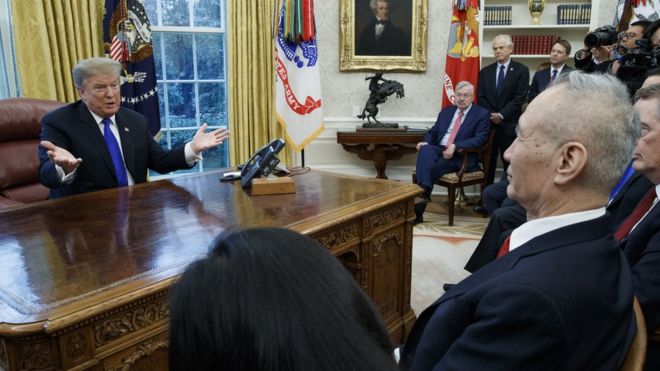
    US President Donald J. Trump (L) talks with Vice Premier of the People"s Republic of China Liu He (R) during a meeting in the Oval Office of the White House in Washington, DC, USA, 22 January 2019.
    The US-China trade war has escalated in recent days, with both countries announcing new tariffs on each other's goods.
    US President Donald Trump has said repeatedly that China will pay these taxes, even though his economic advisor, Larry Kudlow, on Sunday admitted that US firms pay the tariffs on any goods brought in from China.
    So is Mr Trump wrong when he says the trade war is good for the US, and generating billions of dollars for the US Treasury?
    And who will lose most as the conflict escalates?

    Who really pays the US tariffs?

    US importers, not Chinese firms, pay the tariffs in the form of a taxes to the US government, confirms Christophe Bondy, a lawyer at Cooley LLP.
    Mr Bondy, who was senior counsel to the Canadian government during the Canada-EU free trade agreement negotiations, says it is likely that these additional costs are then simply passed on to US consumers in the form of higher prices.
    "They [the tariffs] have a strongly disruptive effect on supply chains," he said.