Страницы

Monday, May 20, 2019

Cybersecurity

Why some of the world’s top cybersecurity hackers are being paid millions to use their powers for good


GP: Hacker with hoodie and computerOne of the most overwhelming problems in cybersecurity is a severe labor shortage. There simply aren’t enough people who are qualified to do cybersecurity jobs to fill all the open roles.
A start-up called Synack is helping companies get around this shortage by providing “crowdsourced” security. Its software platform provides automated ways for companies to discover security flaws, then it turns those vulnerabilities over to penetration testers, known as pen-testers — basically, hackers who use their powers for good. The company makes a point of hiring top pen-testing talent, then sees how they can use the flaws to breach the client.
Synack competes with both companies that provide vulnerability monitoring with machine learning, and with bug bounty programs, which allow companies to hire hackers with hard-to-find skills en masse to test their networks.
Middle East

UK Special Forces ‘Joining US Strike Force’ in Gulf Amid Iran Tension - Report

A picture released by the official Iranian News Agency shows members of Iran's elite Revolutionary Guard riding their boat along with an Iranian naval vessel during manoeuvers along the Gulf Sea and Sea of Oman, 03 April 2006
The USS Abraham Lincoln aircraft carrier strike group earlier arrived for patrols in the Arabian Sea, with the US reportedly ready to deploy as many as 120,000 troops to the Middle East to counter alleged threats from Tehran.
British Special Forces have flown to the Middle East in the framework of a top secret mission to rebuff possible Iranian attacks on merchant ships, according to The Sun.
Members of the elite Special Boat Service are reported to have joined UK registered oil tankers heading towards the Persian Gulf, subsequently to be tasked with monitoring Iranian military activity in the vicinity of Qesham Island, home to the country's naval gunboats, the paper reports.

Sunday, May 19, 2019

Drug trafficking

Pure methamphetamine in rock from, known as ice, is photographed at the DEA's North Central Laboratory in Chicago, Ill. Managers at the lab say this is, by far, the most common type of meth they've been seeing. (Anthony Souffle/Minneapolis Star Tribune/TNS) As the opioid crisis peaks, meth and cocaine deaths explode


Most states are keeping a close eye on opioid overdose deaths, but they may need to start focusing on cocaine and other stimulants as well.
It turns out that the same lethal drug that has been driving the nation's spiraling opioid epidemic is also causing a historic surge in overdose deaths among cocaine users.
That's according to a new analysis of death certificate data from the U.S. Centers for Disease Control and Prevention showing that fentanyl — a cheap synthetic opioid that is a hundred times more potent than morphine — and other opioids were involved in nearly three-fourths of all cocaine overdose deaths and an increasing number of methamphetamine deaths.
In a drug overdose epidemic that has killed more than 700,000 Americans since 1999, state and local officials have been primarily concentrating on opioids, which were involved in nearly 70% of overdose deaths in 2017.
The CDC's new analysis indicates that public health and law enforcement officials should be just as vigilant when it comes to cocaine, meth and other prescription and illicit drugs of abuse in their communities.
Forensics

Stop the Explosion Before it Starts

Research found that when an explosion starts, it requires a reaction speed of 120-150 milliseconds to halt it. After an explosion is detected, gas or powder can be released to stop it. A new system activates a trigger signal within 67 microseconds (67 millionths of a second) from the start of the detonation.
The technology detects the start of a detonation and provides a trigger signal to an Active Mitigation System (AMS) such as a water bomb to neutralize the effect of the detonation. The explosion detection and active mitigation system are designed to protect against threats such as landmines and improvised explosive devices (IEDs).
The technology was developed by India’s Council for Scientific and Industrial Research (CSIR), India’s national R&D organization. It consists of sensor hardware to detect a detonation in progress, signal processing electronics that implement a unique algorithm for discriminating between background signals, and electronics that issue a trigger signal to the AMS within 67 microseconds from the start of the detonation.
The system can detect a landmine (or other buried charge) detonation in progress and issue a timeous trigger signal to an AMS to neutralize or significantly reduce the threat. The ultimate benefit is to the soldiers inside the vehicle being better protected against serious injury, the CSIR said.

Friday, May 17, 2019

Cybersecurity

Hacktivist attacks dropped by 95% since 2015


Hacktivist attacks 2015-2019
Threat intelligence analysts have long said that hacktivism was dead but new data published by IBM X-Force today confirms the complete collapse of hacktivism scene, with activity levels going down by 95% since 2015.
According to IBM, security incidents caused by hacker groups operating under hacktivism causes has been on a decline since 2015, when the company recorded a peak, with 35 publicly reported incidents.
Since then, incidents have gone down at a steady pace, with only five reported in 2017, two in 2018, and zero during the first months of the year.
Attacks from hacktivist groups have continued to happen, but the number of actual incidents (successful breaches) has gone down at a constant pace.
Researchers blame two factors for this decline -- the death of the Anonymous hacker collective and a sustained crackdown by law enforcement officials that have thinned out hacktivist ranks.
Defense spending

Germany announces biggest defence spending rise since end of Cold War

The new frigate F225 'Rheinland-Pfalz' of the German navy (Bundesmarine) is moored at Blohm & Voss shipyards in Hamburg, northern Germany,
Germany is to increase defense spending by more than €5bn (£4.4bn) this year, Angela Merkel’s government informed Nato on Friday.

It is the biggest rise in the German military budget since the end of the Cold War, but will still leave the country far short of meeting Nato’s target of spending 2 per cent of GDP on defence.

The increase comes after months of US pressure for Germany and other European members to contribute more towards the cost of the alliance, and will be seen as a victory for Donald Trump.

But it remains to be seen whether Mr Trump will be satisfied with military spending that still only equates to 1.35 per cent of Germany’s GDP.

The rise also comes amid growing concern among Germany’s allies over equipment shortages and breakdowns that led the country’s own military watchdog to warn last year that it could not meet its Nato commitments.
Espionage

Ex-CIA officer sentenced to 20 years in prison over Chinese spying conspiracy


Ex-CIA officer sentenced to 20 years in prison over Chinese spying conspiracy
A former CIA officer was sentenced to 20 years in prison on Friday for a conspiracy to send national defense information to a Chinese intelligence operative.
Kevin Patrick Mallory, 62, was charged in 2017 and convicted last June under the Espionage Act. Officials said Mallory’s actions put intelligence assets in harm’s way as China continues to try to recruit former U.S. agents.
U.S. District Judge T.S. Ellis III issued the sentence in federal court in Alexandria, Va., on Friday.
“Mallory not only put our country at great risk, but he endangered the lives of specific human assets who put their own safety at risk for our national defense,” G. Zachary Terwilliger, U.S. attorney for the Eastern District of Virginia, said in a statement.
“As the Chinese continue to attempt to identify and recruit current and former members of the United States intelligence community, those individuals should remain vigilant and report any suspicious activity to the appropriate security officials. This case should send a message to anyone considering violating the public’s trust and compromising our national security by disclosing classified information.” 
Electronic warfare

US Air Force deploys missiles that can fry Iran and North Korea’s weapons with microwaves as Saudi urges Trump to launch airstrikes now

 Graphic shows a Counter-electronics High Power Microwave Advanced Missile Project missile taking out a targetTHE US Air Force has deployed 20 missiles which can zap enemy electronics with powerful pulses rendering weapons virtually useless.
They can be launched into enemy airspace at low altitude and emit blasts of high-power microwave energy that immediately disable any devices targeted.
The Counter-Electronics High Power Microwave Advanced Missile Project (CHAMP) is the brainchild of Boeing's Phantom Works lab.
They have not been operation until now and could be used to frazzle the military defences of Iran and North Korea, reports DailyMail.com.
News of the state-of-the-art weapons - which are carried into battle by B-2 stealth bombers - comes as a Saudi state newspaper called for the US to launch "surgical strikes" against Iran now.
Mary Lou Robinson, the chief of the High Power Microwave Division of the Air Force Research Lab at Kirtland Air Force Base, told DailyMail.com the missiles are now operational.
They are equipped with an electromagnetic pulse cannon which causes voltage surges in electronic equipment and military vehicles.
Navy

After Only 3 Years in Service, the USS Zumwalt’s Mission Is Changing


Largest U.S. Destroyer Out For Trials
The USS Zumwalt and her two sister ships are undergoing a dramatic change of mission just three years after the first ship was commissioned. The destroyers, originally meant to provide naval gunfire support for the Marines and bombard targets far inland, are now being reorientated to a ship-killer role.

The Zumwalt-class of destroyers was meant to dramatically boost the fleet’s gun firepower. After the retirement of the four Iowa-class battleships in the early 1990s, the service studied a number of solutions before deciding on the Zumwalts. Each ship would be equipped with two 155-millimeter Advanced Gun Systems, each firing a precision-guided Long Range Land Attack Projectile to ranges of up to 83 miles.

The U.S. Navy originally planned to buy 32 destroyers, a number that was cut to seven ships, and then finally to just three. The cost of the LRLAP projectile, originally pegged at $50,000 each, ballooned to $800,000 each making them unaffordable to even the mighty U.S. Navy. Without enough ships and guns, the Zumwalts were in danger of becoming the white elephants of the fleet.

The Zumwalt destroyer program has been an expensive mess. The program has cost $23 billion to date, producing just three ships with an average cost of $7.8 billion—more than three times the cost of Arleigh Burke-class guided missile destroyers that make up the bulk of the Navy’s surface fleet. Furthermore the ships are five years late and, without LRLAP ammunition, cannot fulfill their original mission.
Financial safety

China’s currency is sending a warning signal about the trade war


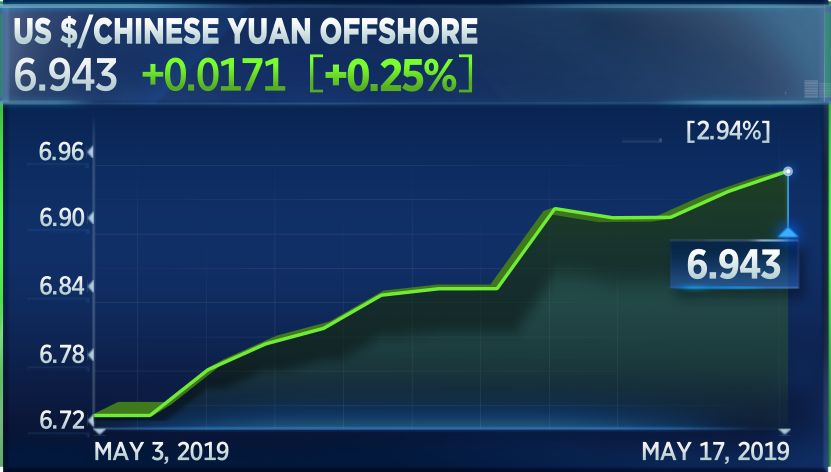
China’s currency has been an important barometer for progress in U.S.-Chinese trade talks, and right now it’s signaling that things aren’t going well.
The question is whether that signal is intentional, and whether Chinese officials will step in to prevent the yuan from reaching a key psychological low of 7 to the dollar. That level has become a line in the sand for markets around the world, and if broken, it could trigger a negative reaction in risk markets globally, as investors move to price in a bigger economic impact from a longer, more contentious trade war.
The yuan has been fairly stable this year, as the U.S. and China carried on trade talks. But since President Donald Trump tweeted about new tariffs May 5, the onshore yuan or CNY, has lost 2.7% against the U.S. dollar.
“Obviously, the trade shock we’re now discussing is a full blown trade war, so it’s obviously a very serious scenario. Then we have this negotiations period, where it could be averted and that doesn’t seem to be very good at all,” said Jens Nordvig, CEO of Exante Data. “It’s also unclear whether the Chinese officials want to fight hard to keep the currency stable.
Artifacts trafficking

‘One third of art market is fake’: Art detective reveals how terrorists, mafia profit from it


‘One third of art market is fake’: Art detective reveals how terrorists, mafia profit from it
As the ‘Indiana Jones of Lost Art’, Arthur Brand often finds himself at the crossroads of the illicit art trade and a shadowy criminal underground. The art detective joined RT’s SophieCo to reveal the secrets of his trade.
From the posh galleries of the European art scene to the farthest reaches of the Afghan Hindu Kush, Brand is on the hunt for stolen treasures. His work can sound much like a spy thriller, a world of clandestine meetings and forged documents.
Working with criminals, of course, has its risks.
“Sometimes you get threats,” he said, “I have to be cautious.”
The mafia and other criminal groups aren’t the only players dealing in stolen artwork; terrorist militants have entered the black market as well – what the CIA calls the world’s fourth largest illegal enterprise. The unlikely archeologists use the proceeds from stolen relics to finance their terror attacks.
“They call it blood antiques,” Brand said. “Groups like the Taliban, Al-Qaeda and ISIS, they conquer a certain area which is full of treasures,” forging paperwork and selling the artifacts in legal markets.
“Museums have bought [them] in the past” he said. “You can find them at auction houses. You can find them at art deals.”


International security

Iranian missiles can hit U.S. ships in Gulf: Guards

Картинки по запросу Revolutionary Guards
A deputy head of Iran’s elite Revolutionary Guards said short-range Iranian missiles could reach U.S. warships in the Gulf, and the United States could not afford a new war, the semi-official news agency Fars reported on Friday.

The comments added to days of sabre-rattling between Tehran and Washington, which has tightened sanctions and built up its military presence in the region alleging threats from Iran to its troops and interests.

Iran has accused the United States of “psychological warfare” and Supreme Leader Ayatollah Ali Khamenei said this week Tehran would not negotiate another deal after Washington quit a 2015 pact over Iran’s nuclear program.

“Even our short-range missiles can easily reach (U.S.) warships in the Persian Gulf,” Mohammad Saleh Jokar, the Guard’s deputy for parliamentary affairs, was quoted by Fars as saying.
Immigration security

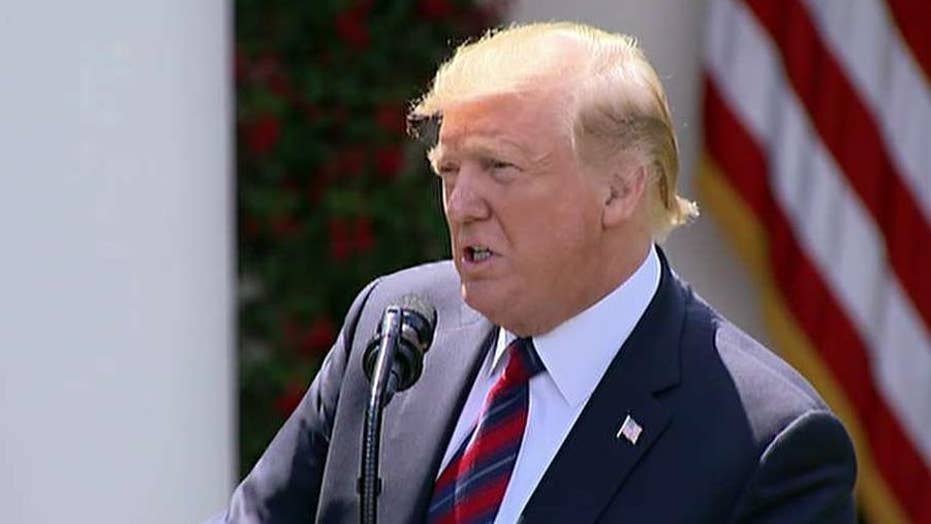
Trump unveils plan to ‘transform’ America’s immigration system, focus on high-skilled workers

President Trump lays out plan to reform US immigration system
President Trump on Thursday unveiled a long-awaited immigration overhaul that would dramatically alter how the U.S. accepts people into the country, upending the system in order to favor admissions based on merit rather than family ties.

"If adopted, our plan will transform America's immigration system into the pride of our nation and the envy of the modern world," Trump said from the Rose Garden.

The proposal would judge immigrants with a points-based system that would favor high-skilled workers -- accounting for age, English proficiency, education and whether the applicant has a well-paying job offer.

Currently, only about 12 percent of immigrants are admitted based on employment and skills, while 66 percent are admitted based on family connections inside the U.S. Administration officials estimate that those numbers would flip to 57 and 33 percent, respectively, under the Trump plan.

"Currently 66 percent of legal immigrants come here based on random chance, they're admitted solely because they have a relative in the United States, and it doesn't really matter who that relative is," Trump said.

He said the plan would help recruit "top talent."
Trade wars

What could happen if China uses its 'nuclear option' in the trade war

China military DF-10 missile Tiananmen Gate
Chinese scholars are reportedly looking into the so-called nuclear option in the trade war — Beijing dumping US Treasurys. 
"Many Chinese scholars are discussing the possibility of dumping US Treasuries and how to do it specifically," Hu Xijin, the editor-in-chief of the state-aligned Chinese tabloid Global Times, tweeted on Monday, setting off a debate about what the consequences would be if China divested its holdings.
While UBS strategists think it's unlikely China would sell the entirety of its holdings, they looked into what could happen just in case. To do so, they looked at the effect the Fed's tapering had on yields. 
"Through quantitative easing programs, the Fed expanded its balance sheet by about $3.5trn," the strategists wrote. "We estimated that this compressed US term premium by about 110bp. Through its balance sheet unwind of $600bn, we estimated that 10-year term premium had risen by about 20-30bp."
Therefore, they concluded that China unloading all $1.1 trillion of its Treasurys, or about 7% of the entire market, would cause the 10-year yield to climb by 30 to 40 basis points. 
But not everyone agrees that yields would go higher. In Bloomberg's daily markets email, Joe Weisenthal, the executive editor for daily news, suggested Treasury yields could actually fall.

Thursday, May 16, 2019

Innovations & technologies

15 commercial products invented by the military include GPS, duct tape and Silly Putty

The jeep proved an invaluable contribution to the U.S. military effort.
The U.S. military spent over $42 billion in research and development in 2018. Though much of this funding tends to go to weapons programs, a great deal of military R&D often ends up also having civilian applications.

Military programs that work on new technology, materials, or gadgets have over the years contributed to the development of several consumer end products, materials used in consumer applications, medical devices, and much more. Some of these products are still made in the United States.

In fact, some of the most widely used commercial products today were originally developed for the purpose of defending the country or were a byproduct of military research. 24/7 Wall St. identified 15 commercial products that are a direct result of military research.
The United States is the world's largest economy and it spends by far the most on its military. This includes large investments in R&D, whether through the military's own research agencies or through contracts with private companies – known as the military-industrial complex. This relationship is still going strong, as there are dozens of companies making more than $1 billion from military contracts.
Opinion

US military complex is a ‘malignant virus’ that's evolved to defend itself – Andrew Cockburn


US military complex is a ‘malignant virus’ that's evolved to defend itself – Andrew CockburnThe US military industrial complex has grown into a self-sustaining organism with an immune system that attacks and smothers any threat to its food supply – the taxpayers' money, writes renowned defense analyst Andrew Cockburn.
Cockburn outlines the process that allows US defense contractors to thrive despite repeatedly missing deadlines and producing overpriced, subpar equipment. The system has evolved to be very good at defending itself – while leaving the country, “in reality so poorly defended,” he writes in his latest think piece for Harper's Magazine titled ‘The Military-Industrial Virus: How bloated defense budgets gut our armed forces’.
Cockburn, whose 40+ years of experience include numerous books and publications on the US' military complex, its foreign wars and adversaries, looks at the current state of America's armed force – from the overpriced “disaster” that is the F-35 fighter, to the few “dilapidated” minesweepers, to faulty personal protection and radios American soldiers are equipped with – and compares it to the exorbitant defense bills the taxpayer has to foot.
Military

71% of young people are ineligible for the military — and most careers, too

Marines participate in a 10 kilometer training march carrying 55 pound packs during Marine Combat Training (MCT) on February 22, 2013 at Camp Lejeune, North Carolina.
The numbers are staggering: Seventy-one percent of young people are ineligible to join the military, according to 2017 Pentagon data. The reasons: obesity, no high school diploma or a criminal record.

The problem isn't just a military one, though: It's an issue for businesses as well because the vast majority of that age group isn't eligible for many jobs either, said retired Rear Admiral Thomas Wilson.

That's why Wilson recently raised the issue at a gathering of business and community leaders in York County, Pennsylvania. The 29 percent of 17- to 24-year-olds who are qualified become prime targets for all recruiting: military, college and jobs.

Wilson calls it “a war for the qualified.” Steve Doster, Pennsylvania State director of Military Readiness for Council for a Strong America, agrees it's a problem.

“This is a very real risk to our national security,” Doster said.
Science


Researchers shed new light on atomic 'wave function'


JQI researchers shed new light on atomic 'wave function'Physicists have demonstrated a new way to obtain the essential details that describe an isolated quantum system, such as a gas of atoms, through direct observation. The new method gives information about the likelihood of finding atoms at specific locations in the system with unprecedented spatial resolution. With this technique, scientists can obtain details on a scale of tens of nanometers—smaller than the width of a virus.
Experiments performed at the Joint Quantum Institute (JQI), a research partnership between the National Institute of Standards and Technology (NIST) and the University of Maryland, use an optical lattice—a web of laser light that suspends thousands of —to determine the probability that an atom might be at any given location. Because each individual atom in the lattice behaves like all the others, a measurement on the entire group of atoms reveals the likelihood of an individual atom to be in a particular point in space.
Financial safety

Countdown to zero: Russia continues dumping US debt


Countdown to zero: Russia continues dumping US debt
Foreign investors have accelerated the reduction of US debt securities, selling $21.7 billion of their holdings in March, according to data released on Wednesday by the US Treasury Department.
Russia, which is no longer a leading creditor of the US, after an unprecedented dumping of the US Treasury bonds in April and May, has slashed its stockpile by almost $800 million in March to $13.716 billion.
Russia has cut nearly 85 percent of its US Treasury holdings from $96.9 billion in January 2018. The drop is even more significant from 2012, when Russia held over $170 billion in US debt bonds.
Criminal investigation

GozNym cyber-crime gang which stole millions busted


Hands on keyboard, screen of data
An international crime gang which used malware to steal $100m (£77m) from more than 40,000 victims has been dismantled.
A complex police operation conducted investigations in the US, Bulgaria, Germany, Georgia, Moldova and Ukraine.
The gang infected computers with GozNym malware, which captured online banking details to access bank accounts.
The gang was put together from criminals who advertised their skills on online forums.
The details of the operation were revealed at the headquarters of the European police agency Europol in The Hague.
It said that the investigation was unprecedented, especially in terms of cross-border co-operation.