Страницы

Monday, May 18, 2020

Innovations & technologies

Dynetics joins DARPA’s unmanned dogfighting effort


Dynetics will help DARPA scale up its artificial intelligence air-to-air combat effort, the company said May 6, potentially enabling a pilot to control a fleet of unmanned platforms in a dogfight.

Dynetics said it has been awarded a phase 1 contract as part of DARPA’s Air Combat Evolution (ACE) program, an effort to develop artificial intelligence for aerial combat. Among other features, ACE seeks to automate some combat functions, freeing up the human pilot for other tasks in a dogfight.

“The overarching goal of ACE is to use aerial dogfighting as sort of the crucible scenario because of its challenges and its ability to increase the complexity in order to get implementations of artificial intelligence that will help increase and help us understand how to increase trust and combat autonomy with with pilots,” explained Tim Keeter, ACE program manager for Dynetics.

"DARPA has disaggregated the program itself into four technical areas of importance, and each technical area has its own performer,” he said.

The first technical area will develop the actual dogfighting algorithms. The second will determine how to build and measure trust between pilots, the algorithms and unmanned platforms and the fourth will integrate the manned and unmanned systems together.
Cybersecurity

The 3 Top Cybersecurity Myths & What You Should Know


With millions of employees now attempting to work from home, it's vital to challenge misconceptions about cybersecurity.
Zack SchulerImagine you're working at the front desk of a tech company when a woman walks through the front door and tells you she was just in a car accident. You ask if there's anything you can do to help, but she says it wasn't serious and asks if you could direct her to a restroom.
You later discover that the woman inserted a flash drive into an unattended computer and infected your company's entire system with a destructive form of malware. Or at least that's what she could have done if the malware was real — this strange scenario was actually an elaborate demonstration (arranged by a cybersecurity professional I know) designed to show employees that not all cyberattacks are carried out remotely.
The idea that cybercriminals never interact with their targets is one of many cybersecurity myths that need to be debunked. With millions of employees now attempting to work from home for the first time due to the COVID-19 pandemic — which increases their vulnerability more than ever — it's vital to challenge stubborn misconceptions about cybersecurity.
Outer space

Space Plane: Mysterious US military aircraft launches


Atlas V rocket carrying the X-37B Orbital Test Vehicle launches from Cape Canaveral
The US Air Force has successfully launched its Atlas V rocket, carrying a X-37B space plane for a secretive mission.
The rocket launched on Sunday from Cape Canaveral, a day after bad weather halted plans for a Saturday launch.
The aircraft, also known as an Orbital Test Vehicle (OTV), will deploy a satellite into orbit and also test power-beaming technology.
It is the plane's sixth mission in space.
The launch was dedicated to front line workers and those affected by the pandemic. A message including the words "America Strong" was written on the rocket's payload fairing.
Prediction

I predict Boris Johnson will be out by Christmas. He was never up to the task of leading this country

Every time I see Boris Johnson, I ask myself how on earth he got the job. Then I remember that it was luck, guile, and the big red bus and the stuff about the NHS getting £350m a week extra – the promise that never was.

So that question pretty much answers itself. I suppose what I really mean is that it’s just begun to dawn on me that he isn’t actually very good at the job. The posh accent and the classical references disguise it a bit, but the truth is starting to show through. He’s just not up to it.

Remember what close colleague and “friend” Michael Gove said of him back in the 2016 Tory leadership debacle? “I have come, reluctantly, to the conclusion that Boris cannot provide the leadership or build the team for the task ahead”. Right first time, Gove.

Every bumbling performance at prime minister’s questions, each stumbling appearance at a coronavirus media conference, each bit of misguided spin that emanates from Downing Street, all the “ramped up” insincere promises and the hasty U-turns serve only to build up the evidence that we have somehow contrived to place a clown with the emotional maturity of a toddler in charge of dealing with the worst pandemic in 100 years.
Economic security


'The end of an era': oil price collapse may force Saudis to rein in arms spending

Saudi Hawks from the Saudi air force performing at the international aerospace and defence exhibition in Tunisia in March.Saudi Arabia may be forced to forego new weapons contracts and delay already-agreed weapons purchases as a financial crisis grips the kingdom, experts predict.
The expected delay of new weapons deals could have long-term political repercussions for the country under the rule of Mohammed bin Salman, the crown prince and de facto ruler who has waged a bloody war with neighbouring Yemen.
Saudi Arabia is facing an unprecedented budget crunch because of the collapse of the oil markets and the global economic turmoil caused by the Covid-19 pandemic, which has reduced oil demand for the foreseeable future.
“I have no doubt, this is the end of an era. The era of the Persian Gulf having all this money is over,” said Bruce Riedel, a senior fellow at Brookings in Washington and 30-year veteran of the Central Intelligence Agency, who has served as an adviser on Middle East issues to several US administrations.
Saudi Arabia spent about $62bn (£51bn) in arms last year, making it the fifth largest spender on weapons globally. Although that figure was less than in 2018, it still represents about 8% of Saudi’s GDP, meaning that the country spent a larger portion of its wealth on weapons than the US (3.4%), China (1.9%), Russia (3.9%), or India (2.4%), according to research by the Stockholm International Peace Institute.
Nuclear security

Will the Trump administration’s accusations doom the nuclear test ban treaty?

Nevada test site
In April, while most of the world was focused on defeating a devastating viral pandemic, the US State Department quietly released its annual compliance report, describing whether and how the United States and other countries have been abiding by various arms control agreements. The report is sober reading for those hoping that the coronavirus would usher in a new era of international collaboration.
The report made waves for raising “concerns” about China’s adherence to a “zero-yield” nuclear testing standard, as called for by the 1996 Comprehensive Nuclear Test Ban Treaty. Although neither the United States or China has ratified the treaty, both have signed it, and both claim to abide by a nuclear testing moratorium.
US allegations in this regard are nothing new; for decades, the United States has accused Russia of conducting low-yield nuclear tests. And in the 2020 report, those accusations are repeated. The report claims—without offering sources in its unclassified part—that “Russia has conducted nuclear weapons-related experiments that have created nuclear yield.” In its response, Russia categorically denied conducting “non-zero-yield tests.” It also made clear that it does “not intend to discuss compliance with the nuclear test ban” with the United States, which “has been delaying the ratification of the [treaty] for 25 years.”
Science

Open-access science funders announce price transparency rules for publishers

Science journals will have to disclose the costs of publishing articles in order for them to be paid for by a coalition of research funders pushing for open access.
The price transparency rules, which will take effect in July 2022, were announced today by cOAlition S, a group of 22 international organizations, European national research agencies, and foundations. In 2018, cOAlition S launched a scheme called Plan S that will require grantees’ work, beginning in January 2021, to be open access, meaning it can be read immediately upon publication, free of charge. One route to accomplish this is for authors to pay journals a fee for each article published this way.
cOAlition S wants the rules to help keep these fees reasonable. The rules require publishers to provide a break down of their prices: what percentages go to cover the cost of services such as proof-reading, copy-editing, and organizing peer review. If they don’t, “we will not meet any publication fees associated with that publisher,” says Robert Kiley, interim coordinator of cOAlition S and head of open research at the Wellcome Trust, one of the coalition’s members. “The intention is to provide more granular information about the value components of each journal article price point,” says Steven Inchcoombe, chief publishing officer at Springer Nature, which publishes the journal Nature.
Cybersecurity

Microsoft Confirms Serious New Security Problem For Windows 10 Users

In this photo illustration a Microsoft Windows 10 logo seen...Microsoft has now joined Intel in confirming a newly reported security vulnerability with Thunderbolt ports, one that enables an attacker with physical access to a PC to modify the port’s controller firmware, disabling its security. As I reported last week, almost all Windows PCs with Thunderbolt ports are vulnerable, except a few from last year that shipped with Kernel DMA protection enabled.
This new security threat has been dubbed “Thunderspy” by Björn Ruytenberg, the Eindhoven University of Technology researcher who discovered and disclosed it. Ruytenberg warns that despite locking or suspending a PC, setting up a Secure Boot and strong system passwords, and enabling disk encryption, “all an attacker needs is five minutes alone with the computer” to compromise a machine.
Trade wars

America Is in a New Cold War and This Time the Communists Might Win

Dragons, Twins, Tibetan, Sign, Religious, China
It had been a bedrock belief of U.S. policy for 40 years that it was possible to bring the People's Republic of China smoothly into the family of nations—and now, one of the architects of that policy was finally acknowledging the obvious.

In a speech six months ago, former World Bank President and Deputy Secretary of State Robert Zoellick reminded listeners of his own famous 2005 call on Beijing to become a "responsible stakeholder." He ticked off a few of the ways in which China had done just that: voting for sanctions on North Korea and limiting missile exports, for instance. But he acknowledged that the project had gone off the rails.

"Xi Jinping's leadership," Zoellick said of the PRC president, "has prioritized the Communist Party and restricted openness and debate in China. China hurts itself by forging a role model for dystopian societies of intrusive technologies and reeducation camps." He added: "The rule of law and openness upon which Hong Kong's 'One Country, Two Systems' model rests may topple or be trampled. If China crushes Hong Kong, China will wound itself—economically and psychologically—for a long time."
Biosecurity

Exclusive: Second more deadly wave of coronavirus 'to hit Europe this winter'

Epidemic, Coronavirus, Lurking, Stay Home, VirusEuropean countries should brace themselves for a deadly second wave of coronavirus infections because the pandemic is not over, the World Health Organisation’s top official in Europe has said. 
In an exclusive interview with The Telegraph, Dr Hans Kluge, director for the WHO European region, delivered a stark warning to countries beginning to ease their lockdown restrictions, saying that now is the "time for preparation, not celebration".
Dr Kluge stressed that, as the number of cases of Covid-19 in countries such as the UK, France and Italy was beginning to fall, it did not mean the pandemic was coming to an end. The epicentre of the European outbreak is now in the east, with the number of cases rising in Russia, Ukraine, Belarus and Kazakhstan, he warned....

Sunday, May 17, 2020

Health security

US-based company claims to discover antibody for coronavirus cure

A couple wearing protective masks from the coronavirus ride a scooter down the street past the Ronald Reagan UCLA Medical Center in the Westwood section of Los Angeles, California, U.S. on May 15, 2020. (AP Photo)Sorrento Therapeutics, a California-based biopharmaceutical company, announced Friday that they have discovered an antibody that could protect people from COVID-19 and eject it out of the human body within four days, according to a report by Fox News.

The company claims that the STI-1499 antibody can provide "100% inhibition" of the coronavirus. It added that the treatment could be available months prior to the release of a vaccine into the market.

"We want to emphasize there is a cure. There is a solution that works 100 percent," Dr. Henry Ji, founder and CEO of Sorrento Therapeutics, told Fox News. "If we have the neutralizing antibody in your body, you don't need the social distancing. You can open up a society without fear."

As coronavirus deaths have reached 100,000 in the U.S., pharmaceutical companies have been toiling to develop treatments.
Law enforcement

How the FBI's intelligence experiment went wrong


FBI partners with Auburn University in crime fighting efforts
For the second time in two decades, the FBI finds itself in turmoil. This time, unlike the first, the problem is of the bureau’s own making — and it needs to course-correct quickly, for the sake of itself and the country it serves.
To do so, one must consider that earlier tumultuous episode and how the response to it ultimately led to the second.
The events of 9/11 have been variously described as a gut punch or a Mike Tyson uppercut to the FBI. Unprepared to understand the threat before the attack or to immediately respond afterward, FBI agents across the country went home to email documents and photographs of the terrorists using their personal AOL accounts because, unbelievably, they lacked technology at work. Then-Director Robert Mueller, who had experience in criminal matters as a prosecutor and Department of Justice official, had been on the job just seven days on that Tuesday morning, but he knew the bureau had to change — and fast.
There were cries to break up the FBI or establish a stand-alone internal security service like Britain’s MI5. Mueller reflexively knew that was a bad idea for two reasons: Other democracies with internal services didn’t have a Constitution and Bill of Rights, and most of those services wanted what the FBI already had — the ability to use criminal investigative tools in the fight against terrorism and counterintelligence threats.
Financial safety

International fraud ring steals millions from US unemployment funds


A COVID-19 Unemployment Assistance Updates logo is displayed on a smartphone on top of an application for unemployment benefits.
A Nigerian fraud ring has reportedly swiped millions of dollars in unemployment benefits — funds meant to help out-of-work Americans.
The complex and widespread theft scheme used stolen identity data from citizens, including social security numbers, to file false claims on behalf of workers who may not even have lost their jobs, according to a New York Times report.
Federal authorities believe most of the phony claims have been filed in the state of Washington, though evidence suggests similar attacks in six other states: Florida, Massachusetts, North Carolina, Oklahoma, Rhode Island and Wyoming, a Secret Service memo obtained by the Times said.
The ring could end up stealing “hundreds of millions of dollars” from state unemployment departments that have been completely overwhelmed by Americans desperate for a financial lifeline after economies shut down.
Roy Dotson, a special agent at the Secret Service, told The Times that investigators were still trying to confirm who was behind the attacks and where exactly they are operating,
Trade wars

China looks to retaliate against U.S. over ‘unreasonable suppression’ of Huawei

China is planning to retaliate against U.S. companies over the Trump administration's latest moves to block Huawei.
Regardless of everything else going on, the U.S. vs. Huawei saga doesn’t seem to be slowing down.
On Saturday, China’s foreign ministry called on the U.S. to stop its “unreasonable suppression” of Huawei and other Chinese companies. The foreign ministry told Reuters that it would “firmly defend its companies’ legal rights” in response to a question about possible retaliation in response to the U.S.
But strong words weren’t all that came out of China’s request to the U.S.
While the ministry didn’t directly threaten to push back in its response to Reuters, a Chinese newspaper connected to President Xi Jinping’s party reported that a source said the Chinese government was ready to retaliate against Washington.
The source, who is described as close to China’s government, told the Global Times that China was planning countermeasures, such as “imposing restrictions” against U.S. companies like Apple, Cisco, and Qualcomm. The source also suggested the possibility of China halting Boeing airplane purchases.
Cybersecurity

6 ways to keep hackers off of your network and computer


1. Check your router to see if it’s been compromised

One trick used by hackers to break into routers is “DNS hijacking,” which involves switching the servers your router normally connects with to malicious ones. This forwards your internet traffic to fake versions of websites that steal your data or spy on your activities.
To see if the DNS settings on your router are normal, tap or click here to use a free DNS scanning tool. WhoIsMyDNS.com identifies the DNS server and IP address that performed the scan and checks them against its database to see if the server has been reported for any suspicious activity.
Once the results load, check to see if the DNS server correlates with your Internet Service Provider. If it doesn’t, your router may have been hijacked.

2. Keep everything up to date

Security threats are constantly evolving, which is why you need to keep your browser updated. Updates help protect you from the latest spreading viruses and attacks. Tap or click here to find out if you need to update your browser.
Hidden treasury

Archaeology shock: ‘Treasure trove of gold’ from Spanish Armada found intact revealed

A treasure trove of gold was recovered from La GironaThe Spanish Armada was a fleet of 130 ships that sailed from Corunna in late May 1588, under the command of the Duke of Medina Sidonia, with the purpose of escorting an army from Flanders to invade England. The aim was to overthrow Queen Elizabeth I and her establishment of Protestantism in England, to stop English interference in the Spanish Netherlands and to stop the harm caused by English and Dutch privateering ships that interfered with Spanish interests in the Americas. English ships sailed from Plymouth to attack the Armada and were faster and more manoeuvrable than the larger Spanish galleons, enabling them to fire on the Armada without loss as it sailed east off the south coast of England.
Following a bloody battle, the Armada, driven by southwest winds, withdrew north, in a bid to return to Spain around the north of Scotland and south around Ireland, but was disrupted further by storms.
Dr Sam Willis revealed during the BBC’s “Britain's Sunken History” how many ships were wrecked on the coasts of Scotland and Ireland, including the Girona.
He said in 2013: “The Spanish commander took a fateful decision, to retreat from the English Navy, and head up the North Sea towards Scotland.
“As the Spanish fleet edged northwards, the weather began to close in, a natural defence of gale-force winds, huge breaking waves and a deluge of freezing rains dashed any last hope they had to land their forces.
Biosecurity

Coronavirus: Are Italians losing faith in the EU?


File pic of a queue of Italians in Palermo
Little help came from its European neighbours in those first weeks in February and March, as hospitals in the north were overwhelmed.
As Italy counts its 31,000 dead, concern is mounting over the economic impact too, and there are signs of a rise in the number of Italians losing faith in the EU.
The Treaty of Rome launched the then European Economic Community in 1957, with Italy a founding member.
"I have changed my mind a little on Europe. We are facing an absolute emergency, and seeing countries turning their backs on each other is really awkward," says Rome real estate agent Marco Tondo, 34.
He is currently receiving nine weeks' redundancy pay from the government at 80% of his normal salary.
Navy

Sweden’s Famously Stealthy Submarine Is Now Even Quieter

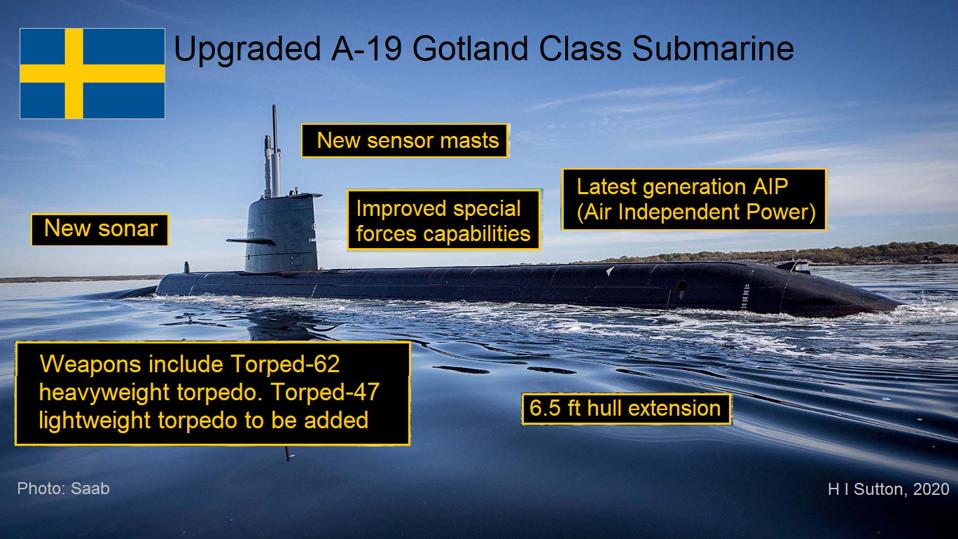
Swedish A-19 Gotland Class AIP submarineWhen Sweden loaned one of its AIP (Air Independent Power) submarines to the U.S. Navy, it made waves. HMS Gotland operated out of San Diego for over 2 years in the late 2000s, reputably ‘sinking’ the carrier USS Ronald Reagan (CVN-76) in an exercise. It wasn’t fast, but it was quiet, which is a valuable quality in underwater warfare. Now that submarine has been upgraded with an even stealthier propulsion system.
A cornerstone of Gotland's effectiveness in exercises with the U.S. Navy was its AIP propulsion. Indeed it was a major factor in why the Navy wanted to exercise against this specific boat. AIP meant that it could stay submerged for much longer than other non-nuclear boats.
Today the AIP is a generation newer than when the U.S. Navy faced her. Gotland was upgraded by Saab in 2018 and a second of the class, HMS Uppland, is nearly ready for delivery.

Saturday, May 16, 2020

Innovations & technologies

Super Steel Defies Everything We Know About the Alloy


two scientists stand side by side, each holding up a sample of a silvery metal
Researchers say they’ve made a new “super steel” that challenges conventional wisdom about new steel alloys. Instead of the usual fine-tuned balance of tradeoffs, scientists at the University of Hong Kong and Lawrence Berkeley National Labs say their super steel mitigates the catch-22s in many previous alloys. The secret is in how the molecular structure of the steel works to absorb and nullify stress damage.

These researchers have introduced delamination toughening into their steel. Let’s break down a complex idea piece by piece—or layer by layer, more appropriately.

Many kinds of steel (and materials in general!) are laminated, in the sense of the word invoked by layered flaky pastries like croissants or baklava. Even the mechanisms are surprisingly similar: Steel can be milled by heating and then rolling it to desired thickness, and those layers accumulate by rolling or folding.
Weapons

The Army's Next-Generation Squad Weapon is a big hit with special operators


Army Next Generation Squad Weapon
The 75th Ranger Regiment, Green Berets and other US special operations ground forces will be equipped with the conventional Army's Next Generation Squad Weapons.
"We are an enthusiastic supporter of the Army's 6.8 mm Next Generation Squad Weapons," Col. Joel Babbitt, of Program Executive Officer Special Operations Forces Warrior, told Military.com recently. "We expect there will be Next Generation Squad Weapons in our formations as soon as we can receive them via fielding."
The Army is in the final phase of evaluating NGSW prototypes from General Dynamics Ordnance and Tactical Systems Inc., Textron Systems and Sig Sauer Inc. to replace the 5.56 mm M4A1 carbine and the M249 squad automatic weapon in infantry and other close-combat units.
If all goes as planned, Army modernization officials will select the final design for the rifle and automatic rifle variants from a single firm in the first quarter of 2022 and begin fielding them a year later.