Страницы

Monday, April 2, 2018

In spy nets

Poisoned daughter of former Russian spy, Yulia Skripal, had ‘secret bank account’, revealed relative

Yulia Skripal with her father Sergei, before the pair were poisoned in a nerve agent attack. Picture: SuppliedYULIA Skripal was targeted in the Salisbury nerve agent attack just days after she gained access to a $200,000 “secret bank account”, her family claim.
According to The Sun , the money belonged to the 33-year-old’s brother Alexander, who died in mysterious circumstances in St Petersburg last year.
Alexander died aged 43, reported Huffpost, while on holiday with his girlfriend in St Petersburg. He was said to have been admitted to hospital for liver failure. Relatives deemed the death as “suspicious”.
BBC Russia suggests that Alexander’s death may have been used to determine where his father lived in the UK.
“We can assume that if the Russian secret services were trying to find out exactly where Sergei Skripal lived, the story of the repatriation of his son’s body could help them very much in obtaining this information.”
Yulia was made power of attorney at the end of February — just days before she was poisoned alongside her Russian ex-spy dad Sergei.
The cash came from the sale of the house Alexander owned in the UK with ex-wife Natalia, who is the daughter of a GRU (the Russian foreign military intelligence agency) military intelligence colonel.
Electronic surveillance

Police forces across UK are using spy technology to download contents of mobile phones belonging to suspects, witnesses and victims without permission

Police forces in the UK are using spy technology to download the contents of mobile phones belonging to suspects, witnesses and victimsPolice forces in the UK are using spy technology to download the contents of mobile phones belonging to suspects, witnesses and victims.
At least 26 forces in the country are using an extractive device to store data from an individual's phone without using a password or thumbprint. 
According to privacy rights charity, Privacy International, forces do not obtain warrants or ask for permission from the people whose phones they examine.
The charity said this 'highly intrusive technology' was rolled out nationally after being used by Scotland Yard during the London Olympics in 2012.
Privacy International said police often break into phones owned by people who have not been convicted of any crime, including witnesses and victims.
They can then gain access to their emails, photos, passwords and conversations on encrypted messaging apps. 


Modern warfare

Military documents reveal how the US Army plans to deploy AI in future wars


Military documents reveal how the US Army plans to deploy AI in future wars
Tomorrow’s wars will be fought with a lethal combination of soldiers, drones, and AI-powered systems. The Internet of Battle Things, as it’s being called, is a vast battlefield network of machines and humans — and the US Army is working to make it a reality.
In what reads like a list of kill-streak perks in a Call of Duty game, the Army described what the “things” in its “Internet of Battle Things” would be in a just-released white paper:
Most of such intelligent things will not be too dissimilar from the systems we see on today’s battlefield, such as unattended ground sensors, guided missiles (especially the fire-and-forget variety) and of course the unmanned aerial systems (UAVs). They will likely include physical robots ranging from very small size (such as an insect-scale mobile sensors) to large vehicle that can carry troops and supplies. Some will fly, others will crawl or walk or ride.
Nuclear security

India and Pakistan are quietly making nuclear war more likely

The Karachi Naval Dockyard, home port and strategic nerve center for Pakistan’s fleet, sits on a sliver of land bracketed between Port Grand, a “family fun” pier that features kiddie rides and a panoramic view of warships at anchor, and Machar Colony, a sprawling slum where cattle graze on garbage and a million human inhabitants live in nearly unimaginable squalor.
It was here, during the quiet predawn of May 6, 2014, that four rogue naval officers walked up the gangway of the PNS Zulfiqar, a 4,000-ton frigate that was preparing to put to sea. A guard inspected their ID badges and saluted. Once on board, their plan was to join up with another group of six militants disguised in marine uniforms who were approaching the Zulfiqar in an inflatable dinghy. Together they hoped to hijack the ship and use it to attack a US Navy patrol in the Indian Ocean.
Tortures

Alarm as government rewrites UK 'torture guidance' in secret

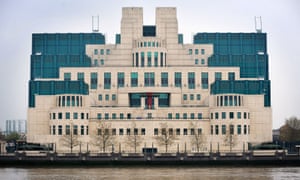
MI6 building in Vauxhall, London
A British government guidance paper that is intended to prevent the country’s intelligence officers from becoming involved in human rights abuses is being rewritten in secret, much to the alarm of civil liberties groups.
Rights activists are deeply worried that the UK government may be tempted to water down the guidance at a time when the US president, Donald Trump, has said he hopes to restore waterboarding – “and a hell of a lot worse” – and has nominated Gina Haspel as the next head of the CIA. Haspel reportedly oversaw a secret CIA prison in Thailand, where a terrorism suspect was tortured.
The UK paper, known in Whitehall as the ”consolidated guidance”, was rewritten and made public by the coalition government following a series of scandals in the years following the 9/11 attack on the twin towers in New York.
Under the terms of the previous version, drawn up early in 2002, MI6 officers had helped to plan a number of so-called rendition operations. Officers from MI5 and MI6 had also become embroiled in the torture of detainees held overseas, usually by handing questions to overseas intelligence agencies with poor human rights records.
Statecraft

On National Security | Space Force fans, be careful what you wish for


Trump Cabinet
A branch of the service dedicated to space warfare is a titillating prospect. And ever since the topic of a “Space Force” was brought up by President Trump, congressional hawks can’t stop talking about it.
Trump and other proponents of a stronger military posture in space argue that this is necessary to counter and deter what other countries are doing to “deny” the United States unfettered access to space and freedom to operate there.
The Pentagon has started a congressionally mandated review of how to organize the military space apparatus for an era of “great power competition.” Despite political pressure from the House Armed Services Committee, the review is supposed to be impartial on whether the solution is a space force, aka space corps.
Everyone loves a shiny object. But it’s hard to imagine the Pentagon will want to yank space authorities and functions from the Air Force and create a completely new organization.
Some experts worry that this has become too much of a distraction. In fact, the Trump administration has yet to put out a National Space Policy. That would be a necessary first step for the military to figure out its future responsibilities with regard to space.
Information security

Alleged NSA leaker files to subpoena cybersecurity firms, national security agencies

Reality Winner, the former National Security Agency contractor alleged of leaking classified information to online publication the Intercept, recently submitted a request to subpoena several U.S. government intelligence agencies, private-sector organizations and state governments.
Winner is standing trial for allegedly retaining and transmitting top-secret documents related to state election systems penetrated by Russian-affiliated cyber actors during the 2016 presidential election.
The March 29 court filing, first reported by Politico, subpoenas the CIA, Department of Defense, National Security Council, Office of the Director of National Intelligence, the White House, the Department of Homeland Security, CrowdStrike, FireEye, ThreatConnect, Fidelis Cybersecurity and representatives from 21 state governments, among others.
Winner’s legal team appears to be bringing the states into the trial based on those government offices being formally notified by DHS in September 2016 that they were targeted by the Russian hackers, according to Politico.
Economic security

Dow drops 459 points as Amazon tumbles, trade war fears rise

Amazon stock sinks following Trump's attacks
The Dow closed down 459 points on Monday. The Nasdaq plunged almost 3% and dropped into the red for the year. Heavy selling in tech stocks left the Nasdaq just shy of correction territory, 10% below its all-time closing high.
At one point, the Dow was down as much as 758 points, a brutal first day of trading for the second quarter of 2018. Market analysts blamed the sell-off on concerns about trade tensions and President Trump's attacks on Amazon.
Amazon (AMZN), one of the biggest drivers of the 2017 market rally, tumbled 5%, wiping out more than $36 billion of its market value.
Trump once again accused Amazon of taking advantage of the US Postal Service, and he suggested that Amazon does not pay its fair share of tax.
In fact, Amazon pays the same lower rate that the post office charges other bulk shippers, and it collects sales tax in every state that charges it. Amazon does not collect sales tax on purchases made from third-party vendors.
Cybersecurity

More than money: How to woo cybersecurity professionals

Today's cybersecurity professionals are in high demand. Millions of jobs need to be filled, yet most companies can't keep the talent that they have. Why? Because employees want to know that they are valued and that the organizations they work for take security seriously.
Current cybersecurity professionals are spoiled for choice, which means that the organizations looking to fill these critical positions need to offer more than a competitive salary both to keep the professionals they have and woo new candidates.
Yes, it's two-fold. Even if current employees aren't looking to switch jobs, one call from a recruiter could lure them into giving a new position some serious thought. And recruiters are reaching out, multiple times a day, every day.
In addition, the 2018 (ISC)2 Hiring and Retaining Top Cybersecurity Talent report found that most currently employed cybersecurity professionals (70%) are open to a change despite having no plans to begin a job search in 2018.
Innovations & technologies

Office of Naval Research launches program to speed up innovation

The Office of Naval Research is launching a new program to spur innovation in the Navy and Marine Corps, in what the service says is a direct response to the National Defense Strategy’s call to accelerate the delivery of technology to warfighters.
The Naval Innovation Process Adoption (NIPA) program, launched March 29, seeks to inject new processes into the service that would allow “light bulb” ideas to go from concept to reality at a faster rate.
“The National Defense Strategy states it clearly,” Richard Carlin, the head of ONR’s Sea Warfare and Weapons Department, said in an ONR press release. “As technology advances faster than ever before, and both state and non-state actors having access to it, the naval research community needs to accelerate accordingly.”
Few examples were included in the release, though it did note a focus on creating a “common language and approach” for both the Navy and Marine Corps. Broadly, NIPA is based on the H4X problem-solving method used by various organizations across the Department of Defense.
Drug smuggling

DEA busts multi-million dollar Afghanistan heroin smuggling ring; defendant said to have Taliban ties

Картинки по запросу DEA
Two men have been convicted of charges related to what authorities call a large-scale conspiracy to smuggle heroin from Afghanistan into the United States.
One of the defendants, Shamsuddin Dost, reportedly bragged to an undercover federal agent during a meeting in San Jose that he had friends in the Taliban and Afghanistan’s government, and said he was willing to kill people who interfered with his business.
“National security people had detained their guys as part of the Taliban…. I secured their release,” Dost said, according to a DEA transcript. He later told the agent, “Don’t worry, those are people that are tied to me….They are Taliban and I know their relatives, uncles and I know their business. If they deviate, I know how to deal with them.”
On March 28, Dost’s co-defendant, Jawed Ahmadi, was sentenced to 70 months in federal prison after peading guilty to conspiracy to distribute heroin. He was arrested in 2016 — on the same day he flew from Kabul to San Francisco — and is facing deportation after completing his sentence.
Economic security

China can succeed with petro-yuan where Gaddafi failed – killing the US dollar in oil trade


China can succeed with petro-yuan where Gaddafi failed – killing the US dollar in oil trade
Muammar Gaddafi wanted to shatter the dominance of the greenback in the Middle East by introducing gold-backed dinar, but failed. China has a chance to finish what he started, one industry expert has told RT.
“Ideas related to oil trade in currencies other than the dollar arose more than once. Some of them were severely suppressed by the United States, one example is Muammar Gaddafi, who proposed the introduction of a regional currency gold dinar and trading oil in the Middle East in this currency,” Aleksandr Egorov, foreign exchange strategist at TeleTrade, told RT.
However, this time, an attempt to oust the dollar could be successful. China has launched oil futures backed by yuan, and Beijing has what Gaddafi didn’t, according to the expert.
“Along with the Chinese role in the global economy and the growing interest in the renminbi, China is also protected by a nuclear shield. It can afford to try to shatter the monopoly in oil trade. This will give even more weight to the Chinese yuan. In addition, China's economy is the world's largest consumer of oil, and consequently, all world producers of raw materials will have to reckon with the strategy of the Chinese authorities,” Egorov said.
According to the analyst, the timing for the launch of the petro-yuan is perfect. Key oil producers Russia, Iran and Venezuela are under pressure from US sanctions, and it is a good moment for them to ditch the dollar in oil trade and substitute it with the yuan.
Statecraft

Why the U.S. Government Is No Longer Capable of Ensuring National Security


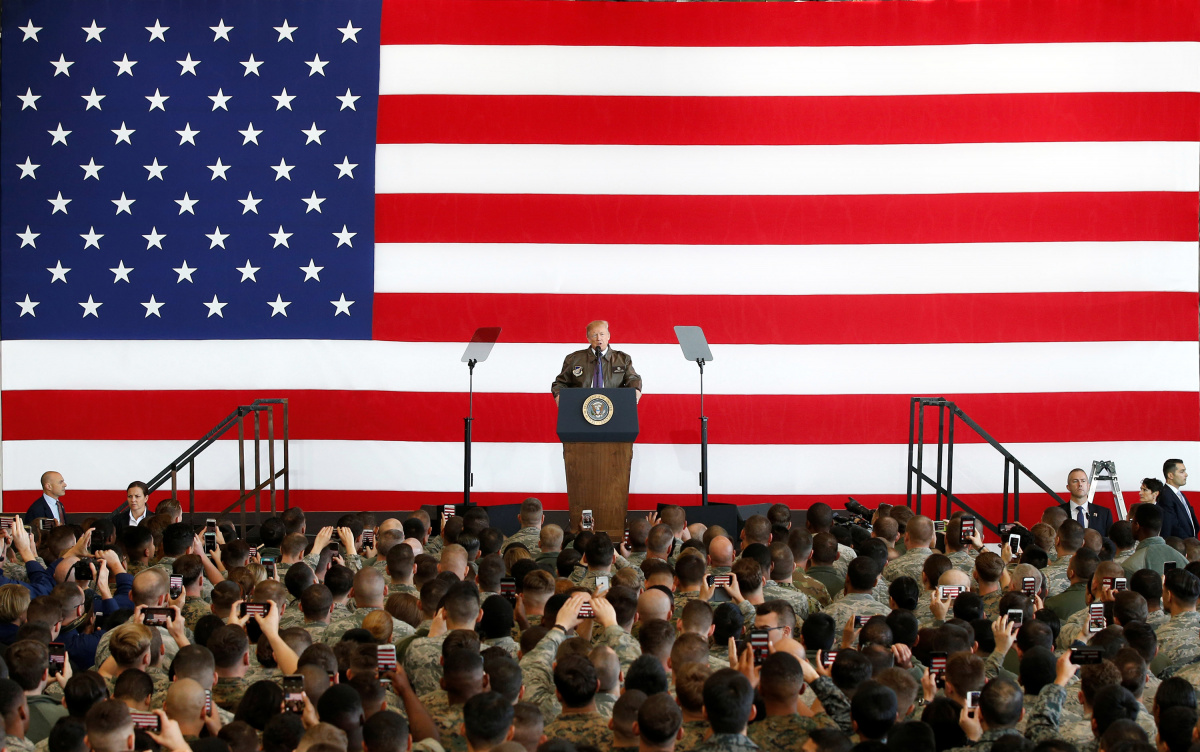
U.S. President Donald Trump addresses members of U.S. military services and Japan Self-Defense Force (JSDF) at U.S. Air Force Yokota Air Base in Fussa, on the outskirts of Tokyo, JapanSuccessful national defense against the sophisticated, complex and highly-capable threats the United States will face through 2050 requires bringing to bear a comprehensive, or inter-organizational, approach to vital challenges. Many key adversaries are already redefining conflict to include hybrid strategies consisting of actions short of war but certainly within the realm of national competition and conflict. A new approach is required to counter these threats, protect U.S. and partner nation homelands, and defend common interests around the globe. This new approach should include not only U.S. military services but also interagency and whole-of-government capabilities, multinational partners, and additional objective-relevant parties likely to include nongovernmental and intergovernmental organizations (NGOs and IGOs) and select commercial enterprises.
Unfortunately, this approach is virtually impossible to achieve with today’s federal government structure. Recent contingencies have reinforced the reality that the military alone cannot win wars or execute those activities necessary to ensuring battlefield victories become strategic successes during subsequent occupations. There exists no overarching U.S. government entity with sufficient authority or control over funding to allow orchestration all functions such a coalition could bring to bear. That the United States is a democracy is undoubtedly a hindrance in this regard. Effective dictatorships are better configured to compel the coordination such orchestration requires.
Health security

How Big Wireless Made Us Think That Cell Phones Are Safe: A Special Investigation

The disinformation campaign—and massive radiation increase—behind the 5G rollout.


Carroll-Hertsgaard-cellphone_imgRemarkably, cell phones had been allowed onto the US consumer market a decade earlier without any government safety testing. Now, some customers and industry workers were being diagnosed with cancer. In January 1993, David Reynard sued the NEC America Company, claiming that his wife’s NEC phone caused her lethal brain tumor. After Reynard appeared on national TV, the story went viral. A congressional subcommittee announced an investigation; investors began dumping their cell-phone stocks; and Wheeler and the CTIA swung into action.
A week later, Wheeler announced that his industry would pay for a comprehensive research program. Cell phones were already safe, Wheeler told reporters; the new research would simply “re-validate the findings of the existing studies.”

Trade war

China retaliates against Trump tariffs with levy on US food imports


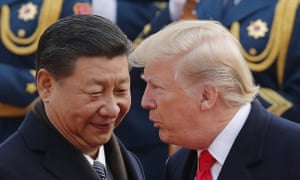
Xi Jinping and Donald Trump.
China has implemented retaliatory tariffs of up to 25% on $3bn in food imports from the US, raising uncertainty over the possibility of a trade war between the two countries.
China’s ministry of commerce said it would be “suspending tariff concessions” on 120 US food products. Fresh and dried fruits, almonds, pistachios and wine would be subject to an additional 15% tariff. Eight other items, including frozen pork, would be subject to a 25% tariff. The tariffs would begin on Monday, the ministry said.
The tariffs were in line with a list of potential duties on $3bn worth of US products released two weeks ago in response to Donald Trump’s tariffs on steel and aluminium. The US president has also promised to levy 25% on $60bn in annual imports from China.
Middle East

The country where the British are blamed for everything


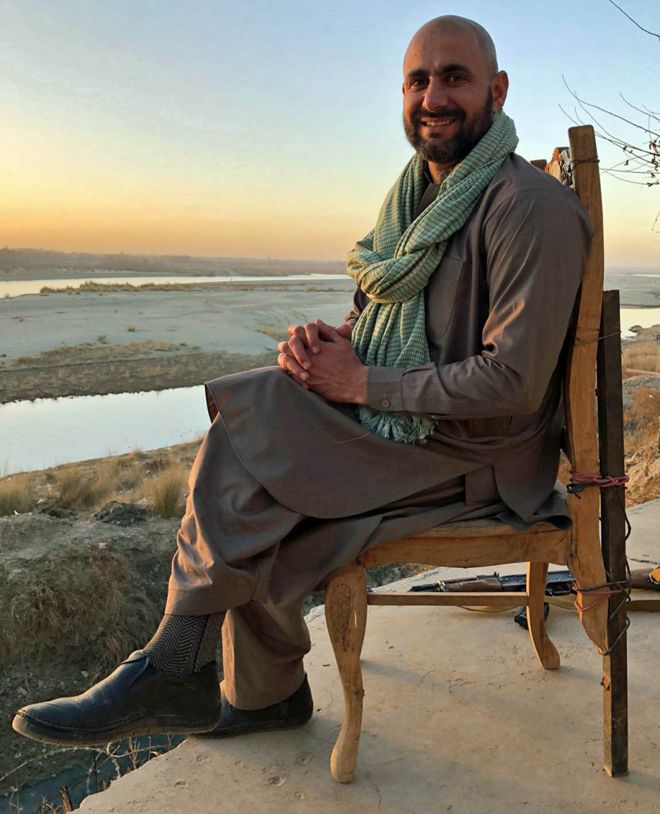
Auliya Atrafi
Conspiracy theories flourish all over the world but in some countries they appear to be more popular than in others. And in Afghanistan, says the BBC's Auliya Atrafi, they often feature sinister foreign powers - first and foremost, the British...
I grew up with conspiracy theories. Some of them very bizarre.
Bruce Lee was poisoned by his wife, I was told, and when he sensed what she'd done, he tore her apart with his bare hands.
I was also told that he could fly.
And that Hitler was still alive - having escaped the Allies in a Jeep that transformed into a plane then a boat then a submarine, from which he was still sending the occasional message, declaring: "I will be back!"
One theory, however, was particularly persistent - that the hand of the British was behind every evil in Afghanistan.
As a child I wondered why this was, but after I moved to the UK in my 20s, I learned there were some good reasons for the suspicion.

Spy story

The CIA's Bold Kidnapping of a Soviet Spacecraft


Soviet Luna 1One day in late 1959 or 1960 -- dates aren't totally clear in declassified documents -- a crack team of four CIA agents worked through the night in stocking feet taking apart a kidnapped Soviet Lunik spacecraft without removing it from its crate. They photographed every part and documented every construction element, then perfectly reassembled the whole thing without leaving a trace. It was a daring bit of espionage at the early years of the space race. Intended to level the playing field between two international superpowers, it was a heist that risked turning the cold war hot.
On January 2, 1959, the Soviet Union kicked off its Luna program, sometimes called Lunik by the Western media, with the launch of Luna 1. This first spacecraft missed the Moon, but the next hit the target and became the first spacecraft to impact the lunar surface in September of that year. A month later on October 7, Luna 3 returned history's first ever pictures of the Moon’s farside. It was a stunning year for the Soviets on the Moon, one in which the United States only racked up a handful of failed lunar missions. The effect, aside from a blow to national morale, was a devastating effect on the American psyche.
Innovations & technologies

China’s AI ambitions are driving US innovation. So what’s America’s hold up?


China’s drive to lead the world in artificial intelligence is spurring American efforts keep its technological edge, especially when it comes to national security.

A technology wave equivalent to the Industrial Revolution, electrification and mechanization, “intelligentization” has the potential to change the way wars are fought, as well as finance, medicine and transportation, said former Deputy Defense Secretary Bob Work, now part of the Center for a New American Security’s Artificial Intelligence and Global Security Initiative.

“I think AI is as ... important as the space race was in the Cold War. And as a nation, we responded to the challenge of competing in space.” Work said at a recent forum on the topic, drawing a comparison to America’s all-in effort to launch the Apollo 11 lunar mission.

The national security nexus is more about economic competitiveness than weaponry, Work said. “We’re not going to approach this as though we’re in an AI arms race with China. But without question China is the pacing competitor in AI right now,” Work said.
International security

Trump proposed Putin visit White House in March 20 phone call, Kremlin says

President Trump proposed meeting Vladimir Putin at the White House in a March phone call, the Kremlin said Monday, a fresh revelation about a conversation that stirred controversy for its friendly tone toward the Russian leader amid mounting tensions with the West. 
After the March 20 phone call — in which Trump congratulated Putin for a reelection victory in a vote widely criticized as not free and fair — Trump said that the two leaders had discussed plans for a possible meeting.
White House press secretary Sarah Huckabee Sanders said Monday that “a number of potential venues, including the White House,” were discussed for the summit. 
A Kremlin aide, Yury Ushakov, disclosed the White House invitation in comments to Russian journalists on Monday. But he added that no preparations for such a meeting have taken place since the March 20 phone call, according to Russian news agencies.
Relations between Moscow and the West have been in a free fall since the nerve agent poisoning of a former Russian double agent and his daughter in Britain March 4. British authorities have linked the attack to Russia, setting in motion tit-for-tat actions that have included expulsions of Russian diplomats from United States, the Europe Union and elsewhere.
Electronic warfare

Breaking down China’s electronic warfare tactics


In the wake of Russia's demonstrations of advanced electromagnetic spectrum and communications jamming capabilities, most recently displayed in their incursion into Ukraine, China also is upping its game in this space, demonstrating similar capabilities in the Pacific.

The U.S. Department of Defense, in an annual report to Congress on China’s military and security developments, assessed that the country is placing greater importance upon EW, on par with traditional domains of warfare such as air, ground and maritime.

"The [People’s Liberation Army] sees EW as an important force multiplier, and would likely employ it in support of all combat arms and services during a conflict," the 2016 report asserts. "The PLA’s EW units have conducted jamming and anti-jamming operations, testing the military’s understanding of EW weapons, equipment, and performance. This helped improve the military’s confidence in conducting force-on-force, real-equipment confrontation operations in simulated EW environments."


According to the report, China’s EW weapons include "jamming equipment against multiple communication and radar systems and GPS satellite systems. EW systems are also being deployed with other sea- and air-based platforms intended for both offensive and defensive operations."
Climate security

Climate change could raise food insecurity risk


climateThe study, led by the University of Exeter, examined how  could affect the vulnerability of different countries to  - when people lack access to a sufficient quantity of affordable, nutritious food.
Scientists looked at the difference between  of 1.5°C and 2°C (compared to pre-industrial levels) and found that - despite increased vulnerability to food insecurity in both scenarios - the effects would be worse for most countries at 2°C.
The study looked at 122 developing and least-developed countries, mostly in Asia, Africa and South America.
"Climate change is expected to lead to more extremes of both heavy rainfall and drought, with different effects in different parts of the world," said Professor Richard Betts, Chair in Climate Impacts at the University of Exeter.
"Such  can increase vulnerability to food insecurity.
"Some change is already unavoidable, but if global warming is limited to 1.5°C, this vulnerability is projected to remain smaller than at 2°C in approximately 76% of developing countries."
Warming is expected to lead to  on average - with floods putting food production at risk - but agriculture could also be harmed by more frequent and prolonged droughts in some areas.
Wetter conditions are expected to have the biggest impact in South and East Asia, with the most extreme projections suggesting the flow of the River Ganges could more than double at 2°C global warming.


Corruption

'Fat Leonard' and his prostitutes affected Pentagon's pick to lead Joint Chiefs

When the Pentagon last chose a new chairman of the Joint Chiefs of Staff, it was rattled by a last-minute surprise: A corrupt defense contractor known as "Fat Leonard" confided to federal agents that he had an unsavory past with one of the finalists to become the nation's top military officer.

Leonard Glenn Francis, a maritime tycoon who had recently pleaded guilty to bribing Navy officers, told authorities in early 2015 that he had paid for opulent dinners and other favors for Adm. Samuel Locklear, then-commander of U.S. military forces in the Pacific, according to previously undisclosed documents and six people familiar with the case.

Francis also shared with investigators several photographs of him drinking and socializing with Locklear, who was one of four contenders to head the Joint Chiefs. Some photos were from a banquet in Singapore that Francis had hosted for the admiral and other Navy officers that featured prostitutes as entertainment, according to the documents and people familiar with the case.

Locklear told The Washington Post that he was at the party but was unaware of any prostitutes, and he said he had limited contact with Francis over the years. After separate investigations, the Justice Department declined to press charges, and the Navy cleared the four-star admiral of wrongdoing. But his association with the 350-pound contractor helped sink his chances to lead the Joint Chiefs, other documents show.

Sunday, April 1, 2018

Directed energy

Tucson Tech: Pentagon, Raytheon re-energize directed-energy weapons push

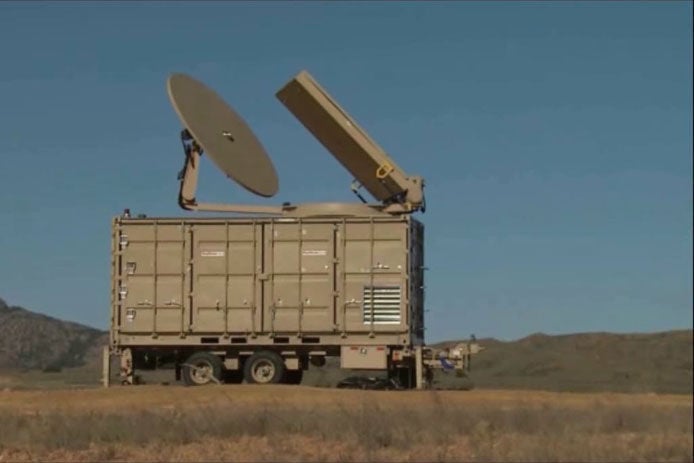
High-powered microwave
Raytheon is amping up development of its directed-energy weapon systems as the Pentagon looks to electromagnetic pulse devices and weaponized lasers to defeat drones and other airborne threats.
The defense contractor recently announced it scored 45 drone kills in an Army demonstration, using an advanced high-power microwave and a laser weapon mounted on an all-terrain vehicle.
The microwave system, made by a division of Tucson-based Raytheon Missile Systems based in Albuquerque, knocked down 33 small drones — two and three at a time — in a December test at the U.S. Army Fires Center of Excellence at Fort Sill, Oklahoma.
In the same test, a high-powered laser mounted on a Polaris MRZR ATV shot down 12 airborne, maneuvering small and medium-sized unmanned aircraft, and destroyed six stationary mortar projectiles. The laser system was developed by Texas-based Raytheon Space and Airborne Systems.


Cybersecurity

New App to Replace Telegram in Iran to 'Ensure National Security'

Telegram
Following anti-establishment protests in December, Iranian authorities have decided to restrict some social networks that had been used to organize the riots and replace them with local ones.
An Iranian app that is set to replace Telegram will start work within the next few weeks, the head of Iran's Parliament National Security and Foreign Policy Commission, Alaeddin Boroujerdi, said on Saturday.
He noted that the Iranian government had decided to replace the app with an Iranian alternative amid the "destructive role" that it played in protests that took place across Iran last year.
This way, local authorities hope to ensure national security, Boroujerdi argued.
Arms trade

Giant Defense Industry to Sell Missiles to Saudi Arabia

saudi
A new missile sale manufactured by the defense industry company Raytheon is expected to advance the Kingdom of Saudi Arabia’s efforts to develop an integrated ground defense capability. Saudi Arabia is in the midst of a war with rebel forces in Yemen and the purchase is seen as a re-armament program.
The US State Department has approved the possible Foreign Military Sale to Saudi Arabia of TOW 2B (BGM-71F-Series) missiles for an estimated cost of $670 million.
The Saudi government has requested to buy up to 6,600 TOW 2B missiles and 96 TOW 2B fly-to-buy lot validation missiles.
The tube-launched, optically-tracked, wireless-guided (TOW) weapon system, with the multi-mission TOW 2A, TOW 2B Aero and TOW Bunker Buster missiles, is the premier long-range, heavy assault-precision anti-armor, anti-fortification and anti-amphibious landing weapon system used throughout the world today.
The TOW missile enables ground forces to achieve overmatch against adversary armored and wheeled systems, regardless of the environment or conditions.
According to defenseworld.net, the US Defense Security Cooperation Agency delivered the required certification notifying Congress of this possible sale.